Remarks by CE at media session before ExCo (with video)
Following are the remarks by the Chief Executive, Mr John Lee, at a media session before the Executive Council meeting today (March 17):
Reporter: Good morning. Your administration has placed significant focus on exploring business opportunities in the Middle East amid geopolitical tensions. But is it still the right course of action when the recent conflict in the region reflects the risks there? How has the conflict affected the Government's plan, and does the Government have any response for measures for the global surge in fuel prices? What is the latest progress for engagement work on Wang Fuk Court’s resettlement plan? What's the proportion of residents who have made their decision? Which option are they inclined to choose, and how many of Wang Chi House owners are inclined to sell their ownership? Thank you.
Chief Executive: The conflict in the Middle East has posed both risks and opportunities to Hong Kong. It is a region which is developing fast economically. That is why I have been working hard to open the market in the Middle East, and I have visited four countries during my term of office so far, and the visits have been successful, resulting in a lot of contracts being signed, a lot of co-operation work has already started, and also a lot of investment capital to and fro both places. The conflicts now in the Middle East actually highlight the strengths of Hong Kong, and also, I think, will create new opportunities for us, because while development is an important consideration when investment is considered, what is even more important is stability, security, and also what in the long term a market will create for the investors. For stability, security, I think Hong Kong is a showcase to the world, that under "one country, two systems", Hong Kong will be very safe, which will be a big contrast to the situation of the Middle East. So investors and businesses looking for diversification at the same time looking for security of the investment will definitely look to Hong Kong. Hong Kong has an added strength because we are connected to both the Mainland market and the international market. So when investors think of where to invest, other than ensuring that their money will be safe, Hong Kong will also ensure that they have vast opportunities. And in my description about the 15th Five-Year Plan, you can see that China, our country, is a big market with profound opportunities for everybody, and you can see so many countries knocking on the door of China. So we'll continue our relations with the governments in the Middle East, and I think it will only add to the gains and the attractions of Hong Kong. There are, of course, risks, because the conflict is creating disruption to the supply of oil. The Strait of Hormuz is disrupted in regard to ships shipping oil to different parts of the world. And a lot of the supply actually will be received in this region, Asia. So we will be seeing shocks and volatility.
In regard to the supply of oil, because of the disruption of supply, oil prices have gone up. We will, of course, take action to try to mitigate the risks. So what the Government is working on is, first of all, ensuring that there will be a stable energy supply. And we also want to ensure that transparency of information relating to supply and energy prices will be enhanced, and the Government will continue to monitor price fluctuations as well as the reasonableness and need of price adjustments. And we will also remind service providers of their social responsibility. Obviously, disruption in oil supply affects different parts of the world, Hong Kong included. So all cities and all governments are working to mitigate the risk. It is something we will have to let people know that we should be paying attention together to be alert, so that we can all work to overcome the challenges. One thing we do to ensure safer supply is making suppliers aware of the risk to ensure that they will have contingency plans. First of all, they should work on ensuring alternative supplies, if it is possible. The second thing is ensuring that they have enough stockpiles. And for electricity production, it is also very important to prepare to adjust the fuel mix so that the proportion of natural gas, coal and nuclear power can be adjusted readily in view of the changing situation. The government departments and authorities under the Government are already in position. For example, under the Commerce and Economic Development Bureau, we have the Competition Commission and the Consumer Council in position, ready to deal with the changing situation. The Competition Commission will monitor the market situation where there is any possible indication of malpractice, such as unfair competition or manipulation of prices, then they will exercise their power to demand information or even ask responsible people to come to the inquiry. The Consumer Council has also made appeals to suppliers so that they will bear in mind people's affordability and also social responsibility. The Government has also been in touch with local airlines, and also will be meeting petrol fuel suppliers so as to ensure that they will know their social responsibility and also provide more updated and early information about supply, about prices, and that is important so as to let people know more about potential changes. So transparency is important.
Regarding Wang Fuk Court, we have done quite a number of things. First of all, we have already rolled out a plan about long-term accommodation, and we have a team of over 100 people to talk to the different families so as to explain and let them choose their option. We will give them sufficient time. And so far, they have been working for over two weeks, and the feedback in some way aligned with our expectations. And I also know that there will be strong demand for the residents to go back to look at their houses. We are working on this. We want to ensure that this can be done early. The Deputy Chief Secretary for Administration, Warner (Mr Cheuk Wing-hing), is working hard on the plan so to ensure it will be done safely and orderly, because a lot of units have been burned very seriously, have structural problems, including ceiling, walls, beams, some have no windows or doors, and the floor is full of debris. So we have to ensure that the number of people that will be allowed to go up and down the staircase, it will be done safely and orderly. And also any support that we need to render to the families when they return to their flats, including help to maybe, people who are of old age, when they have to walk up and down the staircases, then assistance will be required, support for taking care of their personal belongings in big quantity. We need to make arrangements, and there is no lift, no electricity and no water supply. So it is a very difficult scene, and we have to ensure that it will be done properly. We hope to be able to announce our plan this month so that in April, the residents of Wang Fuk Court can go back to their houses to take back their belongings.
And as regards to Wang Chi House, there have been indications that a lot of the families want the Government to also allow them to consider taking up the plan in the same way as the other seven buildings, but there are also residents of Wang Chi House who want to go back. After all, Wang Chi House hasn't been burned, so in that way, we have to respect the decisions of the families. While we will not proactively include them into our plan, which have been rolled out for the seven buildings, we have also indicated, if there is a great consensus that the residents of Wang Chi House be included in the government plan, we may consider it and we can then talk to the residents. The "engagement team" will be working on all these things so as to find out the position.
(Please also refer to the Chinese portion of the remarks.)

Source: AI-found images
DH releases "Student Health Service Annual Health Report for 2024/25 School Year"
The Department of Health (DH) today (March 17) released the "Student Health Service (SHS) Annual Health Report for 2024/25 School Year", which summarised the key findings of the annual health assessment service and questionnaires provided to primary and secondary school students in Hong Kong during the school year. Results show that overweight (including obesity) and excessive recreational screen timeremain prevalent among students in Hong Kong, and vision health remains unsatisfactory. The DH urges students to maintain a balanced diet, engage in more physical activity, reduce screen time, protect their eyesight and pay attention to their psychosocial well-being.
Annual health assessment service is comprehensive
---------------------------------------------------------------------
The annual health assessment service includes growth monitoring; screenings for vision, hearing and scoliosis; physical examinations; health assessment questionnaires on health behaviours and psychosocial well-being; individual health counselling; health education; and mop-up vaccinations. In the 2024/25 school year, approximately 256 000 primary school students and 172 000 secondary school students received free annual health assessment service at the DH's Student Health Service Centres (SHSCs).
Weight management, diet and physical activity
----------------------------------------------------------
Starting from the 2024/25 school year, the DH has adopted the updated growth charts, the Hong Kong 2020 Growth References, to assess and monitor the growth of children and adolescents. The results of the annual health assessment indicate that weight problems among Hong Kong students remain prevalent. In the 2024/25 school year, the prevalence of being overweight (including obesity) among students was 17.5 per cent (17.2 per cent for primary school students and 17.9 per cent for secondary school students). In the 2023/24 school year, the prevalence of being overweight (including obesity) among students was 17.1 per cent (16.9 per cent for primary school students and 17.4 per cent for secondary school students) (see Note).
Regarding fruit and vegetable consumption and physical activity, the data are similar to those of the previous school year. In the 2024/25 school year, 89.4 per cent of students (82.5 per cent of primary school students and 96.8 per cent of secondary school students) reported an inadequate intake of fruits and vegetables per day (i.e. an average of fewer than four servings for primary school students and fewer than five servings for secondary school students). Concerning physical activity, 93.6 per cent of students (91.5 per cent of primary school students and 95.8 per cent of secondary school students) reported insufficient levels of daily physical activity, i.e. not having at least 60 minutes of moderate- to vigorous-intensity physical activity daily.
"Being overweight during childhood and adolescence adversely affects health and is associated with a greater risk and earlier onset of various non-communicable diseases, such as type 2 diabetes, cardiovascular disease and certain cancers. Childhood and adolescent obesity can also have adverse psychosocial consequences, affecting students' school performance and quality of life. The DH will continue to provide weight management and nutrition counselling advice through the SHSCs to students in need and will continue to promote the importance of a balanced diet and regular exercise to students and parents. Furthermore, the Hong Kong Special Administrative Region Government launched the inaugural Action Plan on Weight Management earlier this month, outlining five key directions. The action plan brings together the strengths of various government bureaux and departments to enhance collaboration between Chinese and Western medicine, aiming to comprehensively promote weight management across Hong Kong through various activities and approaches. We urge schools and parents to actively participate and join hands with the Government in nurturing a healthy new generation," the Consultant Community Medicine (Family and Student Health) of the DH, Dr Chuang Shuk-kwan, said.
Vision and use of Internet and electronic screen products
---------------------------------------------------------------------
Compared with the 2023/24 school year, the visual health of students in Hong Kong remains a concern. The proportion of Primary One students wearing glasses was 14.5 per cent, which was comparable to 14.3 per cent in the previous school year, but much higher than the pre-COVID years of approximately 11 per cent. Furthermore, the proportion of students wearing glasses is higher among students in higher grades. The proportion of Primary Six students wearing glasses reached 55.1 per cent. Among primary and secondary school students who had their visual acuity tested in the 2024/25 school year, 17.3 per cent required further assessment by the SHS of the DH or private optometrists due to a failed preliminary visual acuity test, or other eye or visual problems. A higher proportion of students in higher grades need to wear glasses or fail the preliminary visual acuity test, indicating deteriorating vision with age.
Healthy eyes and vision are critical parts of children's development. Visual problems can interfere with children's daily activities and learning. Prolonged screen use increases the risk of myopia. According to the data from the DH's health assessment questionnaires, in the 2024/25 school year, 41.8 per cent of primary school students reported spending two hours or more using the Internet or electronic screen products (including computers, tablets, smartphones, video games and television) for recreational purposes on a typical school day. Although the figure represents a decrease from 43.3 per cent in the 2023/24 school year, it remains higher than the pre-COVID years of around 30 per cent. For secondary school students, the corresponding proportion reaches as high as 81.1 per cent, which is a cause for concern. A number of studies have shown that spending time doing more outdoor activities can both prevent the onset of and delay the progression of myopia in children. With reference to international guidelines, the DH recommends children aged between 6 and 12 years old to limit recreational screen time to less than two hours a day.
Dr Chuang noted that if health or behavioural issues (such as excessive use of electronic screen products) are identified in students, healthcare professionals will provide health counselling and relevant information and refer them to the Special Assessment Service of the SHS of the DH, specialist clinics, or other organisations as appropriate for further assessment and follow-up.
In response to public concerns regarding the health impacts of screen and social media use on children and adolescents, the DH has been following up on the measures outlined in the "The Chief Executive's 2025 Policy Address" and established the Advisory Group on Health Effects of Screen and Social Media Use for Children and Adolescents in October last year. The interdepartmental expert Advisory Group is currently reviewing the latest medical and scientific evidence, as well as the relevant development and experiences in other countries and regions while consolidating expert opinions, with the aim of issuing updated health recommendations on the use of screen and social media by children and adolescents within this year.
Psychosocial well-being
----------------------------
The DH's health assessment questionnaires indicate that the majority of students reported that they enjoyed or very much enjoyed family life (96.0 per cent) and school life (93.8 per cent) in the 2024/25 school year. Both percentages were higher than the previous school year. However, 2.1 per cent of students reported experiencing cyberbullying in the past 12 months, a decrease from the previous school year (3.0 per cent). Meanwhile, 1.6 per cent and 0.7 per cent of students reported having planned or attempted to commit suicide in the past 12 months respectively. Both figures are lower than the previous school year (2.2 per cent and 1.0 per cent respectively). In the 2024/25 school year, among the students receiving annual health assessment services at the SHSCs, 1.0 per cent were referred to the clinical psychologists of the SHS of the DH, specialist clinics or other suitable organisations for further assessment and management of their psychosocial and behavioural problems.
The Government has set up the 18111 - Mental Health Support Hotline to provide one-stop, round-the-clock support for people with mental health needs. The Government has also implemented the regularised Three-Tier School-based Emergency Mechanism through cross-departmental collaboration of the Education Bureau, the Health Bureau and the Social Welfare Department in all secondary schools in Hong Kong in 2025/26 school year. The mechanism has been extended on a trial basis to Primary Four to Six students to ensure early identification and support for students at higher risk of suicide and provide them with timely assistance and professional counselling or treatment services.
Furthermore, "The Chief Executive's 2024 Policy Address" announced the enhancement of the Whole School Health Programme (WSHP). Apart from publishing a territory-wide health report, the DH will prepare individualised health reports for each participating school, recommending targeted school-based health promotion measures for physical activity, diet and other matters to improve students' physical and psychological well-being. As of early March this year, 891 schools in Hong Kong have joined the WSHP, covering more than 75 per cent of primary and secondary schools in Hong Kong, marking an encouraging development. The DH encourages all schools in Hong Kong to actively participate in the WSHP, enabling Hong Kong to ultimately achieve the World Health Organization's vision of "making every school a health-promoting school".
At the same time, the Primary Healthcare Commission is actively promoting the Life Course Preventive Care Plan via the District Health Centres (DHCs), DHC Expresses and family doctors. A personalised preventive care plan will be formulated to address the health needs of citizens, including vaccinations required by children as well as prevention of infectious diseases, cancers and chronic diseases. The DHCs and DHC Expresses also provide children-targeted services, such as emotion management, weight management and healthy diet classes, as well as collaborate with schools to provide outreach health education, health-risk factors assessment, low salt and sugar diet education and promotion activities. In the long run, the Government will, in accordance with the Primary Healthcare Blueprint, integrate some of the DH's primary healthcare services (including maternal and child health service and student health service)into the primary healthcare system, in order to enhance children's primary healthcare services in Hong Kong and create a better environment for children's medical care and healthy development.
Full implementation of E-enrolment to streamline process
----------------------------------------------------------------------
"The free annual health assessment services provided by the SHS of the DH enable early identification of students with health or behavioural problems and provide them with timely advice and intervention services. In addition to letting individual students understand their own health condition, the DH regularly analyses collected data to monitor the overall health condition and relevant trends among local students. The information is disseminated to the public to raise their awareness about student health. In line with the Government's policy to promote e-Government services, the SHS has fully implemented the Online Enrolment Scheme during the 2025/26 school year. By streamlining the enrolment procedures, we aim to further encourage and facilitate participation of students, parents and schools," Dr Chuang said.
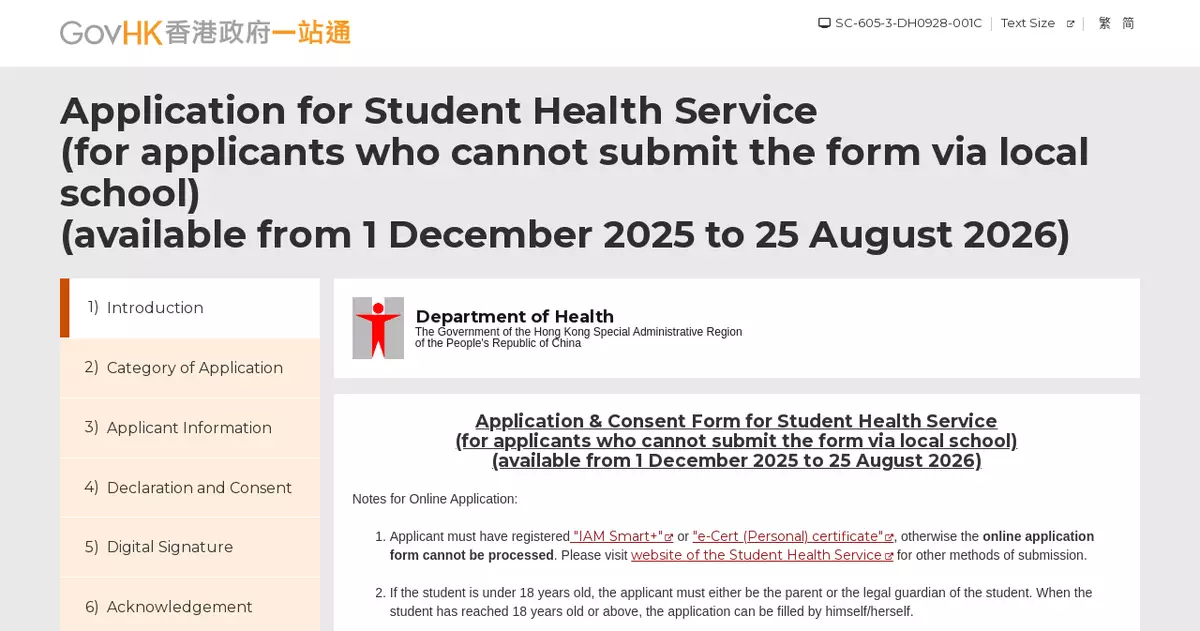
Enrolment for the annual health assessment service of the 2025/26 school year is now open. Students who have not yet enrolled may submit an online application through GovHK, or complete the Application and Consent Form and submit it along with the required documents by email (dh_stdhs_enrolment_exercise@dh.gov.hk), post or fax to the designated SHSC. Please refer to the websiteof the SHS of the DH for application details and forms.
Note: retrospectively calculated using the updated Hong Kong 2020 Growth References.
Source: AI-found images