NEW YORK (AP) — Millions more Americans will likely donate to nonprofits following changes in tax laws passed by Congress last summer, but those changes will also likely reduce the overall amount of money given to charity, according to new research.
The report from the Indiana University Lilly Family School of Philanthropy published Tuesday reflects how “top heavy” charitable giving is, meaning the largest donors and corporations have an outsized impact on overall giving trends, said Jon Bergdoll, interim director of data and research partnerships at the school, who also led the research.
New tax deductions available to most tax filers will encourage between 6 and 8.7 million more Americans to donate to nonprofits over time, the researchers found. However, gifts to nonprofits will likely drop around $5.6 billion annually because of new rules that apply to corporations and to the wealthiest people.
Bergdoll cautioned that these impacts won’t take effect immediately. He said other macroeconomic forces are likely to have a much larger impact on the total amount donated to nonprofits in 2026 than the changes in the new law, called the One Big Beautiful Bill.
“Giving I could imagine going in so many different directions this year,” said Bergdoll. “And so this is not saying, ‘Giving will absolutely go down in 2026.’ It just there’s this little extra weight dragging it down.”
A drop in giving by $5.6 billion would represent less than 1% of the $592.50 billion that was given to nonprofits in 2024, according to Giving USA. The Treasury Department did not return a request for comment on the impact of the new tax law on charitable giving.
The main change that will encourage people to donate is a new charitable deduction of up to $1,000 for individuals and $2,000 for married couples that the vast majority of people can claim. It applies to the 87% of people who take the standard deduction and do not itemize their taxes.
Bergdoll said it may take a while for people to learn about the new deduction.
“That behavior will only change based off of households becoming aware,” he said. “And the stakeholders that have the most to gain by those households becoming aware are nonprofits.”
Advocates for nonprofits credited Republican Oklahoma Sen. James Lankford in particular for championing the new charitable deduction. He had previously introduced a bill along with Democrat Sen. Chris Coons, a Democrat, to expand available charitable deductions after changes passed under President Donald Trump’s first administration reduced the number of Americans who could get a tax benefit from giving to nonprofits.
Speaking at a press conference in 2023, Lankford said of that legislation, the Charitable Act, which did not become law, “Currently, our tax code is written in such a way that only the wealthy get any kind of benefit from giving financial aid to nonprofits. We want to spread that out to everybody.”
For wealthy donors, two changes included in the One Big Beautiful Bill are likely to drive down donations. The first is a new, lower cap on the overall deductions that the wealthiest people can claim. Those who itemize their taxes and fall within the highest tax bracket will now be limited to claiming total deductions of 35% of their income, down from 37% previously.
“Because of the nature of giving, because of how much giving is coming from those top marginal income households, this actually has the largest effect of anything we’ve looked at,” Bergdoll said.
A second change applies to everyone who itemizes their taxes, or around 11% of filers, and implements a new floor. Under the new law, these households must give more than 0.5% of their income to nonprofits to claim a tax benefit. If their gifts fall below this threshold, the donor won't get a tax deduction.
The new law also puts a new floor on corporate charitable donations at 1% of their pretax profits. Companies that give less than that now can't take a charitable deduction for those gifts.
The Lilly School research found this change will likely reduce corporate giving by around $1.5 billion annually, but that is less than what they had expected, Bergdoll said.
There is little comprehensive data about the giving of corporations at the company level, he said. But researchers drew on findings from Chief Executives for Corporate Purpose (CECP), which while not representative, indicated that the lion's share of charitable donations come from companies that are giving over the new threshold.
Sheila Bravo, president and CEO, Delaware Alliance for Nonprofit Advancement, which supports and advocates for nonprofits in the state, said the large businesses, like banks, that she talks with did not anticipate their giving would be impacted by the new floor for deductions.
“Here in Delaware, the shifts that we’re seeing in corporate giving are not specific to that tax law as much as there’s other factors that are influencing corporate giving,” Bravo said. Those could include rising costs and uncertainty about the business environment as well as changes within corporations about who directs decisions about charitable giving.
Bergdoll said these projections reflect what they see as the most likely outcome of the tax law changes on charitable giving, but don't represent a precise forecast. However, in all cases they examined, he said overall giving was likely to decline.
“At the very worst of things, we see giving dropping by almost $12 billion,” he said. “And at the lighter end of things, we see giving dropping by about $2.5 billion.”
Associated Press coverage of philanthropy and nonprofits receives support through the AP’s collaboration with The Conversation US, with funding from Lilly Endowment Inc. The AP is solely responsible for this content. For all of AP’s philanthropy coverage, visit https://apnews.com/hub/philanthropy.

FILE - President Donald Trump holds his signed signature bill of tax breaks and spending cuts at the White House, July 4, 2025, in Washington, surrounded by members of Congress. (AP Photo/Julia Demaree Nikhinson, File)
ROME (AP) — The Vatican appeals tribunal declared a mistrial Tuesday in the Holy See’s big “trial of the century,” a stunning blow to both Pope Francis’ legacy and Vatican prosecutors who had put a cardinal and several other people on trial over alleged financial crimes.
In a 16-page ruling, the appeals court ruled that Francis and Vatican prosecutors both made procedural errors that nullified the original indictment against Cardinal Angelo Becciu and the others and required a new trial. The court set a June 22 as the date for the new trial to begin.
Defense lawyers said such a ruling was enormously significant if not historic, since it amounted to a Vatican court declaring an act of the pope null.
The ruling was a win for the defense and a huge setback to Vatican prosecutors, who have been scrambling to salvage their case. The prosecution and 2023 convictions against Becciu and others had been held up by the Vatican and late pope as evidence of his willingness to crack down on financial misconduct in the Holy See.
Becciu's lawyers said the ruling showed they were right in arguing that the defense was put at an unfair disadvantage from the start.
“It shows that from the first moment, we were right to raise the violation of the right to defense and to request that the law be respected to have a fair trial,” Becciu's lawyers Fabio Viglione and Maria Concetta Marzo said in a statement.
The case had as its main focus the Vatican’s investment of 350 million euros ($413 million) in a London property. Prosecutors alleged brokers and Vatican monsignors fleeced the Holy See of tens of millions of euros in fees and commissions to acquire the property, and then extorted the Holy See for 15 million euros ($16.5 million) to cede control of it.
The original investigation spawned two main tangents involving Becciu, once a leading Vatican cardinal and future papal contender. He was convicted of embezzlement and sentenced to 5½ years in prison. The tribunal convicted eight other defendants of embezzlement, abuse of office, fraud and other charges and imposed tens of millions of euros (dollars) in restitution to the Holy See.
All defendants maintained their innocence and appealed after a two-year trial that opened a pandora's box of unwanted revelations about papal ransom payments to Islamic militants, Vatican vendettas, espionage and other dirty laundry of the Holy See.
During the initial trial, Becciu’s lawyers in particular had complained that prosecutors hadn’t turned over all the evidence to the defense, violating their right to a fair trial. Prosecutors had redacted some documents, withheld the cellphone records of a key prosecution witness and redacted texts among the players, arguing that such omissions were necessary to protect the secrecy of other investigations.
Defense lawyers also alleged that four secret decrees Francis signed giving prosecutors wide-ranging powers to investigate violated the defendants' right to a fair trial. They only learned about the decrees just before the trial began, since the decrees were never published.
The appeals court agreed with both defense arguments.
In the ruling, the appeals court ruled that one of Francis’ decrees amounted to a law, and that Francis’ failure to publish it nullified it. The court also decreed that Vatican prosecutors’ failure to turn over to the defense all their evidence nullified their original indictment.
Defense lawyers were pleased by the ruling.
“The historic decision by the Court of Appeals—which, for the first time in Vatican history, ruled that a papal rescript was invalid and void due to failure to publish it—in our view results in the complete nullity of the entire investigation and trial,” attorneys Massimo Bassi and Cataldo Intrieri, who represent former Vatican official Fabrizio Tirabassi, said in a statement.
“We are confident that we will be able to reach a swift conclusion to the trial with a largely acquittal verdict.”
The tribunal, headed by Archbishop Alejandro Arellano Cedillo, ordered prosecutors to deposit all the documentation, “in their original form,” by April 30. It gave the defense until June 15 to prepare their motions before the June 22 start of the new trial.
It was the second major blow to prosecutors since the appeals phase opened last year.
In January, the Vatican’s highest Court of Cassation upheld the lower court’s decision to throw out the prosecutor’s appeal of the first trial entirely because prosecutor Alessandro Diddi committed an embarrassing rookie procedural error.
On the same day as the Cassation ruling, Diddi also dropped months of objections and abruptly resigned from the case, rather than face the possibility that the Cassation court would order him removed.
At issue was Diddi’s role in a now-infamous set of WhatsApp chats that threw the credibility of the entire trial into question. The chats documented a yearslong, behind-the-scenes effort to target Becciu and suggested questionable conduct by Vatican police, Vatican prosecutors and Francis himself.
Tuesday's decision was issued just days after Pope Leo XIV opened the Vatican’s judicial year. Leo, a canon lawyer, met Saturday with the judges and prosecutors who oversee the judicial apparatus of the Vatican City State, which follows its own peculiar legal code that is inspired by a century-old Italian code and the church’s in-house canon law.
In his remarks, Leo spoke of justice as a means of fostering unity in the church, insisting that it be aimed at searching for truth and paired with charity. He also spoke about justice as a means of fostering credibility within an institution, remarks interpreted by some as a reference to how the Becciu trial had in some ways damaged the Holy See’s reputation because of its many anomalies.
“The observance of procedural safeguards, the impartiality of the judge, the effectiveness of the right of defence and the reasonable duration of proceedings are not merely technical instruments of the judicial process," Leo said. "They constitute the conditions through which the exercise of the judicial function acquires particular authority and contributes to institutional stability.”
Associated Press religion coverage receives support through the AP’s collaboration with The Conversation US, with funding from Lilly Endowment Inc. The AP is solely responsible for this content.
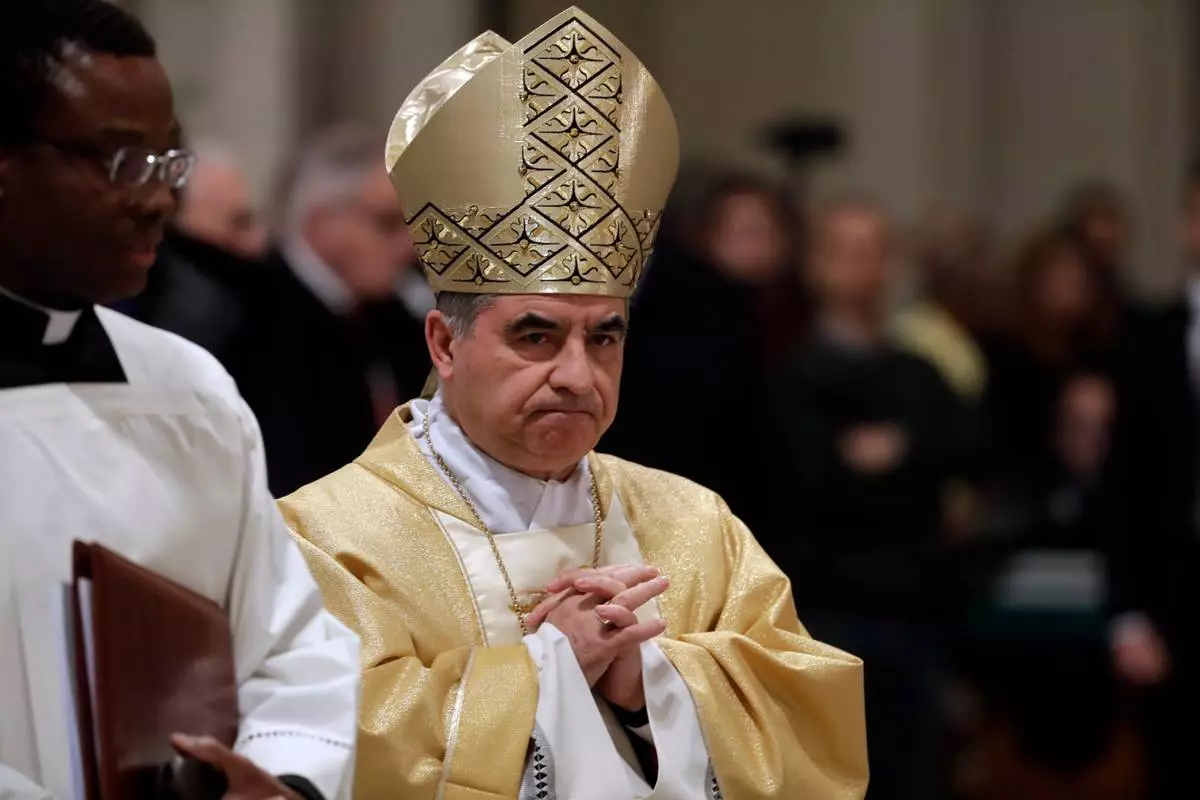
FILE - Mons. Angelo Becciu presides over an eucharistic liturgy at the St. John Lateran Basilica in Rome, Feb. 9, 2017. (AP Photo/Gregorio Borgia, File)