BUENOS AIRES, Argentina (AP) — Three months before its World Cup defense, Argentina lost a great chance to gauge where it's at against European champion Spain when the Finalissima was canceled.
Since winning the 2022 World Cup, Argentina has steamrolled through South American qualifying — four defeats in 18 matches — won the 2024 Copa América and played 11 low-key friendlies and won them all.
Coach Lionel Scaloni was counting on facing Spain this month to clear up the great uncertainty of captain Lionel Messi 's availability for the World Cup, evaluate other starters and assess younger prospects.
But the war in the Middle East made staging the Finalissima in Qatar on March 27 impossible, and the Argentine Football Association couldn't find a suitable new date with UEFA. The AFA also had to scrap a friendly against Qatar.
That sent the AFA into frantic negotiations for new opponents in this month's international window and they settled for Guatemala at home on March 31.
“The work schedule, the squad selected for this FIFA date, and the stadium will be announced in the coming days," the AFA said in a statement.
Argentina has not confirmed any final warmup opponents in late May before the World Cup in June.
In January, Scaloni said, “The players need to be in top form shortly before the (World Cup) matches. I’m not saying it’s pointless now, but the crucial part will be from March onwards. They need that bit of luck to arrive in peak condition.”
Argentina could arrive at a World Cup without facing a European rival in the qualifying cycle for the first time ever.
This is the result of a deliberate strategy by the AFA to obtain greater commercial benefits, even at the cost of facing lower-level opponents in exotic locations.
Before the 2022 World Cup, Argentina faced Germany, Italy, and Estonia. In the last three and a half years, Argentina has profited from its world champion status and Messi's presence by playing Curaçao, Indonesia, El Salvador, Guatemala, Puerto Rico, and Angola, among others.
Argentina still doesn’t know if it will be able to count on Messi, who will turn 39 during the World Cup.
Regarding the possibility of playing in his sixth World Cup, Messi said late last year, “I’m going to take it day by day. Being honest and trying to be realistic and feel good.”
Three-time champion Argentina begins World Cup group play against Algeria in Kansas City on June 16, followed by Austria and Jordan.
AP soccer: https://apnews.com/hub/soccer

FILE - Argentina's Lionel Messi celebrates with the trophy in front of fans after winning the World Cup final soccer match between Argentina and France in Lusail, Qatar, Dec. 18, 2022. (AP Photo/Martin Meissner, File)
LONDON--(BUSINESS WIRE)--Mar 18, 2026--
Cocoon Carbon, a company unlocking a new, scalable supply of key materials used to make concrete, today announced the closing of a $15 million Series A round. The investment was co-led by 2150 and Brick & Mortar Ventures, investors in the built environment and construction sectors. The round included participation from TVC (The Venture Collective) and continued support from existing investors Wireframe Ventures, Celsius Industries, Gigascale Capital, and SOSV.
This press release features multimedia. View the full release here: https://www.businesswire.com/news/home/20260317569912/en/
A Strategic Material in Short Supply
Concrete is the most widely used material on earth after water — and we’re running out of a key ingredient. Widely used cement substitutes, known as supplementary cementitious materials (SCMs), have historically come from heavily polluting coal plants and iron blast furnaces. As those industrial processes are retired across the U.S. and Europe, SCM supply is shrinking and incumbents are consolidating to lock in supply. At the same time, construction is booming due in part to the rapid increase of data center construction, and global infrastructure is projected to double over the next 40 years. SCM demand is growing at approximately 6–7% per year, and in several markets, SCM prices have already doubled since 2017 as supply tightens.
Cocoon's Solution: A New, Growing Supply
Cocoon unlocks a new source of SCMs by converting an underutilized and robust supply of steel slag, a byproduct of electric arc furnaces (EAFs), into a low-cost, high-performance cement replacement. EAFs re-melt scrap using electricity, compared to coal powered blast furnaces that turn iron ore into pig iron. With tens of millions of tons of steel slag produced annually in the U.S. and Europe, and EAF steelmaking projected to double by 2050, Cocoon expands the domestic supply base concrete producers rely on to keep costs stable. Cocoon’s new product matches the performance of traditional SCMs while reducing the embodied CO 2 of concrete by up to 40%.
Capital-Efficient by Design
Unlike other emerging alternatives to cement, Cocoon’s product is cost competitive and doesn’t demand a prohibitive “green premium” that has historically limited uptake of new solutions in the market. Rather than developing a standalone production process from the ground up, Cocoon developed a rapid cooling technology that retrofits directly into existing EAF steel waste handling processes. Cocoon captures molten slag straight out of production and cools it 100x faster than existing technologies to produce a reliable SCM supply. By working within existing systems, Cocoon operates without high energy inputs, high capital expenditure, operational disruption, or safety compromises. Co-located at steel mills in areas of heavy industry, transportation costs (a significant component of SCM's delivered price) are minimized and the need for new logistics infrastructure is negated.
Near-term deployment: 50 sites in the US & Europe
The Series A funding will support deployment of Cocoon’s first commercial demonstration facility in the United States. This project will validate performance at industrial scale and establish the operating track record needed to finance a broader rollout across more than 50 steel plants in the U.S. and Europe, with Cocoon’s plug-and-play approach allowing for faster deployment.
The company has already piloted its technology at a major steel mill and completed third-party validation of its material in concrete applications. Over the past year, Cocoon has built out its R&D facility and concrete testing lab in London.
Cocoon is doubling the team size with the hiring of process engineers, materials scientists, and commercial team members in the UK, as well as plant operators and technical staff in the United States to support deployment of the demo facility.
“The SCM market is facing a structural deficit at exactly the moment infrastructure demand is rising,” said Eliot Brooks, CEO and Co-Founder of Cocoon Carbon. “We’re focused on delivering a plug-and-play solution that gives concrete producers access to affordable, local materials - while improving the economics of electric steelmaking. Expanding supply is the fastest way to stabilize costs and lower carbon in concrete.”
“Concrete is one of the biggest value streams on the planet, providing the foundation of our civilization, from buildings to infrastructure to data centers. It consumes orders of magnitude more energy than AI and emits more CO2 than any other sector,” says Jacob Bro, partner and co-founder of 2150. “Cocoon stands out in the innovation landscape with a product that is better and cheaper than cement and delivers a true drop-in replacement product for the industry.”
About Cocoon
Cocoon unlocks a new, scalable supply of a cost-competitive cement replacement — helping producers meet rising infrastructure demand quickly without raising costs. As data center construction booms and global infrastructure doubles over the next 40 years, the widening supply gap of widely-used, low-cost supplementary cementitious materials has made it a critical material. Cocoon’s low-capex, modular process converts electric arc furnace byproducts from growing, clean steel production into a cost-competitive cement replacement that lowers the carbon intensity of concrete production.
Led by co-founders Eliot Brooks, Will Knapp, and Freddie Scott, the London-based company brings deep expertise in engineering and materials science. For more information, visit www.cocooncarbon.com
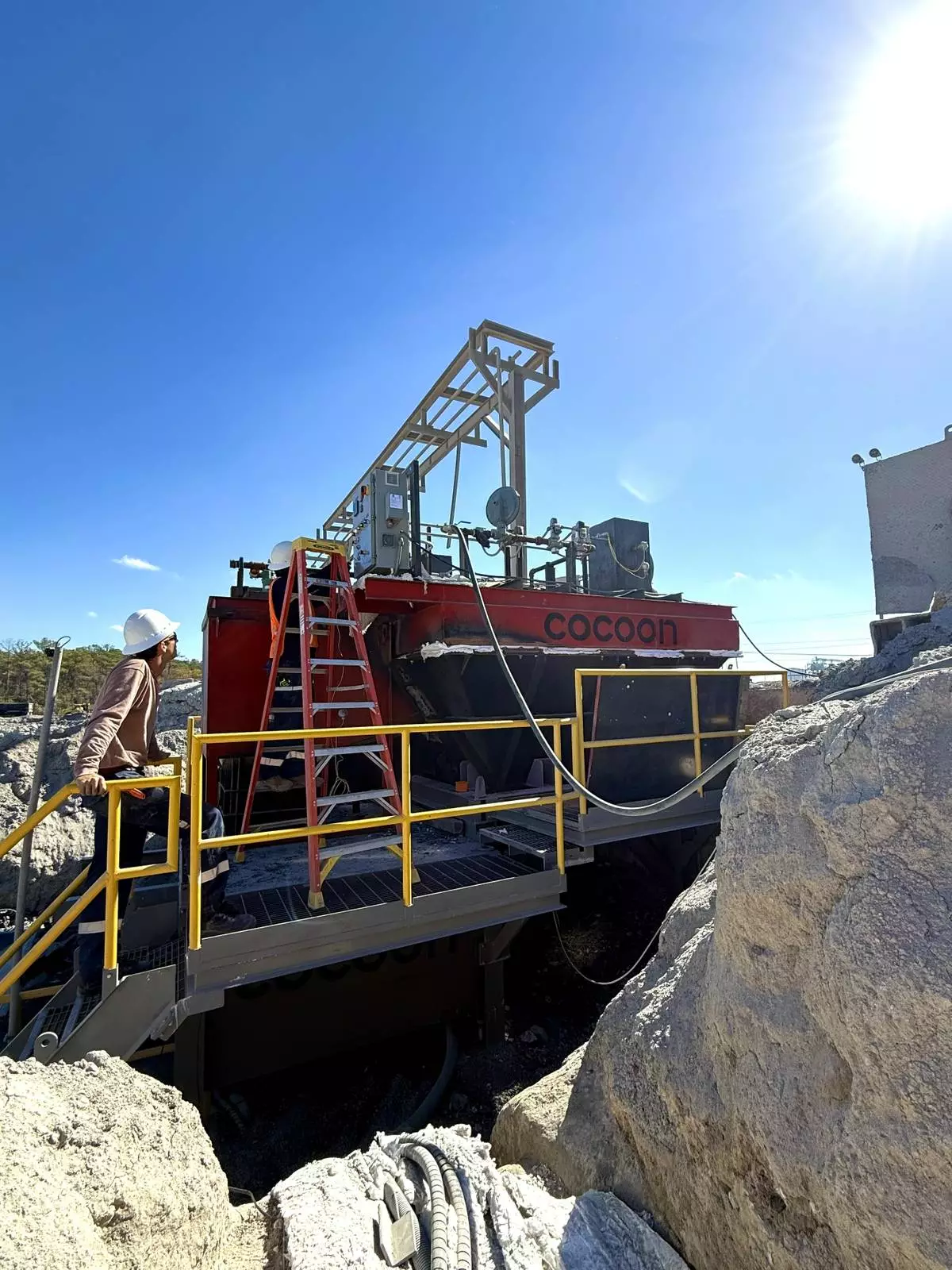
Cocoon's pilot facility