MONTGOMERY, Ala. (AP) — Ruling in the case of a Black pastor who was arrested while watering his neighbor’s flowers, the Alabama Supreme Court said police can demand to see identification during a stop if they are dissatisfied with a person's verbal answers.
Justices issued the 6-3 decision last week after a federal judge presiding over a lawsuit about Michael Jennings' 2022 arrest asked the court to clarify whether officers can demand to see a person's identification under the state's "stop-and-identify” law. The minister was arrested when he declined to show Childersburg police identification.
Justice Will Sellers wrote that state law, “does not exclude from its purview a request for physical identification when a suspect provides an incomplete or unsatisfactory response to an officer’s demand to provide his or her name and address and an explanation of his or her action.”
In May 2022, officers questioned Jennings in his neighbor’s yard. Another neighbor had called 911 because she saw an unfamiliar car and a “young Black male” around the house. Officers who responded found Jennings watering flowers and asked what he was doing.
Jennings identified himself as "Pastor Jennings" and told officers that he lived across the street and was caring for his neighbor's yard while they were vacationing. Officers asked to see his identification and Jennings refused, saying he hadn't done anything wrong. The woman who called 911 also later identified Jennings as another neighbor.
Jennings was charged obstructing a government operation. The charge was later dismissed.
Jennings sued the city and the officers for false arrest. A federal judge dismissed the lawsuit, but the 11th U.S. Circuit Court of Appeals reversed the decision. U.S. District Judge R. David Proctor then asked the state Supreme Court to determine whether the state law prohibits an officer from demanding identification if the person gives an incomplete or unsatisfactory response to questions.
Matthew Cavedon, director of the Cato Institute’s Project on Criminal Justice, said the decision is a “significant expansion of government power over people."
The Cato Institute and the American Civil Liberties Union had written an amicus brief in the case arguing the statute does not authorize any demands for physical identification. Cavedon said the case centers on what happens if a person gives an answer that the officer doesn’t find satisfactory.
“The significance now for Alabamians is if an officer’s not satisfied with whatever answer you give, I sure hope you’ve got your driver’s license or passport on you," he said.
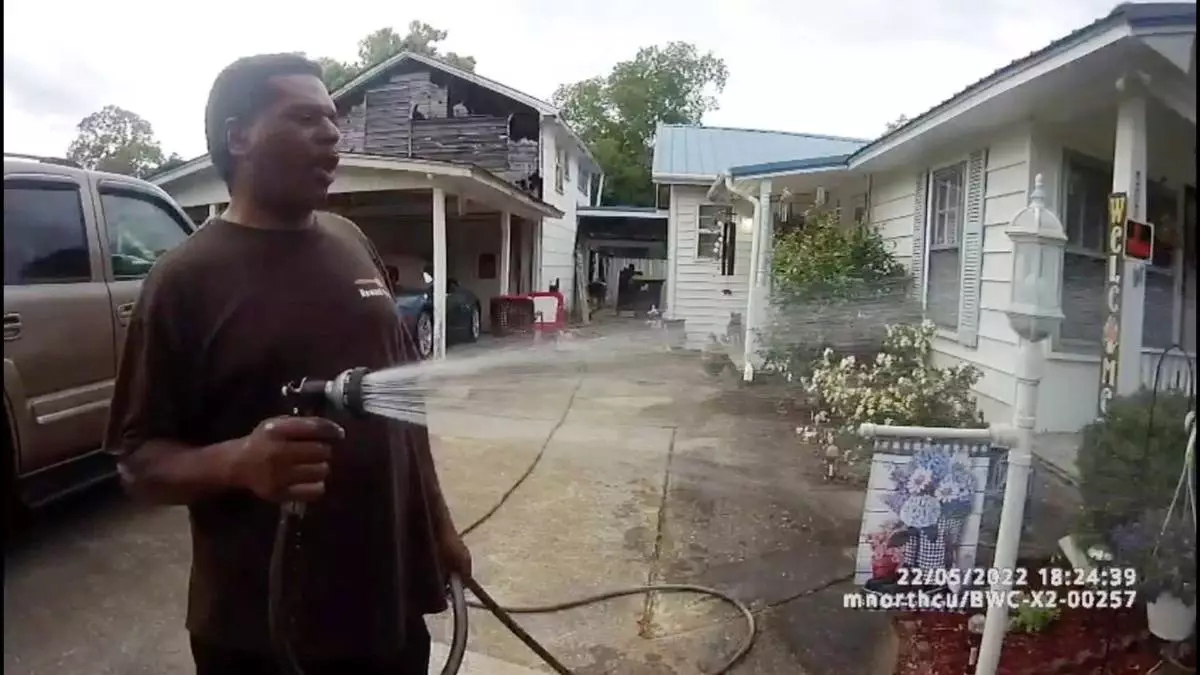
FILE - This image made from bodycamera video released by the Childersburg (Ala.) Police Department and provided by attorney Harry Daniels shows Michael Jennings, left, watering flowers in Childersburg, Ala., May 22, 2022. (Childersburg Police Department via AP, File)
DUBAI, United Arab Emirates (AP) — Ali Larijani, a top Iranian security official, was widely believed to be running the country as it reeled from the killing of its supreme leader and a widening war. Israel said Tuesday that it killed Larijani in an overnight strike.
Israel's military also said it killed Iranian Gen. Gholam Reza Soleimani, who led a powerful internal security force that has crushed waves of mass protests against the Shiite theocracy.
Iranian authorities later confirmed both deaths. Supreme Leader Ayatollah Ali Khamenei and other top security officials were killed in the surprise U.S. and Israeli strikes that started the war. Khamenei's son, Mojtaba, who was appointed to replace him, has not been seen in public, and Israel suspects he was wounded.
The killing of top leaders has so far had little impact on the war itself, as Iran's Revolutionary Guard continues to fire missiles at Israel and Arab Gulf countries. Iran has also effectively closed the Strait of Hormuz, through which a fifth of the world's traded oil passes, sending prices up and rattling the world economy.
Israeli Prime Minister Benjamin Netanyahu said the strikes were aimed at weakening Iran's government “to give the Iranian people the opportunity to remove it.” There have been no signs of anti-government protests since the war began, as many Iranians are sheltering from the American and Israeli strikes.
Larijani hails from one of Iran’s most famous political families, which many media outlets have compared to the Kennedys in the United States. One brother, Sadeq, served as the head of Iran’s judiciary, while another, Mohammad Javad, was a senior diplomat who closely advised the late Khamenei on foreign affairs.
Larijani has been a conservative force within Iran’s theocracy, issuing increasingly hard-line threats throughout the years. In the 1990s, he served as Iran’s culture minister, tightening censorship. He served as parliament speaker from 2008 to 2020, and most recently as head of the Supreme National Security Council.
Larijani has also written at least six philosophy books, including three exploring the works of German philosopher Immanuel Kant.
He was appointed to advise Khamenei on strategy in nuclear talks with the Trump administration and traveled to Oman to meet with mediators just two weeks before the war began. Like other top Iranian leaders, he was under heavy U.S. sanctions and implicated in the violent repression of mass protests in January.
He was ineligible to become supreme leader because he is not a Shiite cleric. But he was widely expected to serve as a top adviser, and many believed he was running the country as U.S. and Israeli strikes have driven Iran's leadership underground. The Supreme National Security Council said his son Morteza Larijani was also killed.
A week ago, after U.S. President Donald Trump threatened to attack Iran “TWENTY TIMES HARDER” if Tehran stopped oil flowing through the Strait of Hormuz, Larijani responded to him on X.
“The sacrificial nation of Iran doesn’t fear your empty threats. Even those bigger than you couldn’t eliminate Iran,” he wrote. “Be careful not to get eliminated yourself.”
Less is known about Soleimani, who led Iran’s paramilitary Basij, an all-volunteer force fiercely loyal to the Islamic Republic. He is not related to Gen. Qassem Soleimani, Iran's top general who was killed in a U.S. strike in 2020.
An Israeli military official, speaking on condition of anonymity in line with regulations, said Soleimani was killed in a combat tent alongside other Basij commanders, who were using it as makeshift headquarters as Israel has targeted several of their bases.
Gen. Gholam Reza Soleimani was born in the mid-1960s in the western Iranian city of Farsan. He first joined the Basij as a volunteer in 1984 during the Iran-Iraq war, when it was notorious for launching human wave attacks at fortified Iraqi positions. He became the commander of the Basij in 2019.
The Basij numbers in the hundreds of thousands, and includes military-style brigades, anti-riot police and a vast network of informers who spy on Iranian society. During protests, plainclothes members can often be seen attacking, beating and hauling away demonstrators.
Soleimani had been under U.S. and international sanctions since 2021 connected to his involvement in crushing protests going back to the disputed presidential election of 2009. The U.S. Treasury said the Basij killed “hundreds of Iranian men, women and children” when it cracked down on protests in 2019.
Thousands were killed and tens of thousands detained in January when Iranians again rose up. It was the bloodiest such crackdown since the 1979 Islamic Revolution and caught the attention of Trump, who threatened to intervene on the protesters' behalf before shifting his attention to Iran's nuclear program.
Lidman reported from Tel Aviv, Israel and Spike from Budapest, Hungary.
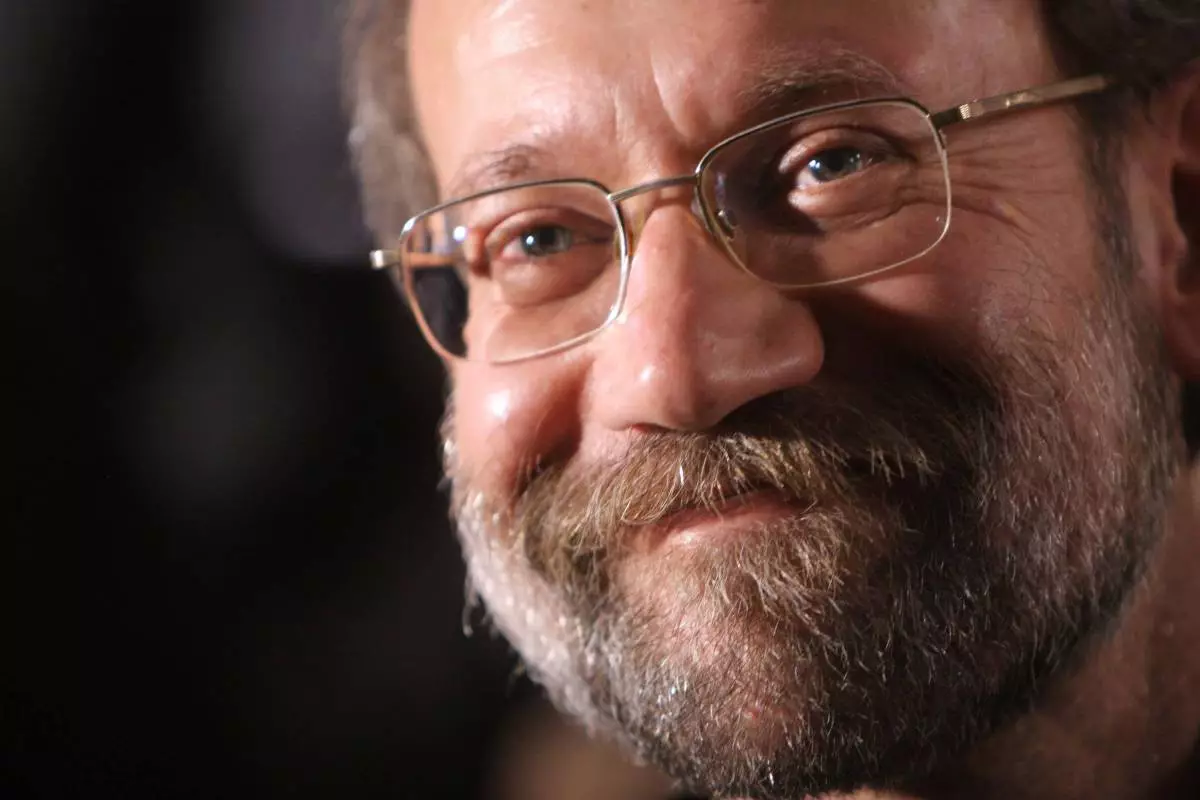
FILE - Iran's chief nuclear negotiator Ali Larijani, smiles as he attends in a ceremony at Iran's nuclear enrichment facility in Natanz, 300 kms 186 (miles) south of capital Tehran, Iran, Monday April, 9, 2007. (AP Photo/Hasan Sarbakhshian, File)
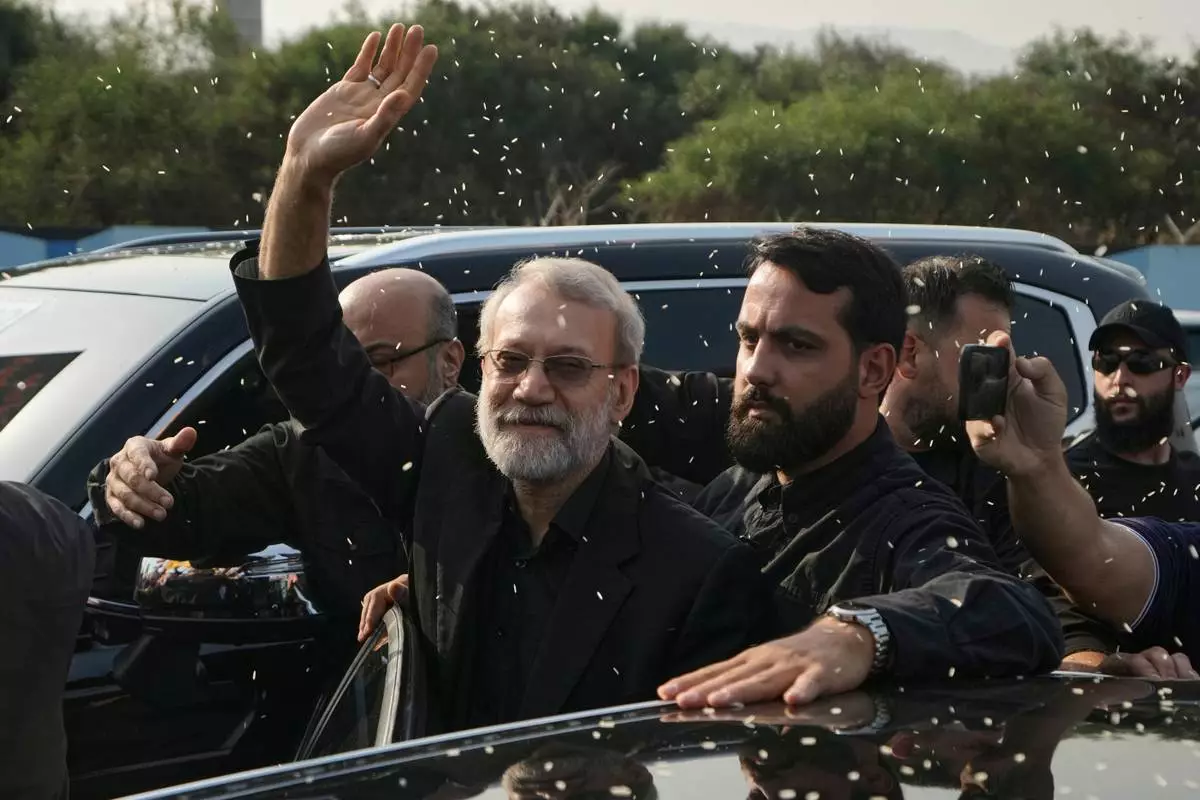
FILE - Ali Larijani, center, head of Iran's National Security Council, gestures as Hezbollah supporters throw rice to welcome him outside Rafik Hariri International Airport in Beirut, Lebanon, Wednesday, Aug. 13, 2025. (AP Photo/Bilal Hussein, File)
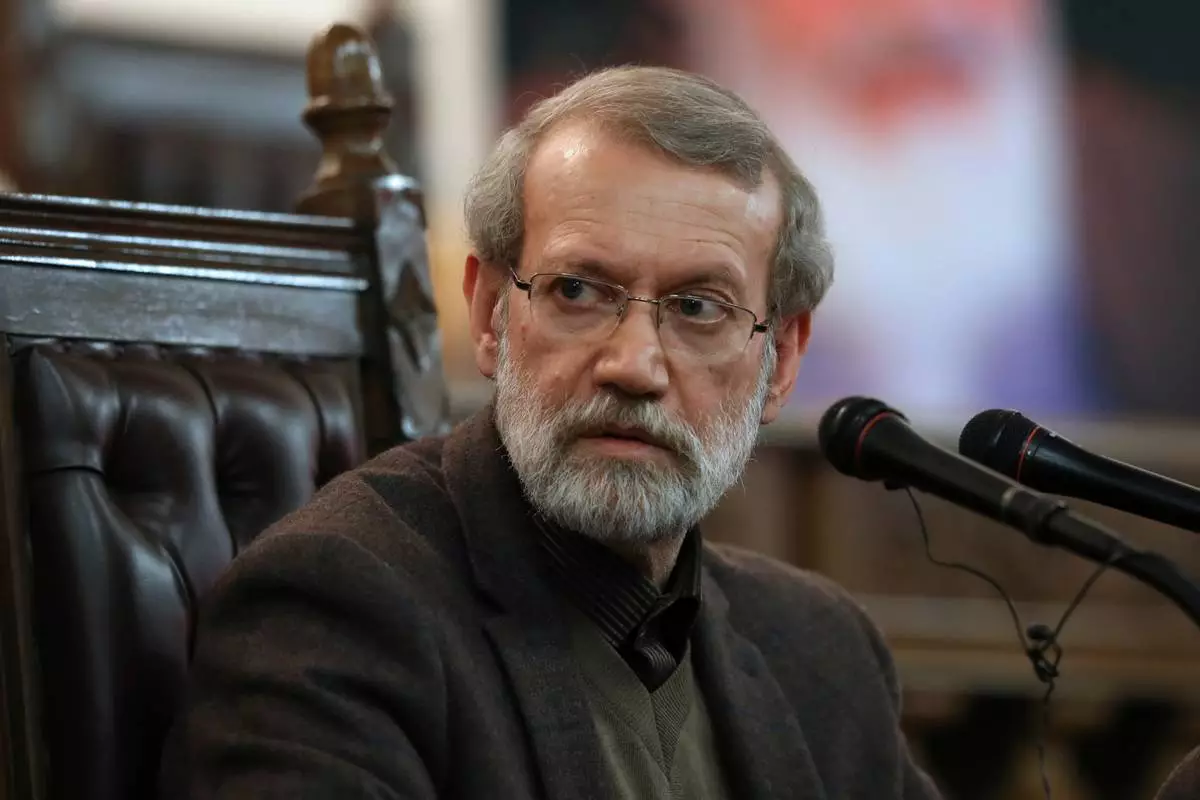
FILE - Parliament Speaker Ali Larijani gives a press conference in Tehran, Iran, Dec. 1, 2019. (AP Photo/Vahid Salemi, File)
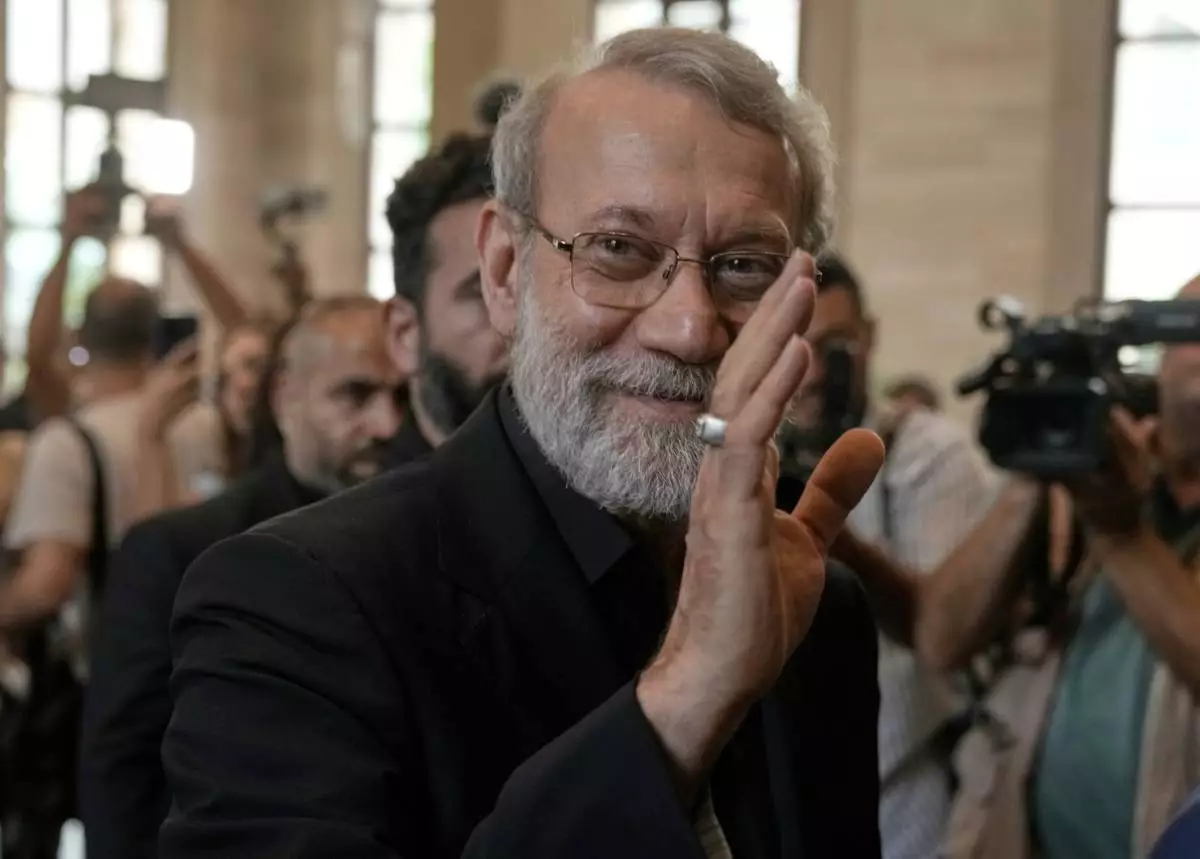
FILE - Iranian Secretary of Supreme National Security Council Ali Larijani, greets journalists upon his arrival to meet with the Lebanese parliament speaker Nabih Berri, in Beirut, Lebanon, Wednesday, Aug. 13, 2025. (AP Photo/Bilal Hussein, File)