Skip to Content Facebook Feature Image

Xcimer Energy Completes Crucial Experimental Shots at University of Rochester’s Laboratory for Laser Energetics

News

Xcimer Energy Completes Crucial Experimental Shots at University of Rochester’s Laboratory for Laser Energetics
News

News

Xcimer Energy Completes Crucial Experimental Shots at University of Rochester’s Laboratory for Laser Energetics

2026-03-18 18:03 Last Updated At:18:31

DENVER--(BUSINESS WIRE)--Mar 18, 2026--

Xcimer Energy today announced that it completed experimental shots at the University of Rochester’s Laboratory for Laser Energetics, accelerating the company’s goal of commercializing laser fusion.

This press release features multimedia. View the full release here: https://www.businesswire.com/news/home/20260318614112/en/

Scientists and engineers from Xcimer and partnering institutions conducted an experiment last month at the OMEGA Laser Facility as part of a National Laser Users’ Facility (NLUF) campaign. NLUF is a merit-based user program supported by the Department of Energy National Nuclear Security Administration, providing academic and industrial scientists and students with access to the world-class Omega Laser Facility for basic research.

The experiment focused on externally driven halfraums (half-hohlraums) as part of early validation of Xcimer’s two-beam approach to inertial fusion energy.

OMEGA cannot replicate Xcimer’s full target–laser architecture, as the facility does not support the beam shaping capabilities or F-numbers required for the final design. Instead, beams were intentionally repointed onto the outer baffles of a halfraum configuration to mimic the laser–target coupling conditions Xcimer is actively designing and modeling.

Copper, gold, and lead halfraums were tested, with measurements of radiation temperature and shock velocity used to constrain the radiation-hydrodynamics models that inform Xcimer’s halfraum designs.

“The goal of this campaign was to generate experimental data that directly informs our hohlraum design work,” said Alison Christopherson, Head of Target Design at Xcimer. “This data provides the validation required for system-level confidence as we scale from individual experiments toward an integrated fusion energy system.”

Crucial benchmark for modeling

The data will be shared with partner institutions developing target designs for Xcimer’s fusion approach and will serve as an early benchmark for the company’s internal modeling efforts. Validated models are essential for designing targets, chambers, and laser configurations capable of supporting a commercial fusion pilot plant.

The halfraums for this campaign were fabricated by General Atomics, Xcimer’s collaborator on target factory design for the Fusion Pilot Plant. The work was conducted in collaboration with the Laboratory for Laser Energetics, Los Alamos National Laboratory, and the Universidad Politécnica de Madrid.

These OMEGA experiments directly support the risk-retirement pathway in Xcimer’s Fusion Pilot Plant (FPP) roadmap by strengthening the physics basis for plant-scale target performance. The roadmap progresses through three dedicated facilities:

“Disciplined experimental validation”

In parallel, key leaders, scientists, and engineers from Xcimer’s Denver-based team participated in the experiment. The team engaged directly with OMEGA facility operators, gaining firsthand exposure to facility operations and shot execution to inform future scaling, operability, and system integration for Anvil and Vulcan.

The OMEGA Laser Facility is operated by the Laboratory for Laser Energetics (LLE) at the University of Rochester – one of the world’s premier high-energy-density science facilities. Designed to advance research in inertial confinement fusion, plasma physics, and astrophysics, LLE plays a critical role in supporting the National Nuclear Security Administration’s mission for stockpile stewardship and scientific discovery.

Laser-driven inertial fusion remains the only fusion approach to have achieved scientific breakeven in the laboratory. Xcimer’s strategy focuses on translating that scientific milestone into a repeatable, economically viable energy system by simplifying driver architecture and rigorously validating performance at each step.

“These shots represent the kind of disciplined experimental validation required to turn laser fusion into an engineered energy system,” said Conner Galloway, co-founder and CEO of Xcimer Energy. “Laser fusion is the only approach that has demonstrated scientific breakeven. The question now is whether it can be engineered into something scalable and reliable. Every dataset like this helps derisk that path—by grounding our models in experiment, tightening our designs, and showing that the physics holds as we move toward practical systems.”

For more details: https://xcimer.energy/news/

About Xcimer Energy Inc.
Xcimer combines novel laser technology with proven science to commercialize laser fusion energy. Founded in 2022 and based in Denver, Colorado, Xcimer is backed by the world’s leading climate tech investors and has been selected for funding by the U.S. Department of Energy. Its mission is to develop a source of unlimited, clean, safe and reliable energy to power the future. To learn more, visit https://xcimer.energy/.
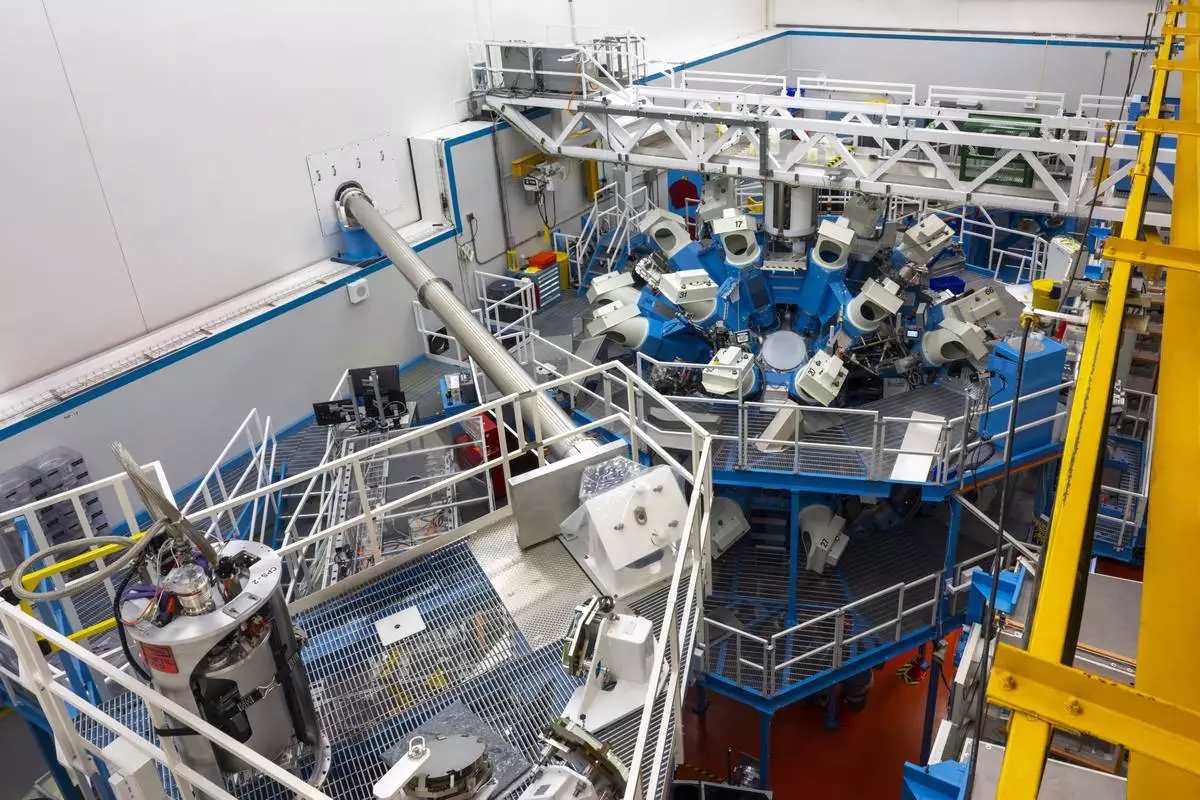
Photo caption: The OMEGA Target Bay, courtesy of the Laboratory for Laser Energetics / photo by Jake Deats
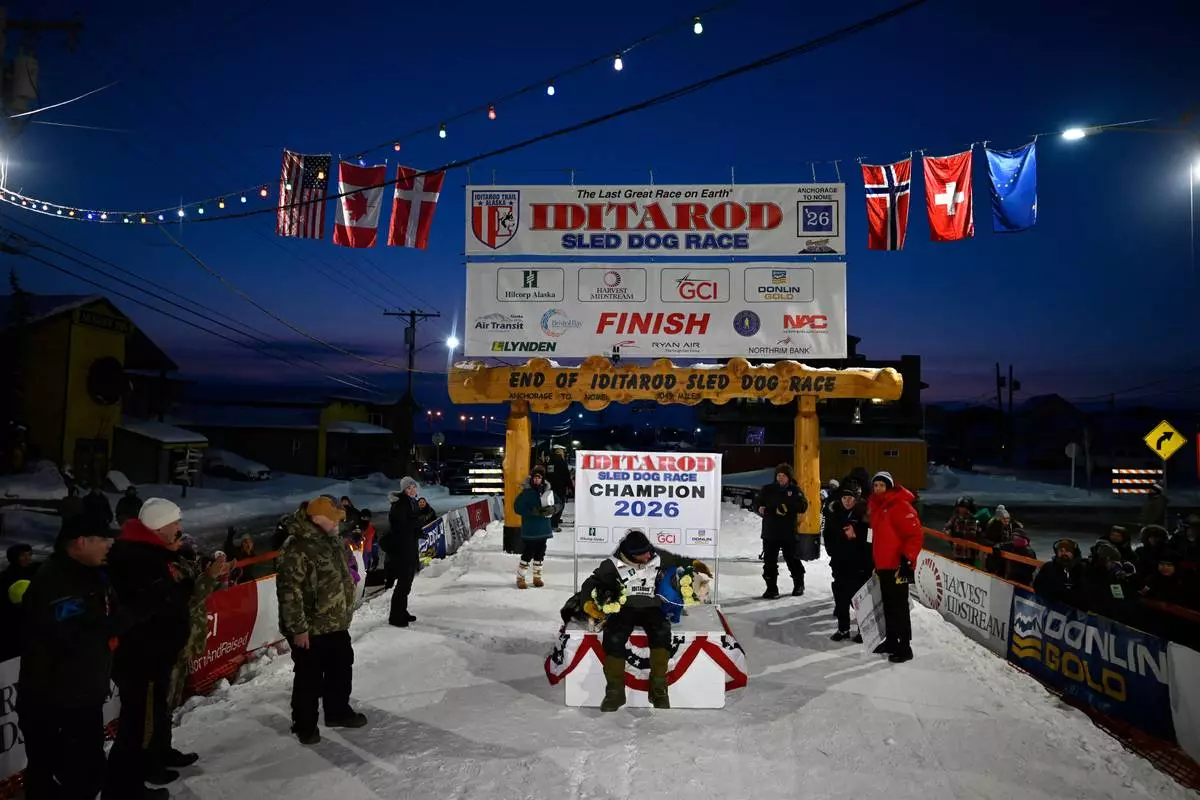
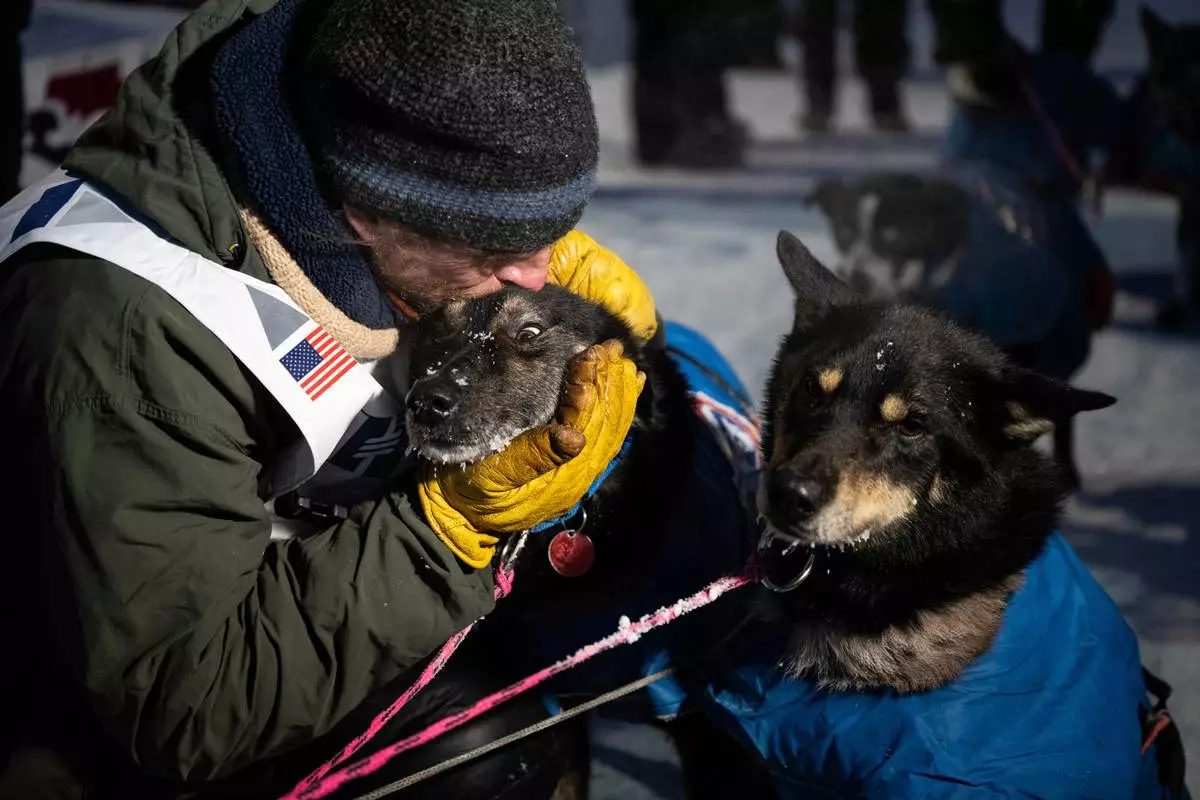
Photo caption: The OMEGA Target Bay, courtesy of the Laboratory for Laser Energetics / photo by Jake Deats
NOME, Alaska (AP) — Former reality TV star Jessie Holmes cruised to a repeat victory in the Iditarod, the roughly 1,000-mile (1,609-kilometer) sled dog race in Alaska.

Holmes guided his dog team across the finish line Tuesday night in the old Gold Rush town of Nome, a Bering Sea coastal community.

The race started March 8 in Willow, a day after the ceremonial start was held in Anchorage. The course took dog teams and their mushers over two mountain ranges, along the frozen Yukon River and across the unpredictable Bering Sea ice.

Holmes, a former cast member on the National Geographic reality show “Life Below Zero,” is the third competitor in the 54-year history of the Iditarod Trail Sled Dog Race to repeat the year after winning for the first time. The others were Susan Butcher in 1986-1987 and Lance Mackey in 2007-2008. Both went on to win four titles.

Holmes told The Associated Press before the Iditarod that this year’s race was the most important of his career. “That’s hard to put that on yourself because you got to live with that pressure every day,” Holmes said. “And if I do not make it, it is going to absolutely crush me.”

He will pocket about $80,000 for this year’s win, up from the $57,000-plus he took home last year. This year's purse was boosted by financial support from Norwegian billionaire Kjell Rokke, who participated in a newly created, noncompetitive amateur category. Rokke reached Nome on Monday, under rules that allowed him to have outside support from a former Iditarod champ, flexible rest periods and to swap out dogs.

Holmes' first Iditarod was in 2018. His seventh place finish earned him rookie of the year honors. He has now raced in the Iditarod nine times, earning seven top 10 finishes. He’s been in the top five the last five races.

He appeared for eight years on the National Geographic reality show “Life Below Zero,” which chronicled the hardships of people living in rural Alaska.

Holmes used the money he earned from the show to buy better dogs and equipment, and also was able to purchase raw land near Denali National Park and Preserve. A carpenter by trade, he’s carved his homestead in the wilderness, where his closest neighbor is about 30 miles (48 kilometers) away.

Rokke, who now lives in Switzerland, provided $100,000 in additional prize money and $170,000 to Alaska Native villages that serve as checkpoints. Another musher in the noncompetitive “expedition” class, Canadian entrepreneur Steve Curtis, pledged $50,000 to help youth sports programs in the villages. Curtis did not finish the race.

The race’s biggest critic, People for the Ethical Treatment of Animals, has claimed that more than 150 dogs have died in the history of the Iditarod. It urged Rokke to spend his money to help dogs rather than put them through “hazards and misery.”

The Iditarod has never provided its count of dogs who have died on the race.

One dog has died in this year's race, a 4-year-old female named Charly on musher Mille Porsild's team, the Iditarod said in a statement Tuesday. A necropsy will be conducted.

Thirty-four competitive mushers started, matching the inaugural 1973 race for the second fewest in race history. The retirements of many longtime mushers and the high cost of supplies, such as dog food, have kept the fields small this decade.

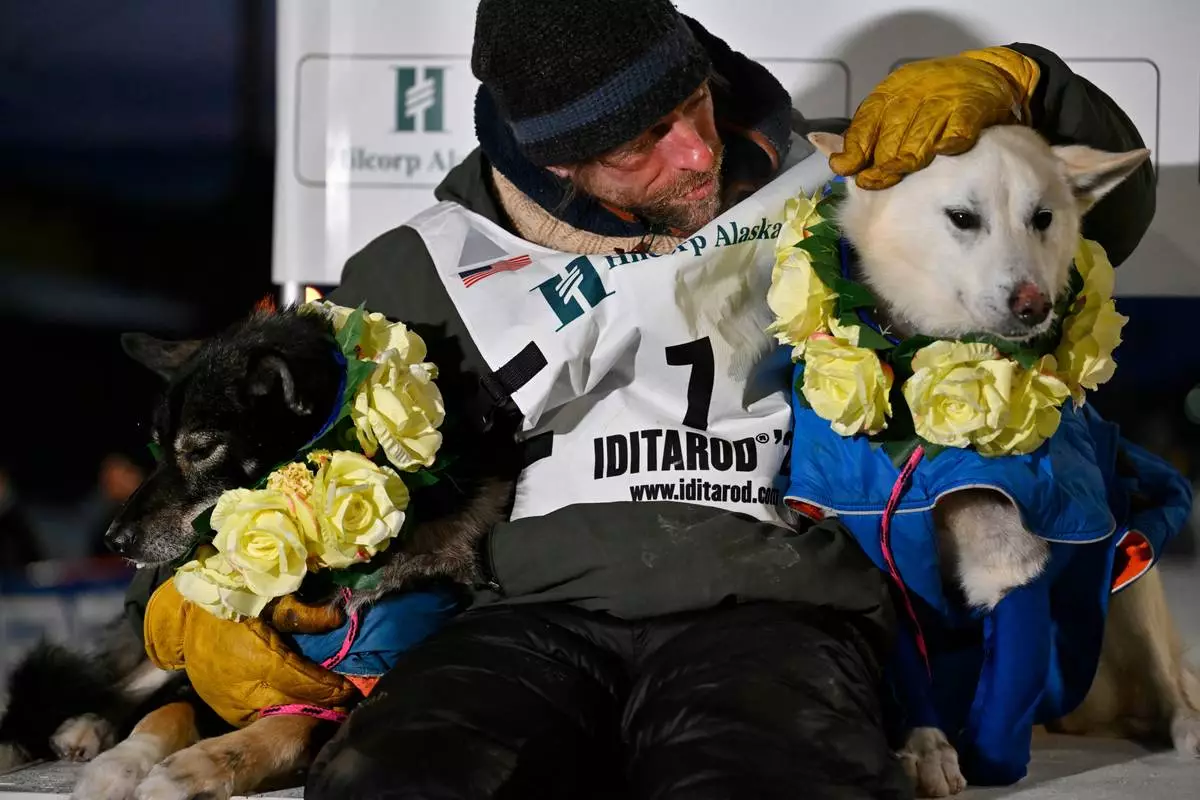
Jessie Holmes poses with his lead dogs Zeus, left, and Polar, after claiming his second straight Iditarod Trail Sled Dog Race championship, in Nome, Alaska, Tuesday March 17, 2026. (Marc Lester/Anchorage Daily News via AP)

Jessie Holmes poses with his lead dogs Zeus, left, and Polar, after claiming his second straight Iditarod Trail Sled Dog Race championship, in Nome, Alaska, Tuesday March 17, 2026. (Marc Lester/Anchorage Daily News via AP)

Jessie Holmes hugs his dogs at the finish line, after claiming his second straight Iditarod Trail Sled Dog Race championship, in Nome, Alaska, Tuesday March 17, 2026. (Marc Lester/Anchorage Daily News via AP)

Jessie Holmes hugs his dogs at the finish line, after claiming his second straight Iditarod Trail Sled Dog Race championship, in Nome, Alaska, Tuesday March 17, 2026. (Marc Lester/Anchorage Daily News via AP)

Jessie Holmes poses with his lead dogs Zeus, left, and Polar, after claiming his second straight Iditarod Trail Sled Dog Race championship, in Nome, Alaska, Tuesday March 17, 2026. (Marc Lester/Anchorage Daily News via AP)

Jessie Holmes poses with his lead dogs Zeus, left, and Polar, after claiming his second straight Iditarod Trail Sled Dog Race championship, in Nome, Alaska, Tuesday March 17, 2026. (Marc Lester/Anchorage Daily News via AP)

Jessie Holmes arrives first to the finish lane, claiming his second straight Iditarod Trail Sled Dog Race championship, in Nome, Alaska, Tuesday March 17, 2026. (Marc Lester/Anchorage Daily News via AP)

Jessie Holmes arrives first to the finish lane, claiming his second straight Iditarod Trail Sled Dog Race championship, in Nome, Alaska, Tuesday March 17, 2026. (Marc Lester/Anchorage Daily News via AP)

Defending Iditarod Trail Sled Dog Race champion Jessie Holmes poses for a selfie with a fan during the ceremonial start of this year's race in downtown Anchorage, Alaska, on Saturday, March 7, 2026. (AP Photo/Mark Thiessen)

Defending Iditarod Trail Sled Dog Race champion Jessie Holmes poses for a selfie with a fan during the ceremonial start of this year's race in downtown Anchorage, Alaska, on Saturday, March 7, 2026. (AP Photo/Mark Thiessen)

Recommended Articles