ATLANTA (AP) — It seemed like the stars had aligned for Republicans to get rid of their biggest targets — Georgia's touch screen voting machines.
But the complicated reality of changing voting systems has gotten in the way, despite the ascent of 2020 election deniers into influential places in state government and the second Donald Trump administration.
Instead, it is looking increasingly likely that Georgia voters will still be casting ballots this November on the machines from Dominion Voting Systems, which was bought by a company called Liberty Vote. The machines print a paper ballot with a QR code, a type of barcode, that scanners use to tally votes.
The president and his allies continue to allege the machines deleted or switched votes in 2020, despite no supporting evidence and big money paid to Dominion in defamation settlements. Trump in March 2025 issued an executive order that purported to mostly ban the use of a barcodes in vote-counting and demand that voters be able to read their recorded selections. A federal judge blocked the provision in a lawsuit brought by the state of Washington.
In the meantime, Georgia Republicans were painting themselves into a corner. Legislators passed a law two years ago setting a deadline of July 1 this year to remove barcodes from ballots. Some people fundamentally mistrust ballots counted using a code that humans can’t read. But lawmakers and administrators failed to agree on any action to meet the mandates of that law — and, crucially, no funding was ever provided.
The promised death of the QR codes was very popular among the cadre of conservative activists who have been agitating for changes in voting since Trump's 2020 loss in Georgia. Those allies now control Georgia's State Election Board and provided the claims cited by the FBI in its seizure of the 2020 ballots from Fulton County, a strongly Democratic area at the center of never-ending fraud claims.
"HAND. MARKED. PAPER. BALLOTS. I will not be moved. I shall not be moved. Got it?” State Election Board member Salleigh Grubbs wrote on social media on Sunday as word of a proposed delay in the July 1 deadline leaked out.
The board, including its lone Democratic member, voted 4-0 Wednesday to urge legislators “to move to hand-marked paper ballots as soon as practicable.”
Opponents of the machines note the computer code has been published online, including after Trump supporters obtained it from the elections office in Coffee County, Georgia. Although the machines aren’t connected to the internet, an examination found software vulnerabilities that could be exploited if someone gained physical access. Dominion issued patches to fix the software problem, but Republican legislators didn't allot any money for GOP Secretary of State Brad Raffensperger to update the software.
Some proposals to meet the deadline to remove the QR codes called for drastic changes to voting or vote-counting in Georgia. One would have required hand-counting every ballot cast in person before Election Day. That is the most popular way to vote in Georgia. Another proposal would have assigned voters to one early voting location, rather than allowing them to vote at any early voting site in their county. Such a shift to designated locations from countywide voting led to confusion in two counties in the recent Texas primary election.
Underlying those false starts is a growing consensus that hand-marked paper ballots counted by scanners is the path forward. Lawmakers said during a Tuesday committee hearing they hope to buy printers that produce ballots as needed instead of paying to preprint millions of ballots. But that comes with an acknowledgment that it is too late to make a big switch in time for November.
Republican Rep. Victor Anderson of Cornelia, who chairs the House Governmental Affairs Committee, said switching away from barcodes this year threatened “a severe upset in our election system.”
"It just wasn’t going to happen,” Anderson said.
Instead, his committee advanced a bill that would require the state to pick a new voting system not by July 1, but by 2028. Lawmakers also pledged to allot money to buy new equipment for Georgia's 159 counties.
It is not a done deal yet. The full House and the more conservative Senate still need to vote for the measure and the Senate, in particular, could balk. Lt. Gov. Burt Jones, who has been endorsed by Trump in his 2026 bid for governor, didn't respond to a request for comment.
But one Republican state senator who has been a leading proponent of switching to hand-marked paper ballots also now acknowledges that November just isn't feasible anymore.
“I’m disappointed in the timeline, but at this point, we have the choice of making an informed legislative decision or unfortunately dealing with a legal option which is not realistic,” state Sen. Max Burns of Sylvania told The Associated Press after the hearing.
One part of the bill that is attractive to conservative activists but disliked by Democrats passes authority over some postelection audits from the secretary of state to the State Election Board. David Worley, a Democrat who formerly served on the board, called the group “hyperpartisan” and warned it had no ability or staff to conduct an audit.
But local officials are effusive in their praise, saying a delay will avert potential chaos.
“This is something that is setting us up for success and not failure," Deidre Holden, election director in the Atlanta suburb of Paulding County, said of the delay. “The timeline was my biggest concern.”
Associated Press writer Kate Brumback contributed from Marietta, Georgia.
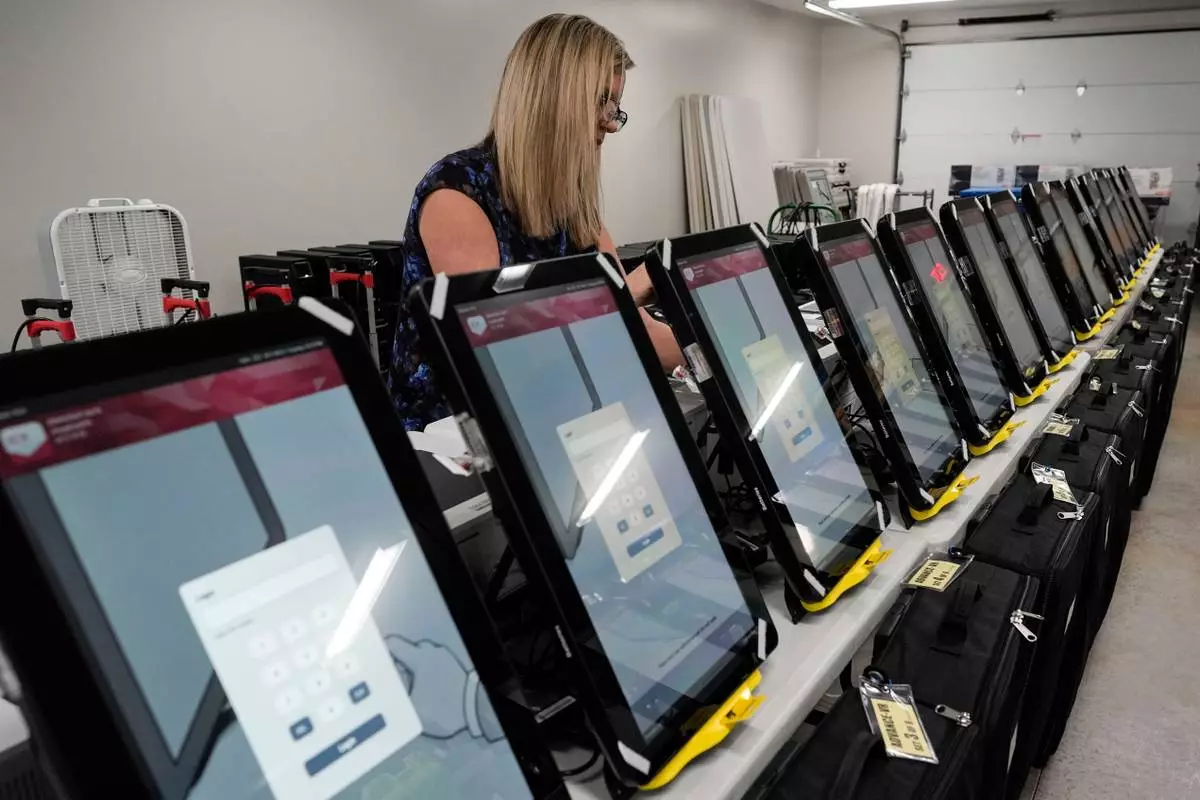
FILE - Voting machines are seen at the Bartow County Election office, Jan. 25, 2024, in Cartersville, Ga. (AP Photo/Mike Stewart, File)