In Doudian Village, located in Beijing's Fangshan District, a green agricultural cycle -- in which crops are used to feed cattle and the resulting manure enriches the soil -- has not only boosted crop yields and produced high-quality beef, but also benefited both the environment and local livelihoods.
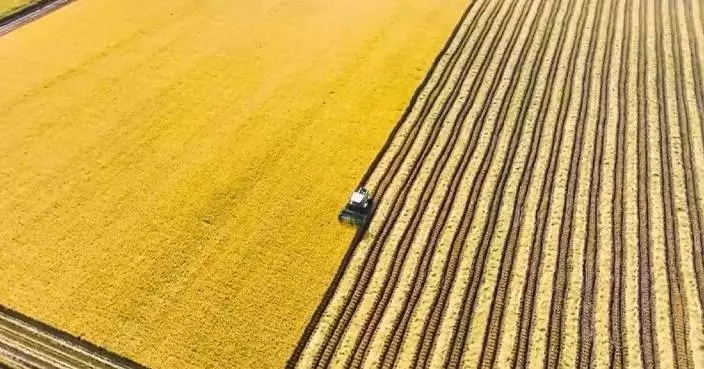
Doudian recently set a new record for wheat yield of the city, surpassing 1,600 jin per mu (approximately 12,000 kg per hectare). What makes this achievement particularly noteworthy is the village's implementation of a circular agriculture model: Crops are used to feed cattle, the cattle in turn nourish the soil with organic fertilizer, and the revitalized soil subsequently supports the next cycle of crop growth. This integrated system forms a sustainable and efficient ecological loop.
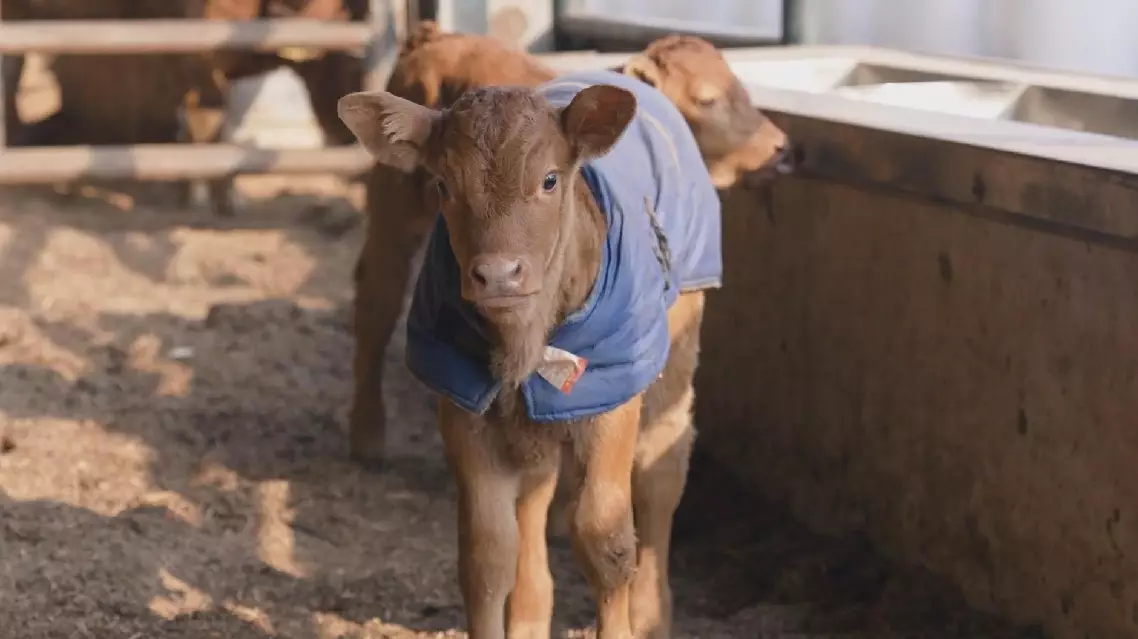
"The main beef cattle we raise are two breeds: Angus and Limousin. As you can see, the cattle are eating grass right now. If you smell the feed, it's not just people who eat 'bread'; our cattle also eat 'bread'. This 'bread' is roughage, which comes from the fields in our Doudian. After the fields are harvested, the straw comes back to our cattle farm for fermentation into feed. This ensures that the feed for our beef cattle is safe and controlled," said Wu Lianfang, general manager of Hengsheng Livestock Breeding Center.
He noted that the cattle's waste is absorbed by bio-beddings, which are then converted into fertilizer following special treatment.
"You see, when the cattle produce manure, the bio-bedding absorbs it. When it reaches a certain quantity and moisture level, we collect it. It is then sent to the next stage -- bio-organic fertilizer production. What you see here is the fresh fertilizer transported from the cattle farm. After it arrives, it undergoes composting and fermentation in these troughs. It stays here for about 25 days," said Wu.
The fermented fertilizer nourishes the fields, promoting robust seedlings and leading to a high yield and abundant harvest -- closing the loop in this sustainable agricultural cycle.
"The wheat is currently at a stage between regreening and jointing. This wheat has three typical strong leaves -- three large leaves -- and theoretically, each tiller can develop its ear. You can see how robust the crop has grown. I believe this is closely related to Doudian's model of circular agriculture. The organic matter content in the soil here is relatively high, and that likely plays a significant role," said Su Zhenqi, a professor at China Agricultural University.
A beef processing workshop in the village ensures that all beef products are fully traceable from farm to table.
"Our company manages the entire process ourselves: raising, slaughtering, processing, and selling. This forms an integrated closed-loop supply chain," said Liu Shuang, a worker of Beijing Doudian Yisheng Halal Meat Industry Co., Ltd.
The farm sold nearly 3,000 head of cattle last year, with a minimum price of 20,000 yuan (about 2,904 U.S. dollars) per animal. Through processing, every ton of manure increases in value by more than twofold.
Moreover, over half of the farm's employees are local villagers, demonstrating how this agricultural cycle boosts local livelihoods.
Green agricultural cycle boosts crop yields, livelihoods in Beijing village