Skip to Content Facebook Feature Image

Bank of England holds interest rates and hints of increases as Iran war jolts inflation outlook

News

Bank of England holds interest rates and hints of increases as Iran war jolts inflation outlook
News

News

Bank of England holds interest rates and hints of increases as Iran war jolts inflation outlook

2026-03-20 01:57 Last Updated At:15:02

LONDON (AP) — The Bank of England held its main interest rate at 3.75% on Thursday as the sharp oil and gas price hikes following the start of the Iran war have stoked renewed concerns about inflation.

The decision was widely anticipated after the United States and Israel started bombing Iran less than three weeks ago. All nine members of the Monetary Policy Committee voted to keep borrowing costs on hold, the first unanimous decision for more than four years.

Until the war erupted on Feb. 28, it was a seen as nearly certainty that the Bank of England would cut interest rates as inflation in the U.K. was expected to fall towards the 2% target in the coming months. In last month's rate-setting meeting, four of the nine rate-setters voted for a cut.

“We have held interest rates at 3.75% as we assess how events unfold,” Bank Gov. Andrew Bailey said. "Whatever happens, our job is to make sure inflation gets back to its 2% target.”

The Iran war has done much to upend the bank's predictions as well as the wider global economic forecasts, not least in how it will affect prices.

The longer the Iran war and the associated closure of the Strait of Hormuz go on, the greater the economic pain will be. A fifth of the world’s crude oil goes through the strait.

The most tangible impact has been in oil and gas markets, with prices rising sharply higher since the start of the war. Prices have surged again Thursday after Iran, in retaliation for an Israeli attack on a key Iranian gas field, intensified its attacks on oil and gas facilities around the Gulf, including Qatar's Ras Laffan, the largest liquefied natural gas export facility in the world.

“War in the Middle East has pushed up global energy prices," Bailey said. “You can already see that at the petrol pump and, if it lasts, it will feed into higher household energy bills later in the year.”

With these new inflationary pressures stalking the global economy, central bankers are having to reassess their projections in 2026, both for inflation and growth. Central banks have been generally cutting rates over the past couple of years, having dealt with the previous energy price shock related to Russia's full-blown invasion of Ukraine.

On Wednesday, the U.S. Federal Reserve also held its key interest rate and cautioned about the increasingly uncertain outlook. The European Central Bank also held rates and said the Iran war has made the outlook “significantly more uncertain.”

For the Bank of England, it's likely to mean that inflation will not fall to its target rate of 2% as soon as expected and will lead to higher prices for the rest of the year — hardly the backdrop for further interest rate reductions anytime soon.

Following Thursday's unanimous decision and the tough language employed by Bailey, financial markets have actually moved to price in higher U.K. interest rates this year.

“Put simply, rate hikes are now a real risk for the economy,” said Sanjay Raja, chief U.K. economist at Deutsche Bank.

Keeping interest rates higher than they otherwise would have been can help keep a lid on inflation. High interest rates weigh on the economy by making it more expensive for businesses and consumers to borrow, thereby bearing down on economic activity and consequently price pressures.
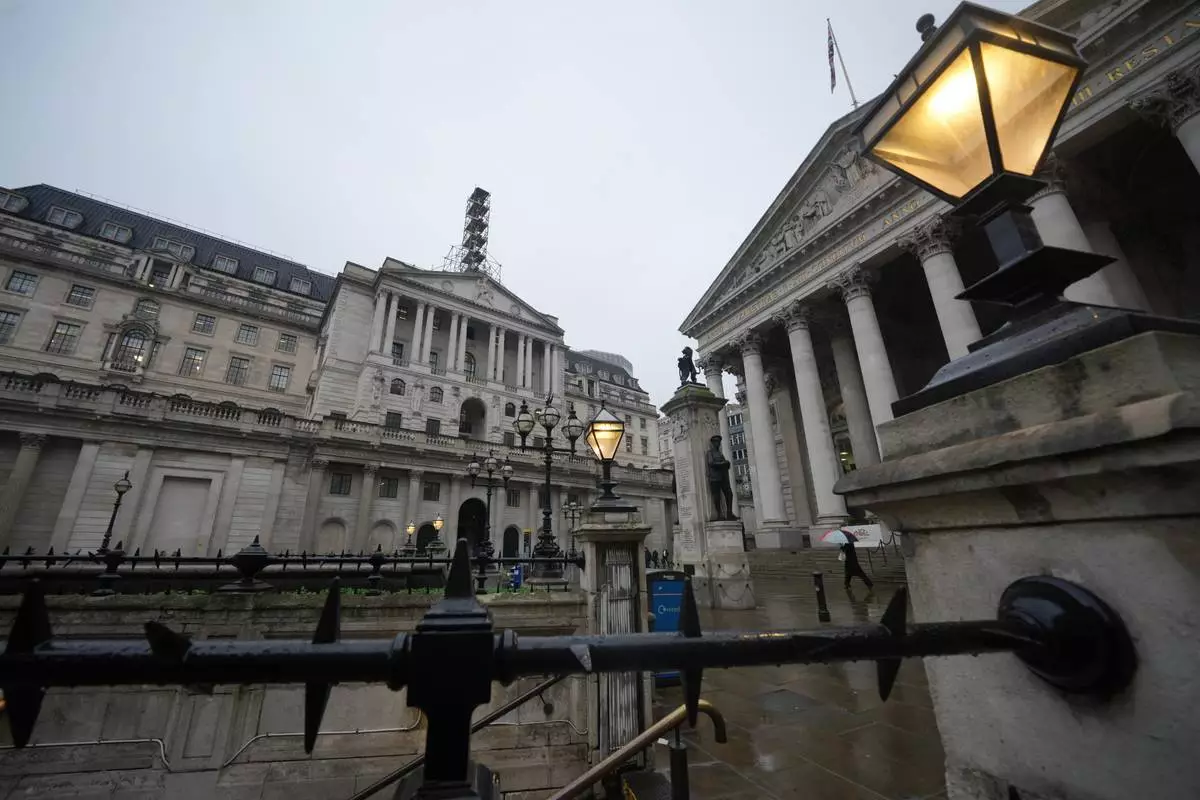
FILE -A man walks in front of the Bank of England, at the financial district in London, Feb. 5, 2026 (AP Photo/Kin Cheung, File)
FILE -A man walks in front of the Bank of England, at the financial district in London, Feb. 5, 2026 (AP Photo/Kin Cheung, File)
President Donald Trump has signed an agreement with Iran that calls for Tehran to dilute its stockpile of highly enriched uranium and waives U.S.-backed sanctions on the country, immediately allowing Iran to sell its oil freely in a major concession from Washington, according to details released by both countries.

The White House had planned a signing ceremony on Friday in Switzerland, but its fate is now uncertain, with conflicting information from the U.S., Iran and Pakistan.

Meanwhile, U.S. Defense Secretary Pete Hegseth lashed out at NATO allies Thursday, announcing a six-month Pentagon review of American forces in Europe whose outcome will depend on how fast the Europeans take responsibility for their own security.

Here's the latest:

Prices fell below $4 a gallon on average Thursday, but just barely.

It’s the first time since March that the average cost for a regular gallon has been that low. Prices fell overnight after President Trump signed an agreement with Iran that calls for Tehran to dilute its stockpile of highly enriched uranium and waives U.S.-backed sanctions on the country.

Gas prices are at $3.999 on average in the U.S., according to motor club AAA.

But fluctuations in gas prices remain across the country. In California, gas prices are averaging $5.64 per gallon, while in South Carolina it’s $3.58 per gallon.

▶ Read more

Trump, soon after returning to Washington early Thursday morning from the G7, took to social media to push back against critics of the Iran deal.

“These fools, who think I haven’t been tough enough on Iran, when the Stock Market Just Hit A RECORD HIGH, and Oil prices are ‘tumbling’ down, are either jealous, bad people, or stupid,” Trump posted on Truth Social.

Donald Trump explained the appeal in one sentence: “Versailles is not gold leaf — Versailles is the real deal.”

For Emmanuel Macron, that was precisely the point.

On Wednesday night, the French president threw open Louis XIV’s palace to his U.S. counterpart for a private reception, show and dinner marking America’s 250th birthday. At a turbulent moment for the trans-Atlantic alliance, it could help Macron keep a personal channel open as the two navigate differences over Iran, Ukraine and tariffs.

It already kept Trump from leaving a Group of Seven summit early, as he did last year in Canada.

“I’m a fan of beautiful places,” he told reporters, saying he had planned to leave earlier until “a very nice man” invited him to dinner.

After posing in front of Versailles’ golden doors, Trump enjoyed a private tour of the chateau’s glittering interior. And in a surprise move over a dinner of lobster, caviar and vanilla ice cream, he signed a memorandum on ending the war in Iran at a venue steeped in historical symbolism.

▶ Read more

The Trump administration said Wednesday it’s buying back another energy company’s U.S. offshore wind leases for four more wind projects, as it seeks to discourage the expansion of wind energy in favor of fossil fuels.

The latest deal brings the total amount spent on these agreements to nearly $2.6 billion.

Chicago-based Invenergy has agreed to end its four offshore wind leases that were very early in development in exchange for reimbursements of lease fees totaling $765 million. The company had already canceled the largest of the four in November, Leading Light Wind off New Jersey’s coast. The others are off the coasts of Maine and California. It will invest that money in natural gas and geothermal ventures that can be built more quickly instead.

By buying back leases, the Republican administration is stopping offshore wind farms that Trump does not support and redirecting the money to fossil fuel projects that he does. It adopted this strategy after federal courts thwarted Trump’s efforts to stop offshore wind development through executive action. Trump has frequently talked about his hatred of wind power and calls turbines ugly.

▶ Read more

U.S. Defense Secretary Pete Hegseth lashed out at NATO allies on Thursday, announcing a six-month Pentagon review of American forces in Europe whose outcome will depend on how fast the Europeans take responsibility for their own security.

“This will be a real review. It will be designed to ensure that NATO is moving fast and irreversibly toward Europe leading, stepping up to take primary responsibility for the defense of Europe,” he told his NATO counterparts in Brussels.

Hegseth lambasted European allies for failing to provide U.S. forces access to bases in Europe to launch attacks on Iran, calling it “shameful.”

“These allies, they put America’s sons and daughters, our sons and daughters, at risk by denying them the predictable access, basing and overflight that never should have been in question at all,” he said.

Taking the microphone at the top of the meeting, Hegseth also railed against migration and gender equality policies in Europe, in remarks reminiscent to those of Vice President JD Vance in February last year that angered many Europeans.

▶ Read more

Senior U.S. officials on Wednesday read the memorandum of understanding with Iran to journalists after days of secrecy over what is in the document.

The officials spoke on condition of anonymity to read the deal before a formal signing ceremony set for Friday. Iranian state TV later released text that largely tracked what the U.S. put out.

Pakistani Prime Minister Shehbaz Sharif, whose country has been mediating between the sides, later said the leaders of the U.S. and Iran had signed the deal and it “shall enter into force with immediate effect.”

▶ Read what’s in the deal

President Donald Trump signed an agreement with Iran on Wednesday that calls for Tehran to dilute its stockpile of highly enriched uranium and waives U.S.-backed sanctions on the country, immediately allowing Iran to sell its oil freely in a major concession from Washington, according to details released by both countries.

The initial deal to end the war takes “immediate effect” after leaders from both countries signed it, Pakistani Prime Minister Shehbaz Sharif, who helped mediate the agreement, said online.

The agreement calls for a permanent end to hostilities and starts a 60-day negotiating clock to reach a final deal on the future of Iran’s nuclear program, though Trump left the door open to resume attacks. It appears to offer Iran several benefits up front while extracting little in return.

The deal has been shrouded in secrecy and confusion for days. The White House had planned a signing ceremony on Friday in Switzerland, but its fate is now uncertain, with conflicting information from the U.S., Iran and Pakistan.

▶ Read more

U.S. President Donald Trump is greeted by French President Emmanuel Macron and first lady Brigitte Macron as he arrives at the Palace of Versailles, Wednesday, June 17, 2026, in Versailles, France. (AP Photo/Julia Demaree Nikhinson)

U.S. President Donald Trump is greeted by French President Emmanuel Macron and first lady Brigitte Macron as he arrives at the Palace of Versailles, Wednesday, June 17, 2026, in Versailles, France. (AP Photo/Julia Demaree Nikhinson)

U.S. President Donald Trump gestures as he leaves the stage after a media conference at the end of the G7 summit in Evian-les-Bains, France, Wednesday, June 17, 2026. (AP Photo/Vadim Ghirda)

U.S. President Donald Trump gestures as he leaves the stage after a media conference at the end of the G7 summit in Evian-les-Bains, France, Wednesday, June 17, 2026. (AP Photo/Vadim Ghirda)

Recommended Articles