WASHINGTON (AP) — When President Donald Trump returned to office last year, he launched a crusade to shift the country away from renewable energy, drastically undoing the climate-friendly policies of his Democratic predecessor to focus instead on oil and other fossil fuels as the answer to his goal of American energy dominance.
But the war in Iran is underscoring the risks of that approach.
As crude oil prices rise above $100 a barrel and gasoline prices surge toward $4 a gallon, the Republican president's strategy of blocking clean energy such as wind and solar power has left Americans with fewer alternative energy sources and thus more vulnerable to supply shocks caused by the war, experts say. The Strait of Hormuz, a key access point for the global oil market, remains effectively blocked as Iran targets traffic through it.
“The biggest short-term losers of the war will be U.S. consumers of oil and gas, as energy prices rise,” said Peter Gleick, a climate scientist and co-founder of the Pacific Institute, a nonprofit that focuses on global water sustainability.
“It turns out fossil fuels have their own supply risks, and the administration has no answers,” added Tyson Slocum, energy director at Public Citizen, a consumer advocacy group.
Trump promised during his campaign to cut energy bills in half but has presided over spikes in electric bills as demand from data centers soars, Slocum said. “Now we are seeing higher gas prices, and nobody knows where it’s going," he said.
Trump told reporters the conflict is a “very small price to pay” after years of terror from the Iranian leadership and predicted that oil prices “will drop like a rock” once the war ends.
“Dig we must. That’s the Trump policy of lots of oil," he said Monday at the White House.
Meanwhile, American consumers are already seeing the effects at the pump.
The national average price for gasoline has jumped to about $3.84 per gallon as of Wednesday, according to AAA, after Trump boasted in his State of the Union address last month that gas prices were below $3.
And in a pivotal midterm election year when affordability is a top concern for voters, Trump’s energy policies could hurt Republicans as Americans feel the brunt of higher energy costs.
“We’re always concerned when gas prices go up,” said Republican Sen. Mike Rounds of South Dakota.
“Gas drives the affordability issue,” added GOP Sen. Thom Tillis of North Carolina.
Trump has long been hostile to renewable energy, particularly offshore wind, and prioritizes fossil fuels to produce electricity. Trump has said wind turbines are ugly and expensive and pose a threat to birds and other wildlife. While wind turbines pose a risk to birds, cats are by far the leading threat, followed by building collisions, government statistics show. A report by the National Audubon Society found that two-thirds of North American bird species could face extinction due to rising temperatures.
In his second term, Trump has gone all in on fossil fuels, providing tax breaks and fast-tracked permits for oil and gas drilling. At the same time, he has blocked dozens of clean energy projects and canceled billions of dollars in grants to promote clean energy, which he derides as the “Green New Scam." Climate change is "the greatest con job ever perpetrated on the world, in my opinion,” Trump told the United Nations last year.
Trump's policies mark a reversal from those of President Joe Biden, who unleashed a flurry of actions intended to slow planet-warming pollution from the power sector and other industries and encourage use of electric vehicles.
A landmark regulation, since reversed, would have forced coal-fired power plants to capture smokestack emissions or shut down. Biden and congressional Democrats also approved nearly $375 billion to boost clean energy, the biggest spending to fight climate change by any nation ever.
Trump and congressional Republicans moved swiftly to overturn those polices. The president has gone so far as repealing a longtime scientific finding that climate change endangers public health and the environment.
“You see an administration that has said, quite literally through reversal of the Endangerment Finding, we shouldn’t worry so much about climate change,” said Jason Bordoff, founding director of the Center on Global Energy Policy at Columbia University.
Under Trump, U.S. policy essentially says, “We’re the largest oil and gas producer in the world, so why buy all this clean energy stuff like EVs and solar panels from China?” Bordoff said on Bloomberg Green’s “Zero” podcast.
Seeking to ease pressure on prices, Trump has moved to release millions of barrels of oil from the U.S. Strategic Petroleum Reserve and temporarily lift sanctions on Russian oil shipments already at sea.
Officials also are considering use of the U.S. Navy to escort oil tankers through the Strait of Hormuz. The U.S. is negotiating with countries heavily reliant on Middle East crude to join a coalition to police the waterway, where about one-fifth of the world’s traded oil normally flows.
Despite those efforts, prices have remained high.
“We are currently experiencing what is the largest oil supply disruption in history,” said Gregory Brew, a senior analyst at the Eurasia Group.
Energy prices will likely remain high for the foreseeable future, Brew said at an event sponsored by the Cato Institute, a libertarian think tank. “The Iranian strategy of applying pressure to the United States will continue to play out, and President Trump will continue to feel the pressure,” he said.
Energy Secretary Chris Wright acknowledged that prices are likely to remain elevated for weeks but said the world will face “short-term pain to solve a long-term problem” as the U.S. and Israel try to “defang” Iran.
“There’s no guarantees in wars at all,” Wright told ABC News on Sunday. “This is short-term pain to get through to a much better place.”
U.N. Secretary-General António Guterres said the turmoil in the Middle East shows “the fastest path to energy security” is to speed up a just transition away from fossil fuels and toward renewable energy.
“There are no price spikes for sunlight and no embargoes on the wind,″ he said.
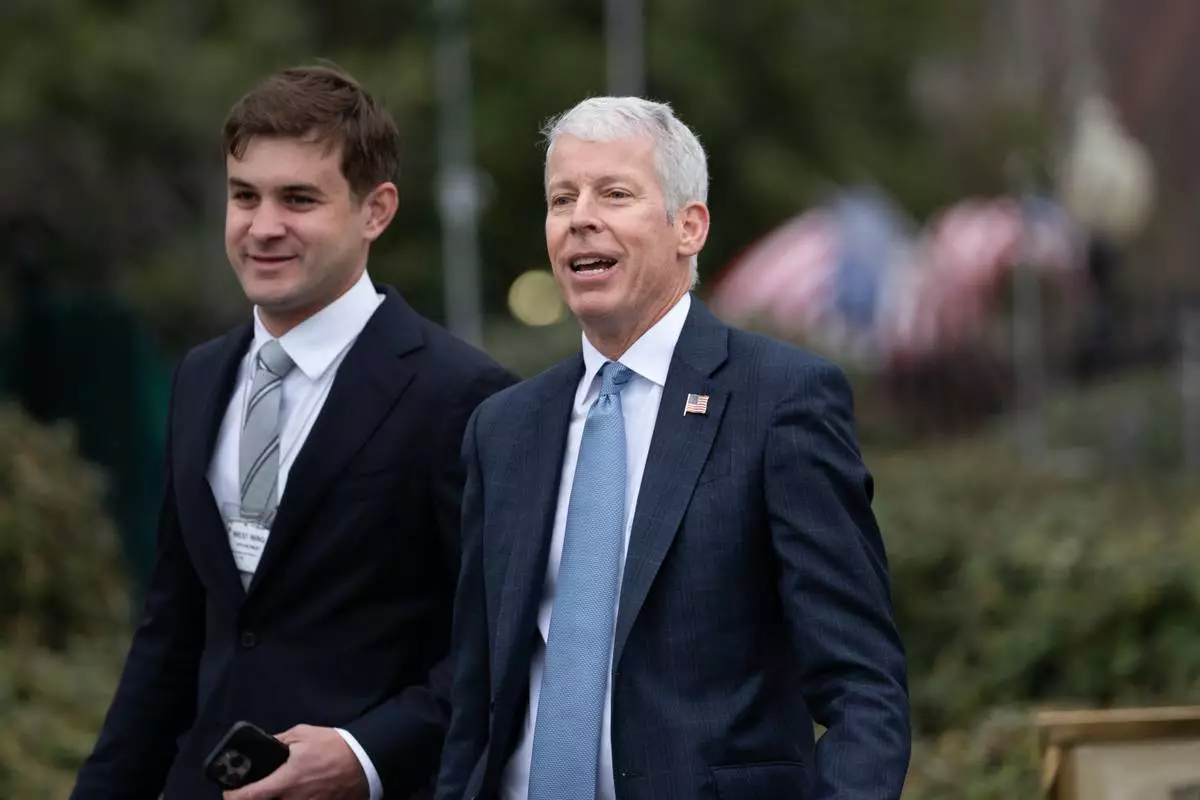
Energy Secretary Chris Wright walks to the White House following an interview with CNN, Thursday, March 12, 2026 in Washington. (AP Photo/Allison Robbert)
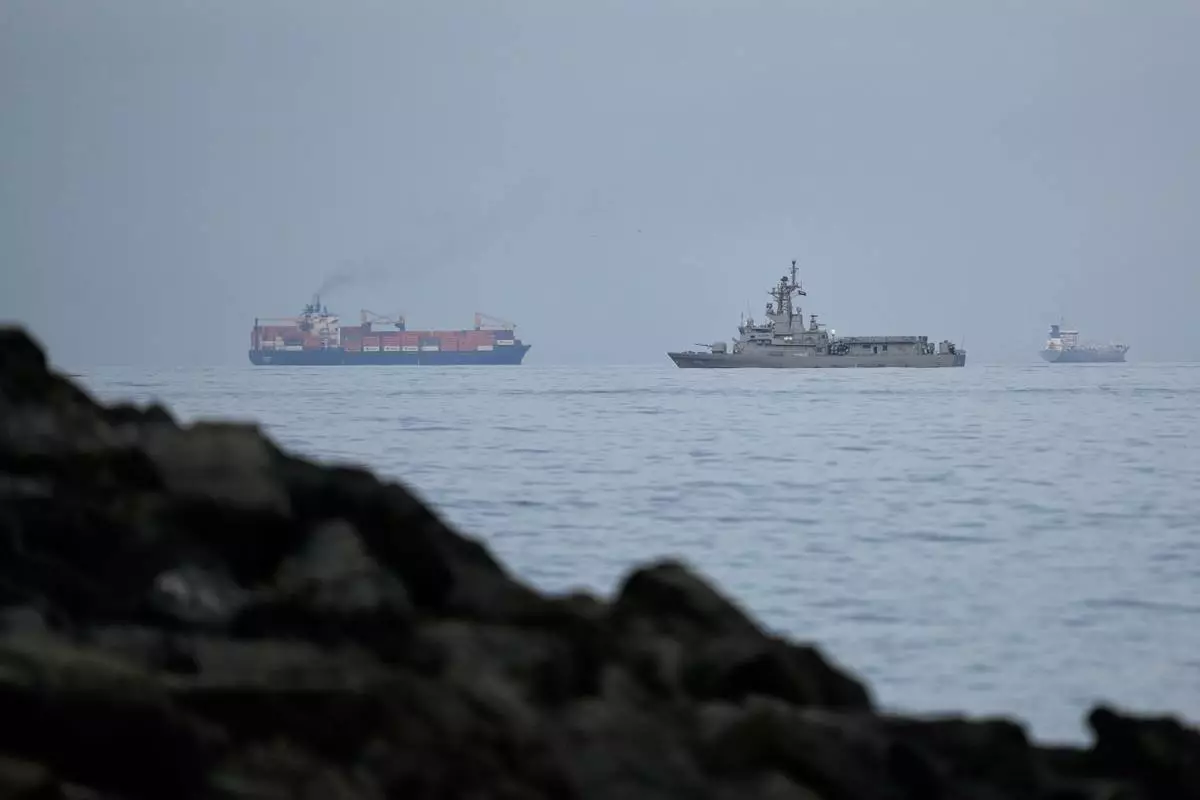
A UAE navy ship sails next to a cargo ship in the Strait of Hormuz as seen from Khor Fakkan, United Arab Emirates, Wednesday, March 11, 2026. (AP Photo/Altaf Qadri)
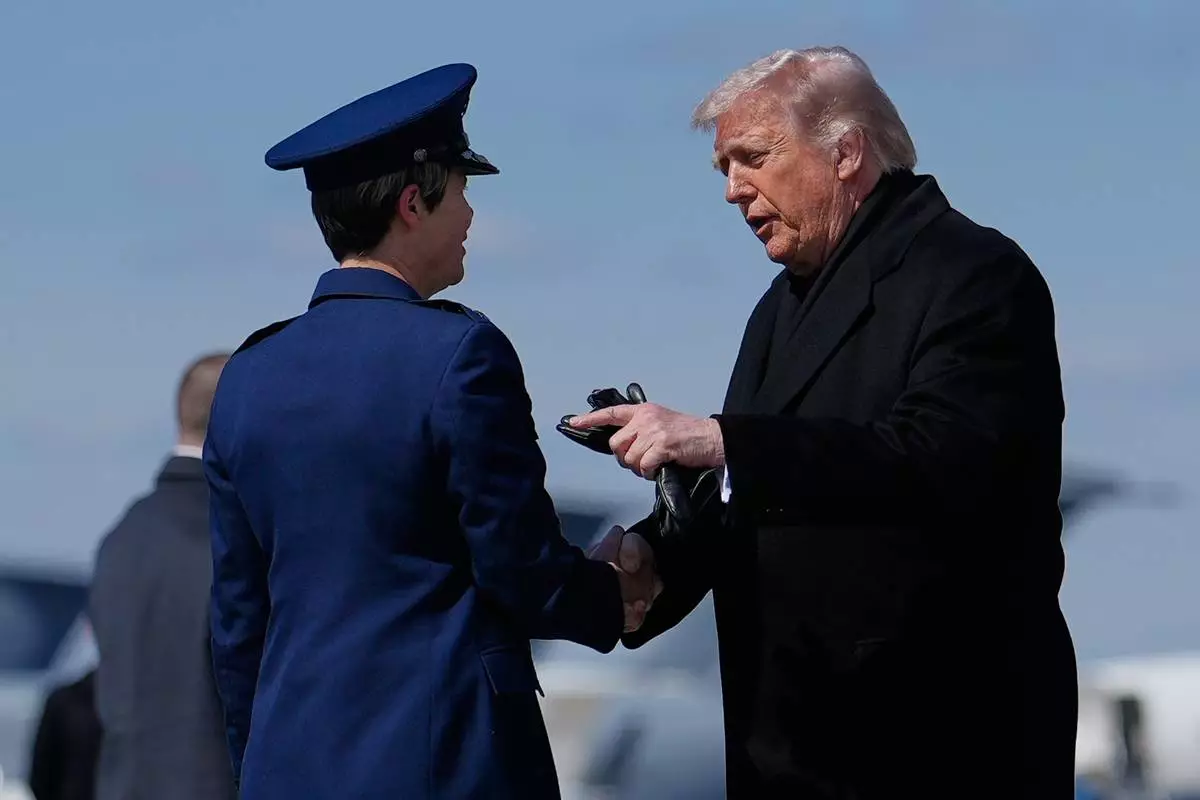
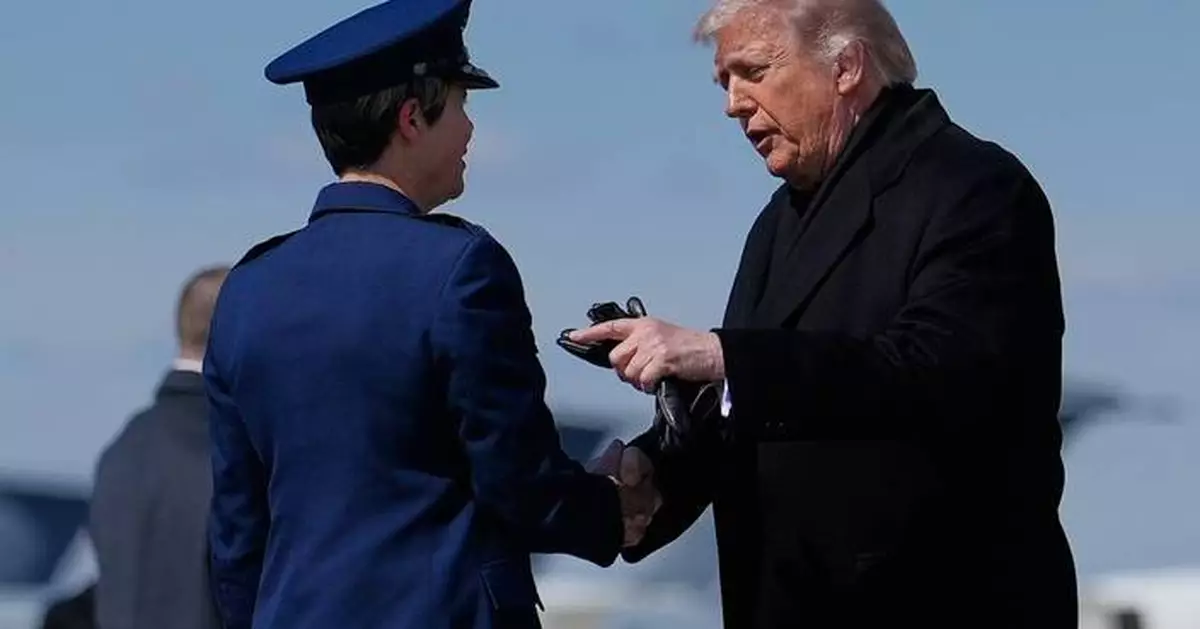
President Donald Trump greets Col. Matha "Jeannie" Sasnett, commander of Air Force Mortuary Affairs, as he arrives on Air Force One, Wednesday, March 18, 2026, at Dover Air Force Base, Del., to attend the casualty return for the six crew members of an Air Force refueling aircraft who died when their plane crashed in western Iraq while supporting operations against Iran. (AP Photo/Julia Demaree Nikhinson)