Hundreds of thousands of mourners on Wednesday gathered in the Iranian capital city of Tehran to participate in the funeral procession honoring the martyrdom of Iranian sailors, as well as one of the country's top security official Ali Larijani and senior commander Gholamreza Soleimani, who were killed in separate Israeli attacks.
Many residents arrived ahead of the ceremony to pay their respect to the 84 navy personnel aboard Iran's Dena frigate sunken by the U.S. military on March 4, as well as Larijani, secretary of Iran's Supreme National Security Council (SNSC), and Soleimani, chief commander of the voluntary Basij force of the Islamic Revolution Guards Corps (IRGC), who were assassinated in Israeli strikes on Tehran on Tuesday.
The funeral procession witnessed one of the largest public gatherings in Tehran in recent weeks, with crowds filling the streets from early Wednesday morning.
The event was also attended by the families of the dead officials and navy sailors, government officials, and military leaders.
On Feb 28, Israel and the United States launched joint attacks on Tehran and several other Iranian cities, killing the country's supreme leader, high-ranking military commanders and civilians. Iran responded with several waves of missile and drone attacks targeting Israel and U.S. assets and bases in the Middle East.
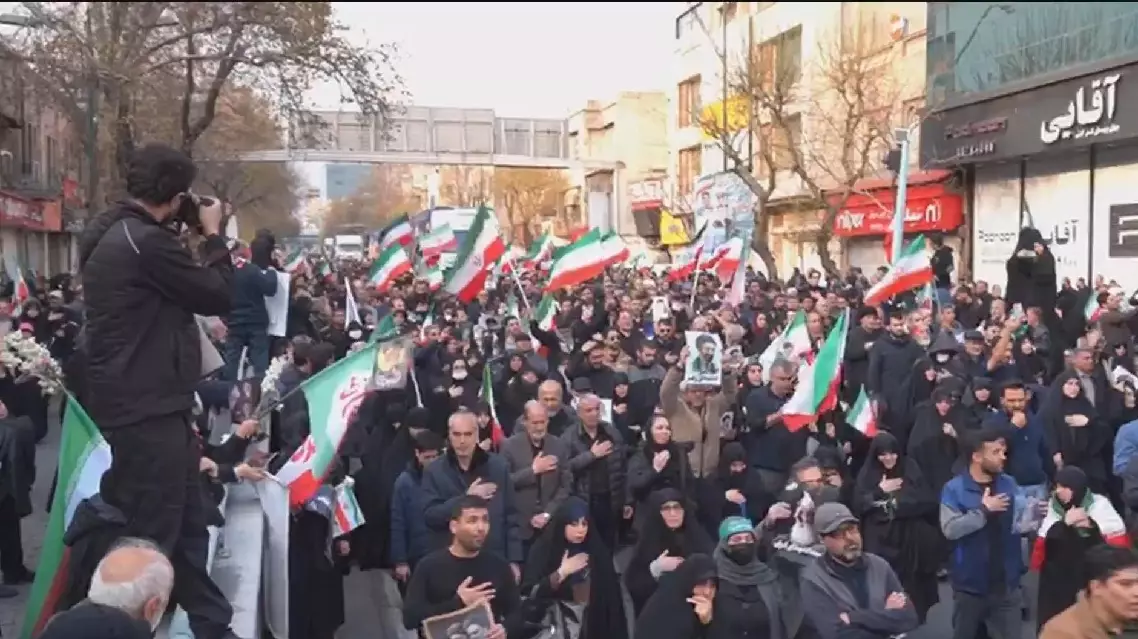
Iranians attend funeral procession for navy sailors, slain senior officials Larijani, Soleimani
The United Nations (UN) is opposed to anything that "could constitute extrajudicial execution" and urged all relevant parties to avoid further escalation of the Middle East conflict, said Farhan Haq, deputy spokesman for UN Secretary-General Antonio Guterres at a press conference in New York City on Wednesday.
Haq was responding to a media query about the killing of Ali Larijani, secretary of Iran's Supreme National Security Council, and Iran's Intelligence Minister Esmail Khatib, in Israeli attacks earlier this week.
The assassinations of Khatib and Iran's top security official Larijani were confirmed by the Iranian government on Wednesday and Tuesday, respectively.
Haq also briefed the press about Guterres' ongoing visit to Brussels, during which the Secretary-General will hold meetings with European Union (EU) leaders on UN-EU ties and global hotspot issues, such as the conflict in the Middle East and the Ukraine crisis.
"The Secretary-General arrived in Brussels earlier this morning for a series of meetings, including with European Union officials. He met earlier this afternoon with Maxime Prevot, Deputy Prime Minister and Minister of Foreign Affairs, European Affairs and Development Cooperation of Belgium. The Secretary-General then began his meetings with European Union officials, starting with Roberta Metsola, the president of the European Parliament. The Secretary-General and the president discussed the partnership between the United Nations and the European Union. They also discussed a number of crises around the world, including the situation in the Middle East and the ongoing war in Ukraine," said Haq.
"The Secretary-General will travel to the seat of the European Commission for discussions with Ursula von der Leyen, President of the European Commission. And later, the Secretary-General will meet with Antonio Costa, President of the European Council, and also have a working dinner with Mr. Costa," he said.
On the killing of a string of senior Iranian officials, Haq expressed the UN's opposition to illegal military strikes and repeated its call for a de-escalation of the conflict in the Middle East.
"First of all, as a point of principle, the United Nations is opposed to anything that could constitute extrajudicial execution, and that's true in all such cases, But beyond that, we do not believe that there is a military solution to this problem and we reiterate our call to Israel, to the United States, to Iran, and to any other parties to avoid any further escalation of this conflict," he said.
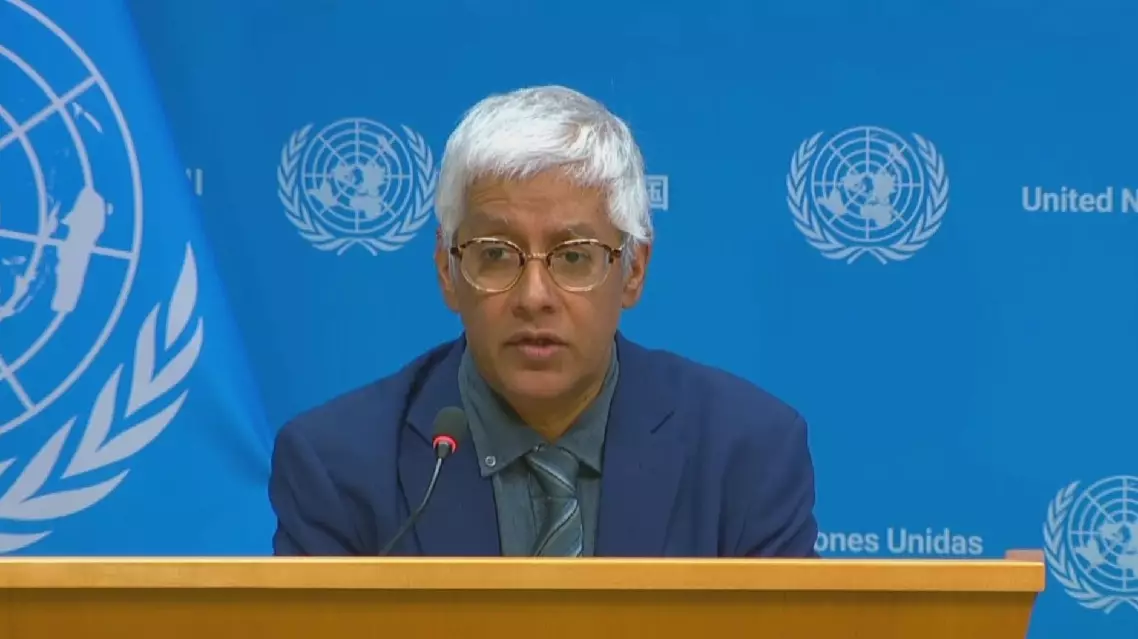
UN opposes 'extrajudicial execution', urges de-escalation of Middle East conflict: deputy spokesman