China is accelerating efforts to make a high-tech future become a present-day reality through advancing AI-driven development, with major breakthroughs in humanoid robotics, autonomous transport and the emerging low-altitude economy all set to be boosted by increased policy support in the coming years.
While already being a global leader in renewable energy and electric vehicles, Chinese lawmakers and political advisors renewed calls for greater scientific and technological advancement during the recent "two sessions" political meetings held in Beijing earlier this month.
The closing day of the meetings last Thursday saw the approval of the outline of China's 15th Five-Year Plan period (2026-2030), a key blueprint mapping out the country's development policy priorities through to the end of the decade.
Cutting-edge technologies are set to be a core focus of the new planning cycle, with a clear goal of integrating these tech breakthroughs across various sectors in order to improve the quality of life of people up and down the country.
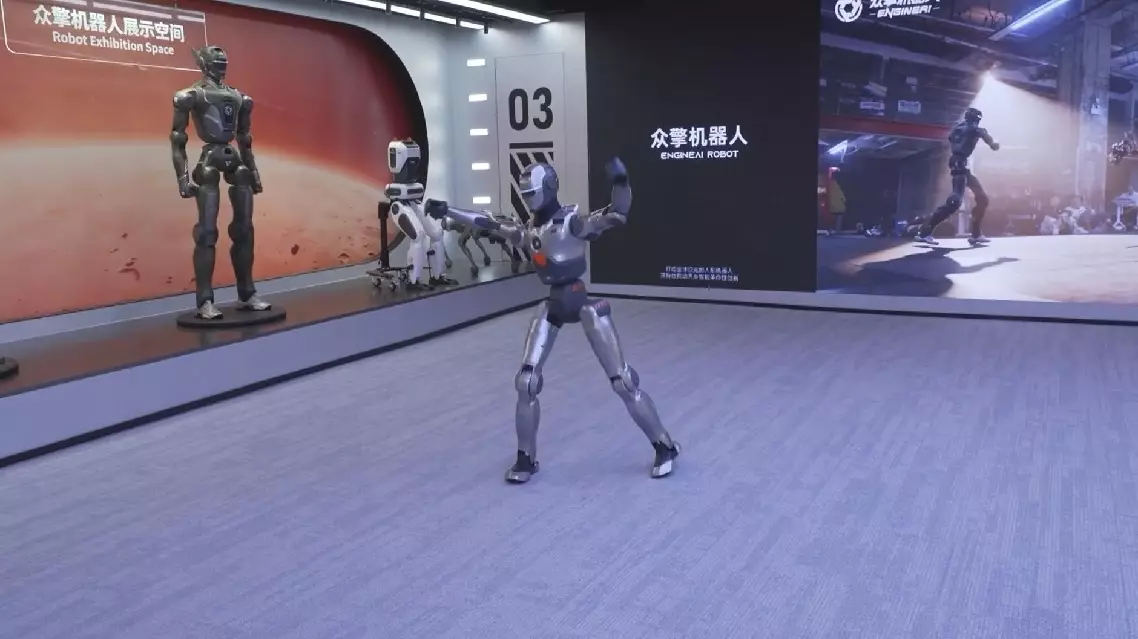
While Chinese-made humanoid robots have drawn widespread public attention for their impressive, human-like movements, from demonstrating their dancing skills in front of a massive television audience to navigating complex environments, these innovations represent far more than entertainment.
They offer a clear glimpse into China's future, underpinned by high-quality development, industrial self-reliance, and new leaps forward in artificial intelligence.
Evan Yao, co-founder and marketing general manager of Chinese robotics start-up EngineAI, said China has distinguished itself and emerged as a global leader in motion control in the humanoid robotics sector.
He stressed that 2025 will be remembered as the year of robot mass production, which marked a pivotal moment for the sector to take its next critical developmental step into everyday deployment.
"So in this year 2026, you will see a lot of the robots are really doing some work in the factory, in shopping malls, or in the street," Yao predicted.
Amid such rapid development, public concerns have been raised over the safety of humanoid robots and the usage of autonomous systems, but Yao said work is ongoing to refine these elements.
"We want the [robots to have] a very healthy body, and have a strong body, and not easy to destroy. Or if there's an accident that happens, or if they fall down, they can recover by themselves very quickly," he said.
Beyond industrial and service robotics, AI innovation is also reshaping China's entire transport sector. The technology first serves as an extra set of eyes and hands for authorities working to monitor and manage the country's busy road traffic networks.
Autonomous driving technology, meanwhile, is no longer a concept of the distant future. Fully driverless taxis are now already up and running in multiple districts of the southern metropolis of Shenzhen, bringing AI-powered commuting to the general public.
For first-time riders, the experience is more intuitive than expected, and though many may need time to get used to a steering wheel moving with no driver at the helm, passengers are happy to enjoy smooth and safe trips.
Looking further ahead, not all commuter traffic may be limited to the ground level. China is also gearing up for the rise of the fledging low-altitude economy -- which refers to all economic activities in airspace below 1,000 meters -- with flying cars emerging as a key frontier of next-generation transport.
AI is plays an irreplaceable role in this field, especially for fully pilotless flying vehicles, which require advanced supporting communication systems and infrastructure to operate safely. With heavy top-down national investment in these future-focused technologies, many believe commuters could be traveling above crowded city roads in less than a decade.
These wide-ranging advancements across robotics, autonomous transport and the low-altitude economy underscore China's broader push to solidify its high-tech development, anchored by its unwavering commitment to artificial intelligence innovation as a core driver of inclusive growth and improved public livelihoods.
China accelerates AI-driven development to make sci-fi future become present day reality