MADISON, Wis. (AP) — A second Republican leader in the Wisconsin Legislature announced on Thursday he will not seek reelection this fall, another sign of the seismic shift in politics in the key battleground state as Democrats get increasingly optimistic about gaining a majority.
The two highest-ranking Republicans in the Legislature are retiring, along with the Democratic governor, soon after district boundaries were redrawn in favor of Democrats, who believe they can win a majority in the state Senate.
Republican Senate Majority Leader Devin LeMahieu became the latest GOP leader to retire, announcing Thursday that he would not seek a fourth term. That came after Assembly Speaker Robin Vos, the longest-serving speaker in Wisconsin history, announced his retirement last month.
“The time has come for a new chapter in my life,” LeMahieu said in a statement announcing his decision. He did not say what he planned to do next. LeMahieu was first elected in 2014 and was chosen as Republican leader of the Senate in 2020.
A series of Wisconsin Republicans have announced their plans to retire rather than run this fall in what is expected to be a challenging year for the GOP around the country.
Wisconsin Democratic Party Chair Devin Remiker said LeMahieu and Vos’ retirements serve as a warning to other Republicans.
“All potential Republican candidates should take note: Both of your leaders have abandoned you,” he said.
In addition to several Republican lawmakers who are not seeking reelection, a conservative state Supreme Court justice announced last week that she would not run again in 2027. That comes after another conservative justice decided against running this year, creating an open race that will be decided on April 7.
Republicans took control of the Legislature in 2011 and newly elected Republican Gov. Scott Walker signed new legislative maps into law that year that allowed the GOP to grow their majorities over the next decade.
Wisconsin became the center of the nation’s conservative movement in the 2010s, with Walker and the Republican Legislature enacting a wide range of conservative priorities, including effectively ending collective bargaining for most public workers, slashing taxes and requiring photo identification to vote.
But liberals were able to win a majority on the Wisconsin Supreme Court in 2023, and in December that year the court overturned the GOP-drawn legislative maps. The new lines signed into law in 2024 by Democratic Gov. Tony Evers allowed Democrats to chip into the majorities with the goal of flipping one or both houses this year.
Democrats need to pick up just two seats to have a majority in the Senate and five in the Assembly.
LeMahieu’s decision shows that Republicans know that the Wisconsin Senate is “the most flippable chamber in the country," said Will Karcz, spokesperson for the committee working to elect Democrats to the state Senate.
“There are no two ways about it: Senate Republicans see the writing on the wall,” Karcz said.
The governor's race is open for the first time in 16 years thanks to Evers' decision to retire. Republican U.S. Rep. Tom Tiffany, who has President Donald Trump's endorsement, is the presumptive GOP nominee. There are seven high profile Democrats running. The primary is in August.
Evers praised LeMahieu’s “patience and persistence,” saying he was able to put politics aside and focus on “doing the right thing.”
Just this week Evers signed bills into law that LeMahieu supported to expand Medicaid coverage for postpartum mothers and cover additional cancer screenings for women with dense breast tissue. LeMahieu and Republicans also worked with Evers to spend money on fighting PFAS chemicals, expand state funding for local communities and keep the Milwaukee Brewers baseball team in Wisconsin.
But under LeMahieu the state’s premiere land conservation program died this year due to lack of funding as did a bipartisan deal to continue funding a public affairs network that is Wisconsin’s version of C-SPAN.
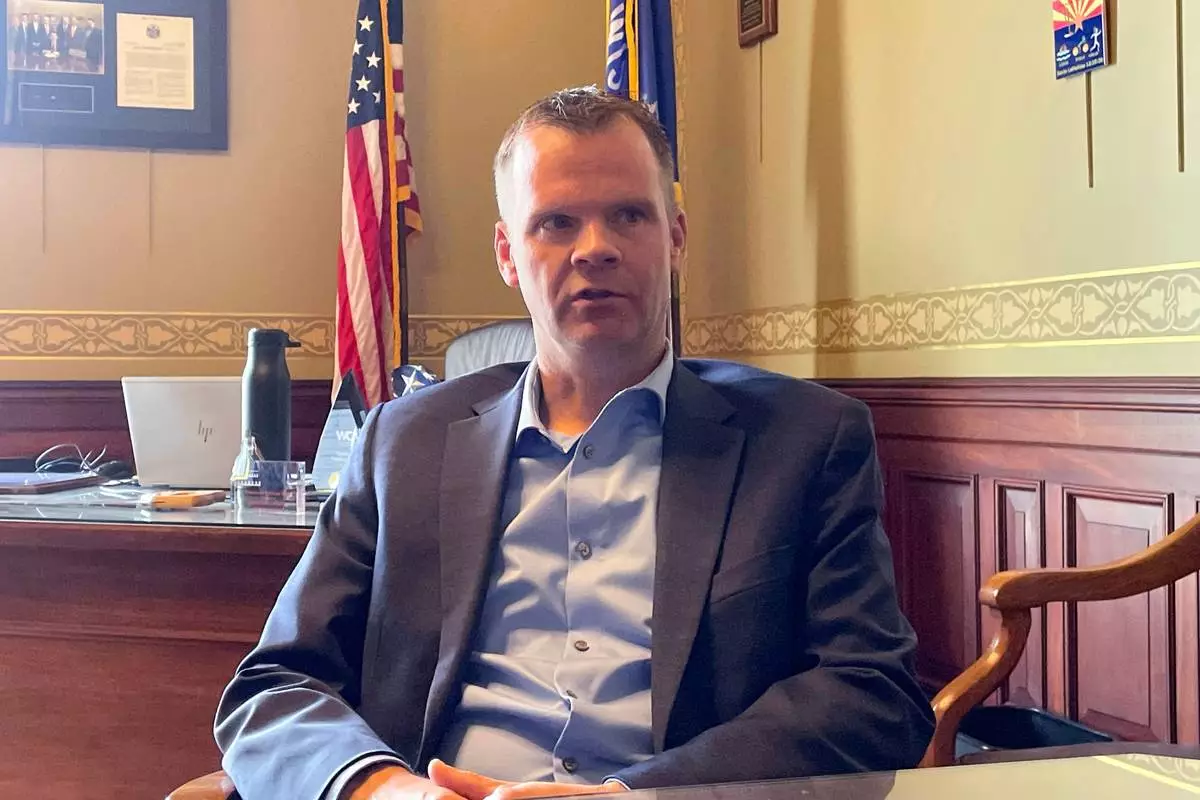
FILE - Wisconsin Senate Majority Leader Devin LeMahieu speaks during an interview with the Associated Press, Dec. 6, 2023, in Madison, Wis. (AP Photo/Harm Venhuizen, File)