Skip to Content Facebook Feature Image

Tons of aid flows into Cuba as humanitarian convoy arrives on the struggling island

News

Tons of aid flows into Cuba as humanitarian convoy arrives on the struggling island
News

News

Tons of aid flows into Cuba as humanitarian convoy arrives on the struggling island

2026-03-21 07:02 Last Updated At:07:11

HAVANA (AP) — Some 650 delegates from 33 countries and 120 organizations began arriving in Cuba on Friday as part of a solidarity caravan transporting some 20 tons of humanitarian aid as the island grapples with a severe energy crisis.

Members of “Our America Convoy to Cuba” arrived by air from Italy, France, Spain, the United States and several Latin American countries, and more are scheduled to arrive by sea on Saturday in a flotilla of three vessels from Mexico, organizers reported.

A group of activists arrived in Havana on Wednesday in advance and delivered donations to hospitals.

The visit comes amid heightened tensions between Cuba and the United States, whose governments have acknowledged holding talks after U.S. President Donald Trump imposed an oil embargo. Earlier this week, Trump said he expected to have the “honor” of “taking Cuba in some form,” adding: “I can do anything I want.”

Solar panels, food and medicine to treat cancer are among the products donated to the island, which has been brought to a near standstill since Trump imposed an energy embargo in January, exacerbating a five-year economic crisis as his administration pressures for a change in the political system.

“In the end, we are dozens and dozens of delegates, and we represent millions of people in this convoy,” said David Adler, a U.S. citizen and coordinator of Progressive International, one of the caravan’s organizers. “We cannot allow this collective punishment. We cannot normalize it.”

Meanwhile, Cuban Deputy Foreign Minister Carlos Fernández de Cossío on Friday refuted comments about a change in the political system or the potential departure of Cuban President Miguel Díaz-Canel as part of the ongoing talks between the two sides.

“The Cuban political system is not up for negotiation, nor is the president, nor the position of any official in Cuba, subject to negotiation with the United States or with the government of any other country,” said Fernández de Cossío.

He noted there are many areas of common interest on which dialogue with Washington is possible, as has been done in the past.

Manolo de los Santos, of The People’s Forum — another of the caravan’s organizers — said that going to Cuba at this time is not only “defying the U.S. blockade,” but also preventing “another Gaza in the Americas."

Several analysts and regional leaders, including Mexican President Claudia Sheinbaum, have warned of a possible humanitarian crisis in Cuba.

Adler said that both the flotilla that traveled to Gaza and the one heading to Cuba share several supporters. In the case of Cuba, in addition to social activists, unions, prominent figures and political parties are represented, including Morena from Mexico, the Workers’ Party of Brazil and the Broad Front of Uruguay.

Some of the figures include British Parliamentarian Jeremy Corbyn; Colombian Senator Clara López; former Spanish politician Pablo Iglesias; U.S. labor leader Chris Smalls; and Brazilian humanitarian activist Thiago Ávila.

After several weeks in which the only aid received by Cuba came from Mexico, which sent food and hygiene products on three occasions, activists and leaders in other countries began establishing support groups and collecting donations.

Díaz-Canel expressed his gratitude on social media.

“They bring shipments of aid to combat the attempt to suffocate us. Welcome once again to the compassion of the people. Solidarity always returns to those who practice it with no other interest than human well-being,” the president stated.

For its part, Brazil announced it would send 20,000 tons of food, primarily rice, beans and powdered milk. A group of Chilean parliamentarians also arrived with aid on Thursday, and China reported through its embassy that a ship carrying 60,000 tons of rice set sail for Cuba.

Follow AP’s Latin America coverage at https://apnews.com/hub/latin-america

CODEPINK co-founder Medea Benjamin speaks with the press after arriving at the airport with other activists as part of the "Nuestra America," or Our America Convoy, in Havana, Cuba, Friday, March 20, 2026. (AP Photo/Ramon Espinosa)
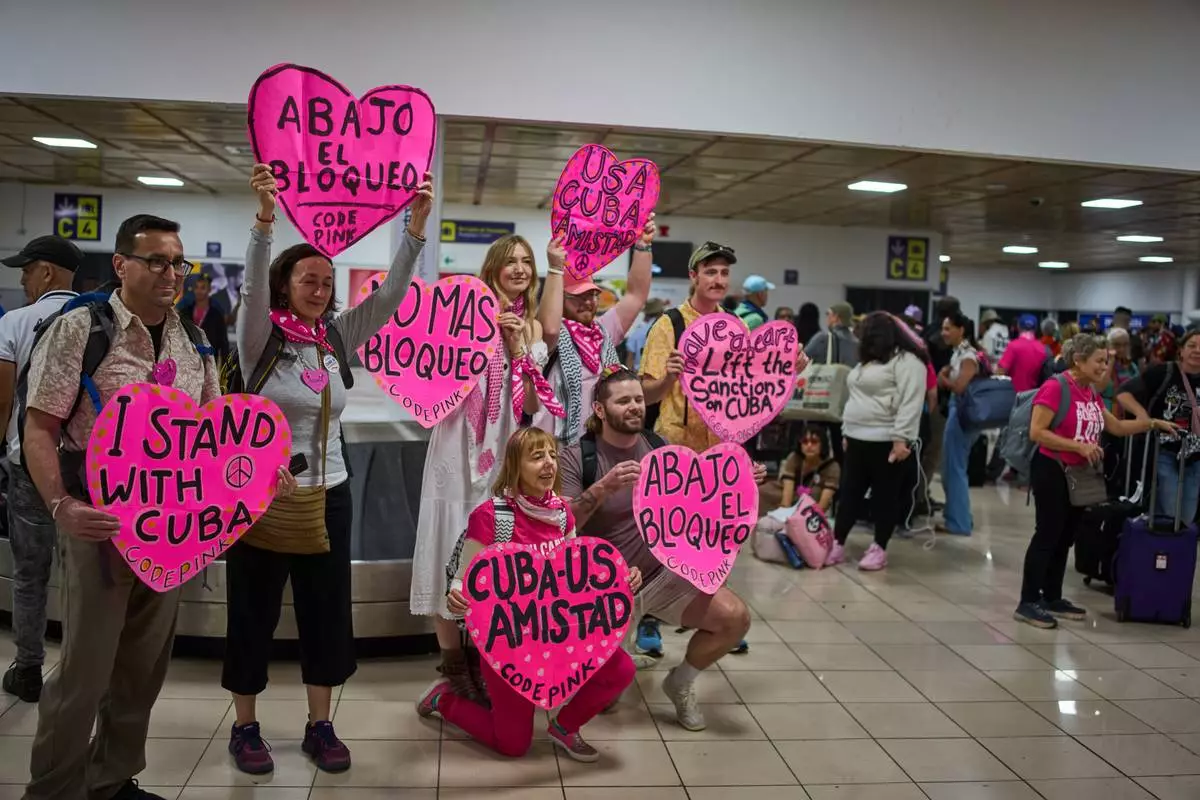
CODEPINK co-founder Medea Benjamin speaks with the press after arriving at the airport with other activists as part of the "Nuestra America," or Our America Convoy, in Havana, Cuba, Friday, March 20, 2026. (AP Photo/Ramon Espinosa)

Activists from CODEPINK, including co-founder Medea Benjamin, kneeling center, and others hold signs as part of the "Nuestra America," or Our America Convoy after landing at the airport in Havana, Cuba, Friday, March 20, 2026. (AP Photo/Ramon Espinosa)
Activists from CODEPINK, including co-founder Medea Benjamin, kneeling center, and others hold signs as part of the "Nuestra America," or Our America Convoy after landing at the airport in Havana, Cuba, Friday, March 20, 2026. (AP Photo/Ramon Espinosa)

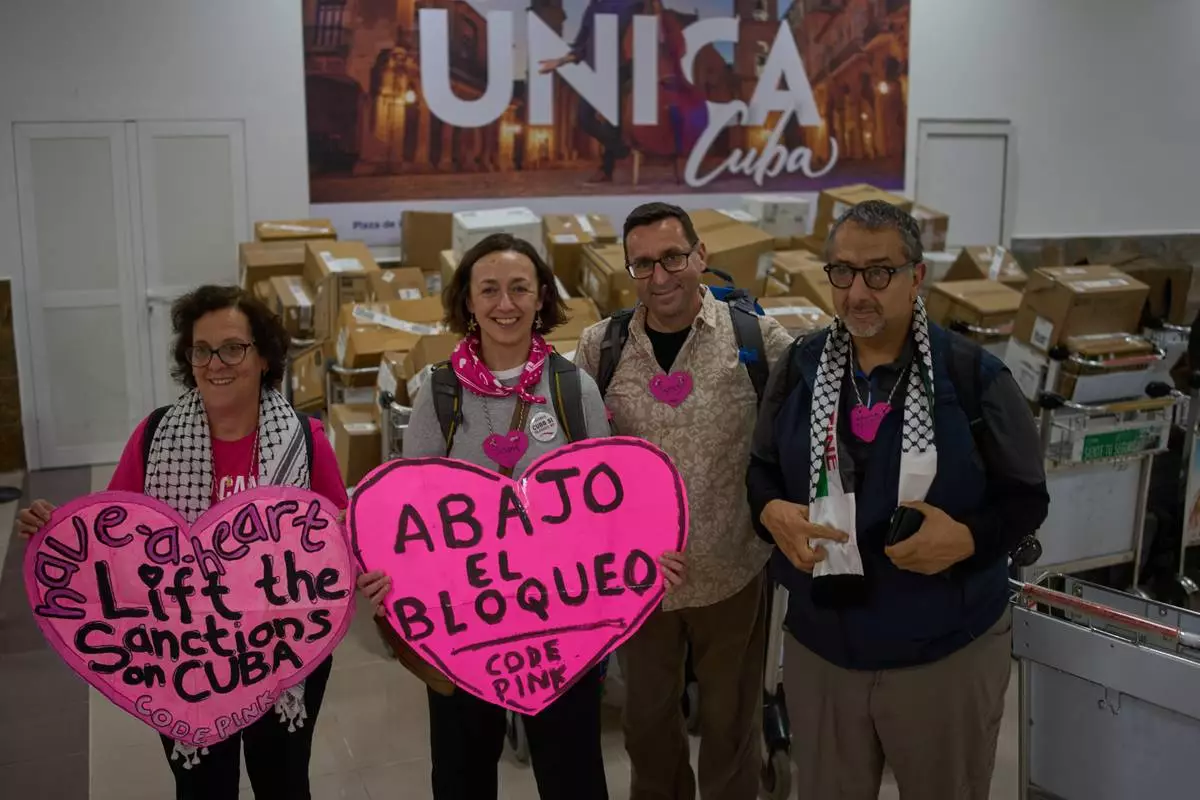
CODEPINK activists hold signs in front of boxes of aid they brought as part of the "Nuestra America," or Our America Convoy, after landing at the airport in Havana, Cuba, Friday, March 20, 2026. (AP Photo/Ramon Espinosa)


CODEPINK activists hold signs in front of boxes of aid they brought as part of the "Nuestra America," or Our America Convoy, after landing at the airport in Havana, Cuba, Friday, March 20, 2026. (AP Photo/Ramon Espinosa)

SPRINGFIELD, Ill. (AP) — The Chicago Transit Authority on Friday filed a federal lawsuit seeking restoration of $2 billion in commuter rail expansion funding that President Donald Trump's administration stopped last fall.

The action, filed in U.S. District Court in Chicago, contends the administration acted arbitrarily in halting transit construction money for the city in an effort to restrict race- and gender-based contracting, which it believes is unconstitutional. It names the U.S. Department of Transportation and the Federal Transportation Authority as defendants.

The Transportation Department responded that it is trying to choke off a “discriminatory” and “illegal” contracting process.

The lawsuit comes days after New York City authorities filed a lawsuit seeking resumption of similar federal transit funding to the tune of $60 million.

Critically affected in Chicago is a 5.3-mile (8.5 kilometer) extension of the Red Line of the elevated L rail system with four train stops to reach 100,000 additional residents in disadvantaged and largely Black neighborhoods. Additionally, the federal dollars had been financing continued work on a North Side project that replaced century-old rails and built four new, accessible stations.

"We are fully committed to the success of these projects, and we will take every step necessary to ensure that they move forward,” CTA Acting President Nora Leerhsen said in a statement. “The Red Line extension is a historic investment into the far South Side of Chicago that will transform public transit and create new economic opportunity for the communities it will serve."

In September, the Trump administration wrote a new rule removing race- and gender-based contracting preferences but applied the rule retroactively only to grants to Chicago and New York, according to the lawsuit. The grant funding was paused on Oct. 3, 2025, and the CTA provided requested documentation a few weeks later.

The Transportation Department requested additional records in December, and since the CTA responded, there has been no further communication, according to the lawsuit, which calls the government's actions “unlawful many times over.”

It complains that the holdup penalizes the CTA for following the rules in place at the time and for failing to “explain why grants to the hundreds of other projects nationwide” that were following the same rules saw no interruption in funding.

The Transportation Department said in an email that it will fight “discriminatory, illegal, and wasteful contracting practices.”

“The American people don’t care what race or gender construction workers, pipefitters, or electricians are,” the department said. "They just want these important projects built quickly and efficiently.”

FILE - Cars pass the 95th Street Red Line Station, the train station currently the farthest south on the line and where the Chicago Transit Authority plans to extend from in 2025, Thursday, Dec. 19, 2024, in Chicago. (AP Photo/Erin Hooley, File)

FILE - Cars pass the 95th Street Red Line Station, the train station currently the farthest south on the line and where the Chicago Transit Authority plans to extend from in 2025, Thursday, Dec. 19, 2024, in Chicago. (AP Photo/Erin Hooley, File)

FILE - A train pulls into the Clark Street and Lake Street Blue Line on Tuesday, Nov. 18, 2025, in Chicago. (AP Photo/Erin Hooley,File)

FILE - A train pulls into the Clark Street and Lake Street Blue Line on Tuesday, Nov. 18, 2025, in Chicago. (AP Photo/Erin Hooley,File)

Recommended Articles