The targeted killings of Iran's top leadership, including security chief Ali Larijani, have significantly narrowed diplomatic options and may push the country toward a more hawkish posture, according to a political analyst.
Tensions between Iran and Israeli-U.S. forces have continued to escalate, as a series of targeted strikes killed several high-ranking Iranian officials in recent days.
Among them were Secretary of the Supreme National Security Council (SNSC) Ali Larijani, Gholam-Reza Soleimani, chief commander of the voluntary Basij force of the Islamic Revolutionary Guard Corps, and Intelligence Minister Esmaeil Khatib.
Larijani was widely seen as a pragmatic and experienced politician who played a central role in nuclear negotiations and was viewed by many as a bridge between Iran and the West.
Iran's Supreme Leader, Mojtaba Khamenei, has vowed that those responsible will soon have to pay.
In an interview with China Global Television Network (CGTN), Foad Izadi, a political analyst, suggested that the killing of Ali Larijani may represent an effort to eliminate any remaining hopes for diplomatic engagement between Iran and the United States.
"He was a moderate [politician]. He basically wanted to make sure that Iran and the United States reach a political agreement. And I think the reason Israelis killed him was because Israelis don't want Iran and the United States to reach a political agreement. So, he was one of the people who could manage that between the political establishment here. And this is very logical: if these people are killed, the people who will replace individuals like Mr. Larijani will become more hawkish," Izadi said.
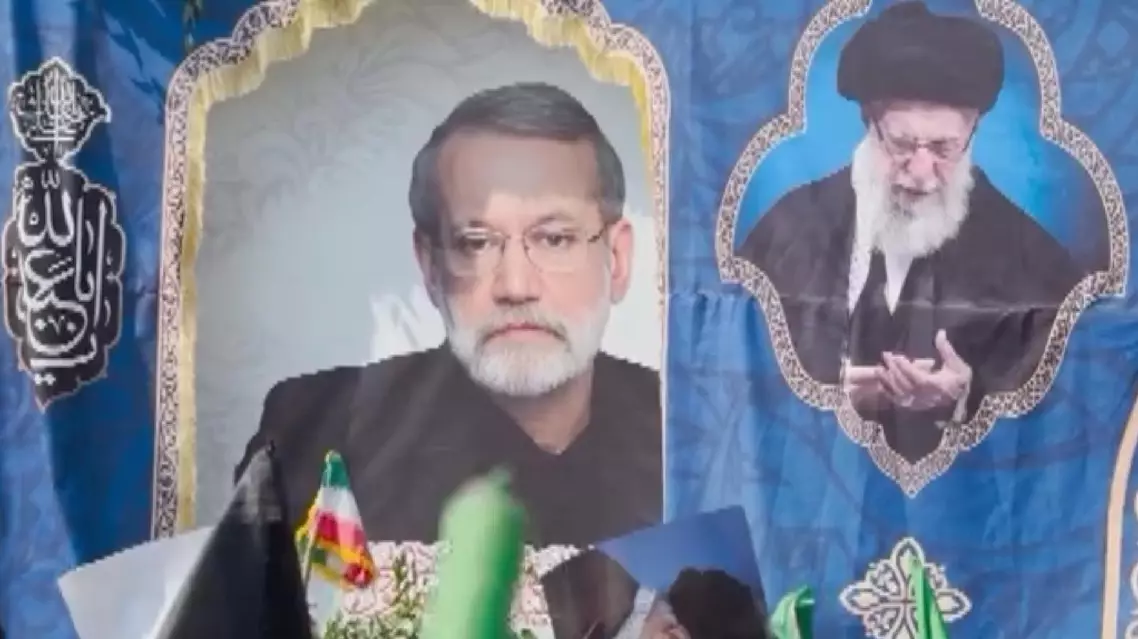
Funerals for Larijani and Basij commander Gholam-Reza Soleimani were held in Tehran, drawing a large number of mourners. They expressed both grief and anger, vowing revenge against the United States and Israel.
On Feb. 28, Israel and the United States launched joint attacks on Tehran and several other Iranian cities, killing the country's supreme leader, senior military commanders and civilians. Iran responded with waves of missile and drone attacks targeting Israel and U.S. assets in the Middle East.
Killing of Iran's top security officials narrows diplomatic path: political analyst
China's top diplomat Wang Yi said on Friday that one of the top priorities at present is to contain the spread of the conflict and prevent further involvement of other countries.
Wang, also a member of the Political Bureau of the Communist Party of China Central Committee and director of the Office of the Central Commission for Foreign Affairs, made the remarks in a phone conversation with Emmanuel Bonne, diplomatic adviser to the French president, at the latter's request.
Wang elaborated on China's position, saying that the current situation in the Middle East is still deteriorating, with the conflict continuing to spread. This has not only undermined the stability of global energy supply but also led to a severe humanitarian crisis.
Resorting to force will not solve the problem, and an unjust war should not be allowed to continue, he said.
In the face of the critical situation, China and France, as permanent members of the UN Security Council, should strengthen strategic communication and coordination, firmly uphold the UN Charter and international law, and prevent the world from regressing to the "law of the jungle," Wang said.
He added that the other two top priorities are for the international community to speak with one voice in calling for an immediate ceasefire and to intensify efforts to advance peace talks, and for the United Nations and the UN Security Council to play their due role in facilitating the early restoration of peace and stability in the region.
Despite the difficulties, dialogue and negotiation remain the right path out of the crisis, Wang said, adding that China and France should work together toward this end.
For his part, Bonne shared his perspectives on the current situation in the Middle East, including developments in Iran and Lebanon.
He said that France and China, as major countries, both support the United Nations, abide by international law, and advocate resolving differences through dialogue.
He said that the two countries should work together to explore solutions and contribute to easing tensions and resuming negotiations.
France is willing to enhance communication and cooperation with China to push for the early achievement of peace and stability in the Middle East, he added.
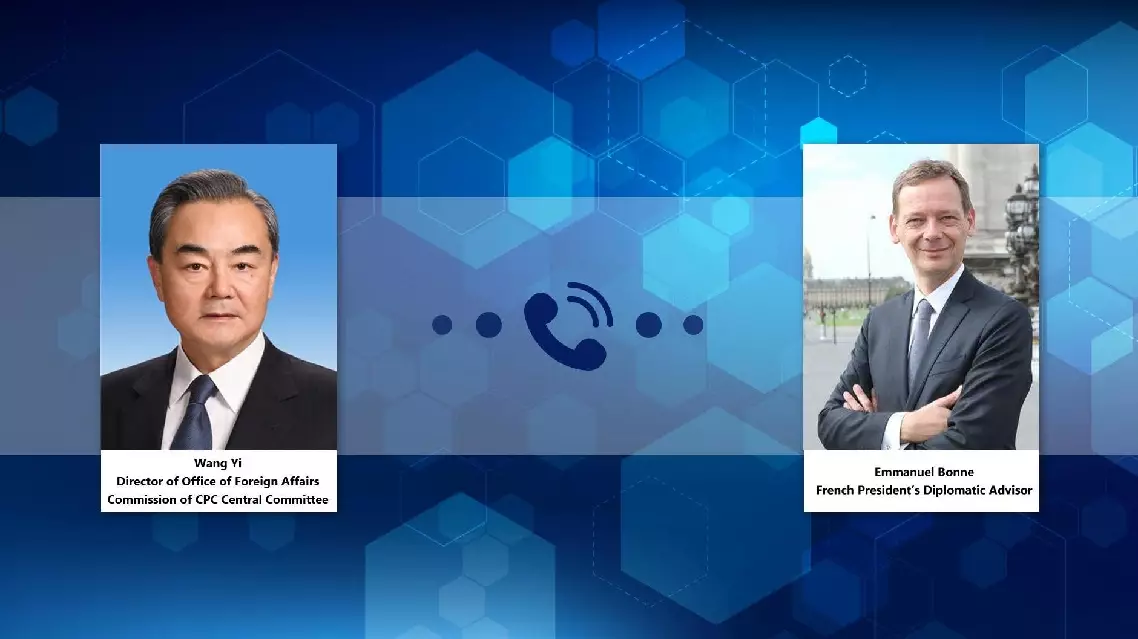
China's top diplomat urges efforts to prevent escalation in Mideast conflict