China's leading film technology suppliers shared their insights on how cinematic innovation is powering industries beyond the screen.
The shift is embodied in the "Movie Plus" concept, which moves beyond a sole focus on box office performance to the broader industry ecosystem.
Li He is a veteran special shoots director who's worked on countless films. But years ago, he hit a wall -- one built by foreign equipment manufacturers.
"In the early days, I worked with foreign equipment and crews. We talked a lot, but they kept saying it couldn't be done, or that 'you don't understand film, you don't understand technology'," said Li, founder of G-ka Robotics Technology.
Li, however, sees it differently: technology should never stand in the way of creativity.
"If high technology restricts thinking, then it's not real technology. True high-tech doesn't limit - it opens a whole new space for more people, including artists and creators," he said.
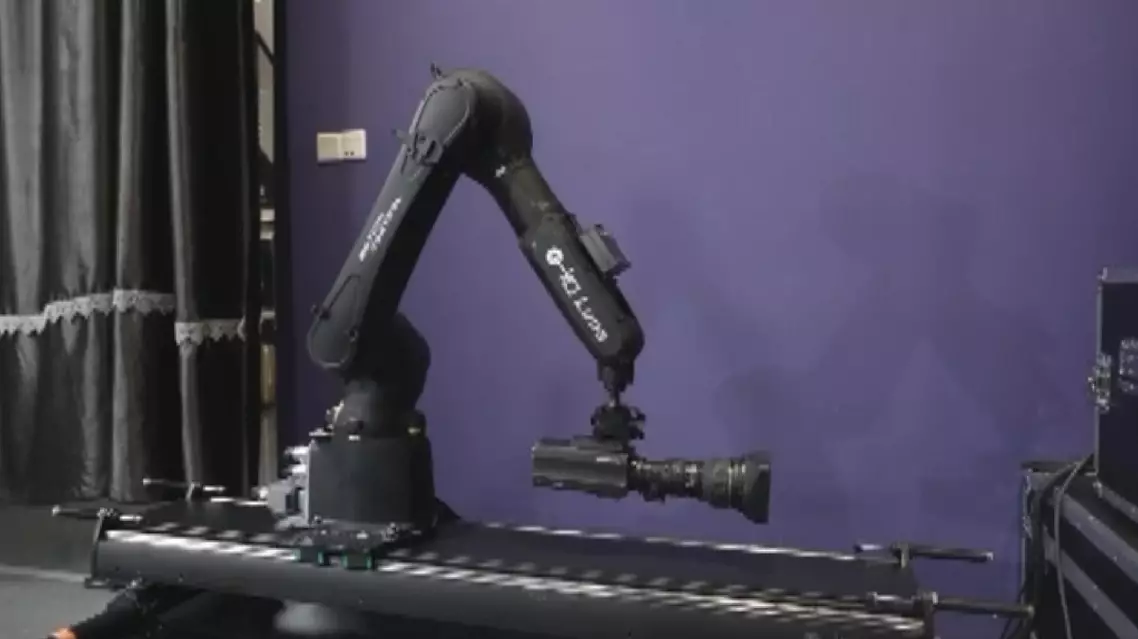
With his deep knowledge of filmmaking and the incredible supply chain in China, Li began developing equipment such as a high-end cinematic motion-control robotic arm. These products deliver complex camera shots with a precision and speed that humans can hardly match. And that's not all.
This technology is not confined to film sets, and it is spreading fast.
Now, the same tech that films movies is also filming tourists at scenic spots. Scan a code, and a robot captures your personal "movie moment." In universities, film students practice on the exact same robots they will use on tomorrow's big sets. And e-commerce merchants are using those dynamic shots to showcase their products and boost sales.
If robots are the bones of a film, light is its soul.
Xie Yi, CEO of one of the world's top professional imaging equipment providers, saw a shift coming.
"What people are doing now is taking the kind of complex lighting you normally see in film production and making it simple enough for everyday use," said Xie, CEO of Aputure Imaging Industries Co., Ltd.
The secret of this technological democratization is its modular design.
"You can get 80 to 90 percent of the effect just by setting it up. In filmmaking, you might chase that last five to 10 percent, but for most real-world uses, 80 percent is already more than enough," Xie said.
This is China's "film-plus" model in action. Backed by a complete industrial chain, cinematic technology is moving beyond the big screen and into everyday life. It is driving new consumption, supporting a range of industries, and turning professional filmmaking into a more widely accessible tool.
"I believe film technology is uniquely suited to crossing over and connecting with ordinary people. As it sinks down, it unlocks a far wider market," Li said.
"The barrier should never be the technology itself. What really matters is creativity," Xie said.
China film tech takes cinematic innovation beyond big screen