China's first 550-megawatt F-class gas turbine unit started to generate electricity on Saturday after a 168-hour full-load trial run, marking a new breakthrough in the application of large-capacity, high-efficiency clean energy equipment in the country.
Located in Tongnan District of southwest China's Chongqing Municipality and operated by China Huadian Corporation, the project has a total installed capacity of over 1.1 million kilowatts and achieves a combined-cycle efficiency of 61.66 percent. It is currently the largest and most efficient single F-class heavy-duty gas turbine unit in China.
"Once fully operational, the project is expected to generate approximately 2.1 billion kilowatt-hours of electricity annually, enough to meet the yearly power demand of 1.75 million households. It will save 200,000 metric tons of standard coal and reduce carbon dioxide emissions by roughly 860,000 tonnes each year," said Wang Yongxian, technical director of the Huadian Chongqing Tongnan gas power project.
The generating units can operate alone and rapidly restore power supply in the event of grid failures. Additionally, each unit is equipped with two transmission lines, ensuring stable full-load power generation even if one line experiences a malfunction, significantly enhancing power transmission reliability and energy supply security.
According to China Huadian Corporation, natural gas power serves as a key, supportive and flexible energy source for building a modern power system. Rather than simply replacing coal-fired power, gas-fired units play a crucial role in providing large-capacity, efficient and clean backup power.
Compared with coal-fired units, gas turbines offer significantly lower emissions, greater flexibility and higher efficiency. They can ramp up to full load in about one hour, roughly five times faster than traditional coal-fired units.
"New energy sources such as photovoltaic and wind power cannot generate electricity when the wind is low or the sun sets. The greatest feature of this gas turbine unit is its rapid load adjustment capability. It takes only one hour from startup to full load, which is about five times faster than traditional coal-fired units. In the current context of rapid new energy development, this shore up weaknesses in instability of new energy generation, providing strong support and a reliable backup for grid safety and stability," said Wang Gang, a senior engineer of the Huadian Chongqing Tongnan gas power project.
By the end of 2025, electricity generation from clean energy sources such as wind and solar in China increased by 14.4 percent year on year, with non-fossil fuel power accounting for 40.2 percent of total power generation.
Amid rapid growth of new energy, fossil fuels such as natural gas and coal are also undergoing continuous innovation in emission reduction and carbon reduction processes, becoming increasingly clean while providing robust support for renewable energy sources like wind and solar power.
Based on operating temperatures, heavy-duty power generation units are classified into E, F, G/H and J classes, with F-class representing the mainstream global model operating at around 1,400 degrees Celsius.
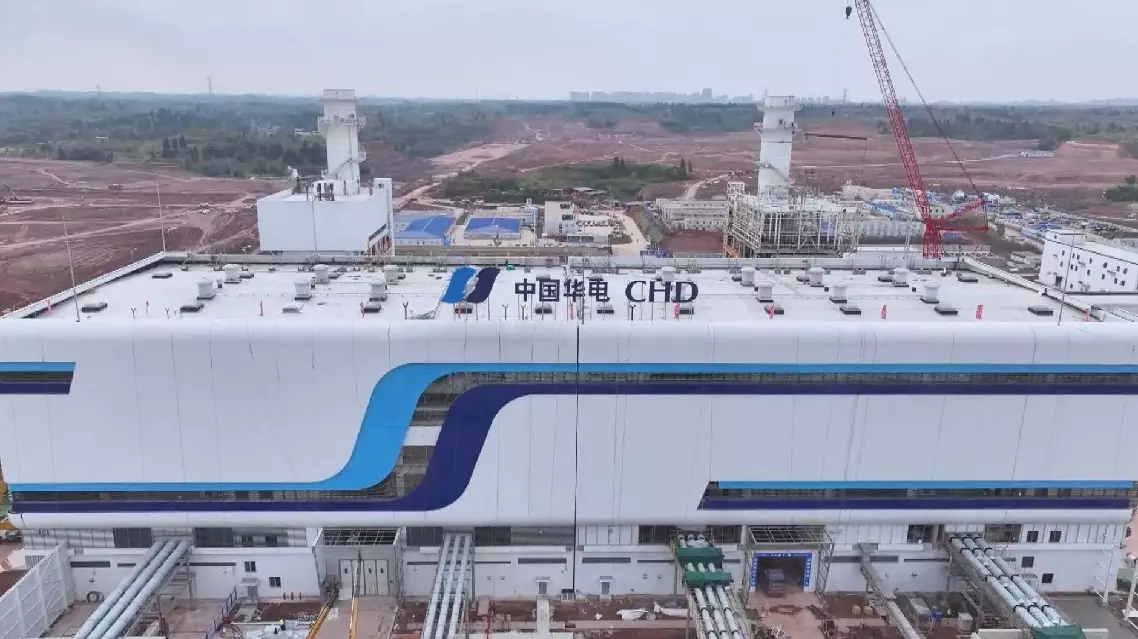
China's first 550 MW F-class gas turbine unit commences operation