Turkmenistan and China seek to further tap into the potential for cooperation across the board from energy, transportation, logistics to emerging areas such as smart technology, said Turkmen national leader Gurbanguly Berdimuhamedov on Wednesday in an interview with China Media Group.
At the invitation of Chinese President Xi Jinping, Berdimuhamedov, chairman of the People's Council of Turkmenistan, the supreme representative organ of people's power, paid a goodwill visit to China from March 17 to 19.
"Today, based on our shared interests, Turkmenistan and China are jointly developing a series of major transportation and logistics infrastructure projects. These initiatives tightly connect the vast geographic space from the Pacific to the Atlantic, injecting strong momentum into the economic development of the entire Eurasian continent. They will promote deep interconnectivity between production networks, technological systems, and industrial corridors. This process will also make important contributions to addressing various social challenges and improving the living standards and well-being of people across many countries," he said.
According to Berdimuhamedov, 90 percent of the locomotives and railcars operating in Turkmenistan's railway system are manufactured in China. Both sides are jointly advancing the construction of the East-West transit corridors. As early as 2014, a railway trunk line connecting China and Turkmenistan, passing through neighboring countries and spanning over 750 kilometers, was officially opened for operation.
"In agriculture, experts from Turkmenistan and China are working together to select and improve traditional crop varieties. We are also eager to collaborate closely on urban planning, jointly building modern smart city support systems, an area in which China enjoys globally recognized leadership. Furthermore, our cooperation agenda also covers critical fields such as high technology, telecommunications, and aerospace," he said.
As a landlocked country in Central Asia, Turkmenistan is rich in oil, gas and mineral resources. It holds the world's fourth-largest reserves of natural gas, and its oil and gas industry forms the backbone of the national economy.
Berdimuhamedov said the energy sector is a central focus of the Turkmenistan-China strategic partnership. A gas pipeline between them was successfully completed and put into operation on December 14, 2009. Since then, Turkmenistan has been reliably supplying nearly 40 billion cubic meters of natural gas to China each year. As of March 1, 2026, the cumulative volume of gas delivered to China through the Turkmenistan-China pipeline has reached 460 billion cubic meters.
The two countries are working together to further increase the pipeline's annual delivery capacity to 65 billion cubic meters, he said.
Turkmenistan established diplomatic relations with China in January 1992. Over the past 34 years, China-Turkmenistan relations have made remarkable strides forward. The two countries established a strategic partnership in 2013, elevated it to a comprehensive strategic partnership in 2023, and jointly announced their commitment to building a community with a shared future at the bilateral level.
Since 2007, trade between Turkmenistan and China has grown twentyfold. It is worth noting that bilateral trade remains stable, reaching 9-10 billion U.S. dollars annually.
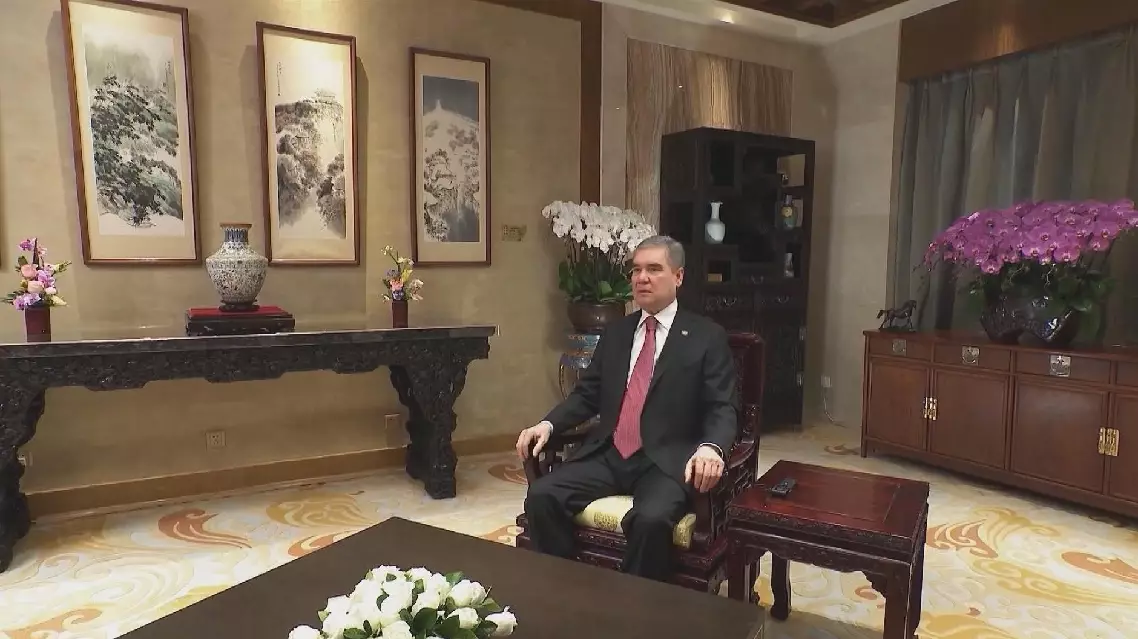
China, Turkmenistan seek to tap cooperation potential in emerging areas: Turkmen national leader