Large-scale protests erupted in Berlin, Germany on Saturday, as demonstrators condemned U.S. and Israeli military strikes on Iran and called for dialogue and diplomacy to resolve conflicts.
Crowds gathered in central Berlin, with people from across Germany, social groups, and peace organizations taking to the streets. Waving banners and chanting slogans, protesters voiced strong opposition to recent U.S. and Israeli military actions against Iran.
"This is clearly a war of aggression. Iran has done nothing and has never expressed any intention to attack Israel or the United States. There is no justification for war, so this is an unprovoked act of aggression. According to international law, this is a war of aggression and a violation of international law," said one protester.
"They are not playing by the rules, just as they did during the Iraq war. The United States has long violated international law, and in recent years, this has only gotten worse. The latest examples clearly show this is a blatant violation of international law," said another protester.
Energy concerns were also a major focus of the demonstration. Analysts said that with heightened tensions in the Middle East, energy market volatility has increased, and Europe's dependence on U.S. energy has become more pronounced.
"Germany is particularly affected by energy issues. We have already reduced imports of natural gas and oil from Russia as much as possible, and imports from the Middle East are no longer feasible. In reality, only the U.S. and Norway remain as suppliers. The U.S. can easily use this as leverage against Germany, for example, by saying, 'If you don't join efforts to secure the Strait of Hormuz, we can reduce LNG and oil exports to Germany and even all of Europe.' I am concerned this could happen," said Michael Lueders, prominent Middle East scholar.

Massive protests against US, Israel strikes on Iran erupt in Berlin
International observers have welcomed the recent summit between Chinese President Xi Jinping and U.S. President Donald Trump, calling deepened China-U.S. cooperation vital for global stability and positive development.
Xi concluded a three-day state visit to the United States on Friday, where he and Trump reaffirmed their commitment to a constructive, strategically stable relationship guided by fairness, reciprocity, and mutual respect.
In separate interviews with China Central Television, leaders and experts from around the world underscored that efforts to find a proper way for major countries to coexist not only benefit China and the U.S., but also inject much-needed stability and positive energy into global peace and development.
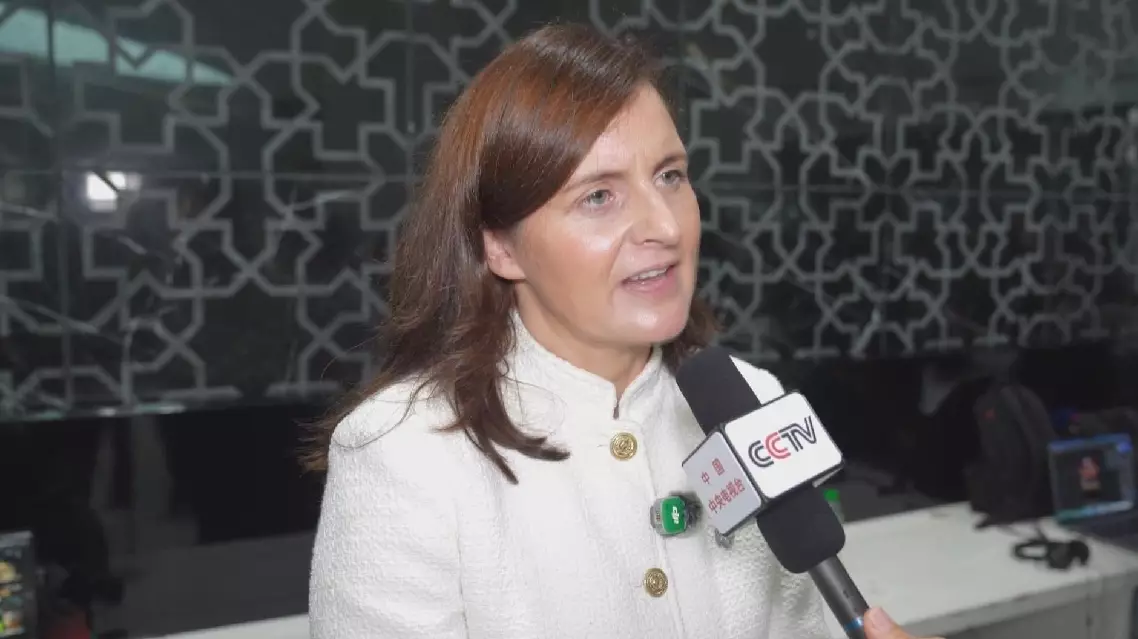
"And having that framework [for cooperation built on the constructive China-U.S. relationship of strategic stability] rolled out between China and the U.S. is really important. We know that type of relationship works and it's successful. So we have to ensure that we see more cooperation between states on a global basis," said Catherine Ardagh, Minister of State at the Department of Justice, Home Affairs and Migration, Ireland.
"After 11 years, President Xi is the first Chinese president to visit the United States of America. [For] the number of takeaways in this visit we see, as far as the outcomes, there are more than eight outcomes -- around eight outcomes are there. The world is looking toward this historic meeting," said Tahir Malik, head of the Department of International Relations, the National University of Modern Languages in Islamabad, Pakistan.
"So this mutual collaboration and respect between the United States and China sort of sets a standard for stability, growth and development. Certainly, the joint collaborations that the two presidents have set up for continual communication, I think, will be important," said Richard A. Black, the Schiller Institute's representative at the United Nations.
"Strong message of President Xi: The biggest investment of China is friendship, is cooperation, partnership, and not armed -- peaceful solutions for actually the world's problems," said Zijad Becirovic, director of International Institute for Middle East and Balkan Studies in Slovenia.
"President Xi Jinping's emphasis about sincerity and communication, coexistence as well as effective communication, is timely and I think we are heading for a stable world when these superpowers speak like that and continue coexisting," said Fabian Mutale, political analyst from Zambia.
Xi's visit was at the invitation of U.S. President Donald Trump. It followed Trump's state visit to China back in May.
Xi’s U.S. visit boosts cooperation, world stability: international observers