China has begun rolling out a nationwide plan to build a "child-friendly society," launching 116 pilot projects by 2025 to reshape public spaces, services and transit systems for more than 110 million minors.
The guideline, titled Opinions on Promoting the Construction of Child-Friendly Society, calls for children's perspectives to be incorporated into public policy and outlines strategies across eight areas, from infrastructure and safety to social participation. It defines a child-friendly environment as one that safeguards children's rights to survival, development, protection and participation.
By the end of 2025, 116 cities had piloted projects spanning urban and rural areas. Public services are required to prioritize children, ensuring accessibility, quality and inclusiveness. Healthcare measures include adding the HPV vaccine to the national immunization plan for girls aged 13 and above, and establishing 24-hour emergency treatment channels for children under three with critical conditions.
Schools are encouraged to open sports facilities during holidays, while scenic areas should offer discounted admission and expand free-entry thresholds. Transport systems are urged to adapt buses, subways and transit hubs, with ride-hailing platforms prioritizing families with infants. Railways and airlines are advised to provide priority boarding, check-in and escort services for unaccompanied minors.
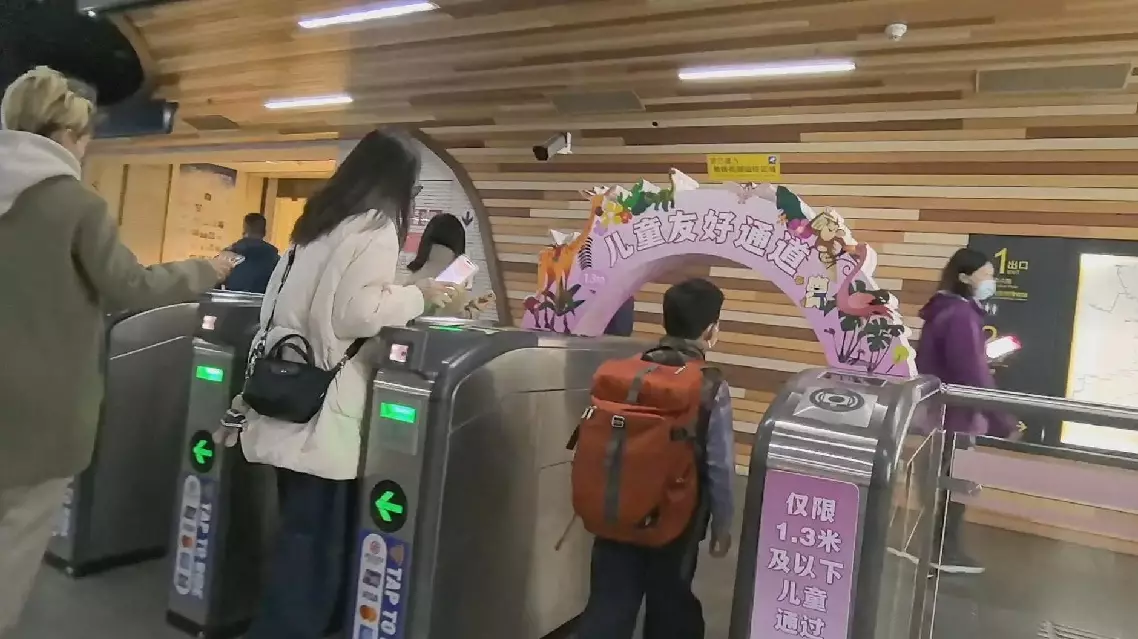
More than 20 major cities, including Beijing, have raised the height limit for children's free subway rides to 1.3 meters. Cities such as Shanghai and Shaoxing in Zhejiang Province have introduced child-friendly subway lanes, while Wenzhou in Zhejiang and Zhuhai in Guangdong Province have relaxed rules on the number of children allowed to travel for free with adult passengers.
In January this year, the Shanghai Metro Line 13's Natural History Museum Station added four child-friendly lanes, allowing children to pass through without swiping their cards. This heartwarming initiative has garnered praise from many parents and children.
"It's very convenient and thoughtful. Because before, when children crawled through a turnstile, they would bump their heads," said a traveler.
"Many parents praise this lane. They think it's user-friendly and fun, allowing children to walk through confidently and proudly," said Cao Ying, head of the Natural History Museum Station of Shanghai Metro Line 13.
In Yiwu City of Zhejiang Province, a group of children were invited to offer their suggestions on improving bus services for them. Visible changes have taken place to create a warm, welcoming environment for children. For example, anti-collision strips were added inside bus carriages, and safety handrails were installed on the windows. Over the past three years, over 50 suggestions have been adopted.
"We usually focus on improving public transportation services from an adult perspective, but we neglect children's needs in terms of height, field of vision, and ease of operation. Their voices have greatly driven us to upgrade our services," said Zhang Wenyong, a staff member of a bus company in Yiwu.
Chinese cities revamp public facilities for child-friendly spaces