The international shipping sector is bearing the brunt of the escalating tensions in the Middle East as insurers drop war risk coverage or push up their premiums.
As the situation in the Middle East is worsening, several members of the International Group of Protection and Indemnity Clubs have announced that war risk coverage for vessels entering the Persian Gulf, certain adjacent waters, or Iranian waters will be automatically terminated or subject to premium surcharges.
Since March, members of the organization including the Gard Protection and Indemnity Club and the London Protection and Indemnity Club have successively issued notices of withdrawal of war risk coverage.
At the same time, the scope of waters designated as excluded areas by the Joint War Committee (JWC) of the London insurance market continues to expand. This means that in waters deemed high-risk, standard marine war risk coverage will no longer apply automatically as shipowners must purchase additional coverage or arrange separate insurance for individual voyages.
Prior to the escalation of the conflict in the Middle East, the premium for a single voyage of war risk insurance in the Persian Gulf was about 0.025 percent of the value of a ship, whereas recently, premiums for shipping war risk insurance in the region have skyrocketed within a short period of time.
"Before the war, insuring an oil tanker worth 100 million U.S. dollars typically cost just 50,000 U.S. dollars in annual premiums. Now, premiums are charged on a per-voyage basis: for voyages of seven days or less, the rate is generally 1 percent of the vessel's value; and for voyages lasting between seven and 14 days, the rate doubles to 2 percent, amounting to several million U.S. dollars," said Wang Guojun, a professor of the School of Insurance at the University of International Business and Economics.
In international shipping, both the vessel itself and the cargo typically require coverage under basic marine insurance, war risk insurance, and reinsurance.
In some international ports, vessels must be insured under war risk and other policies to operate normally.
As the international shipping insurance market tightens, cost pressures on the shipping industry are further intensifying.
"Rising insurance premiums and policy cancellations can have a massive impact on international trade, as insurance is essential for international trade to proceed now. In this war, shipowners are likely to be the first to feel the impact. They will either have to pass on the increased premiums to cargo owners or absorb the losses themselves. If the costs are passed on to cargo owners, they will be affected, and this will in turn have a massive impact on upstream and downstream manufacturers of the goods, the economies of an entire country or region, and global trade as a whole," said Wang.
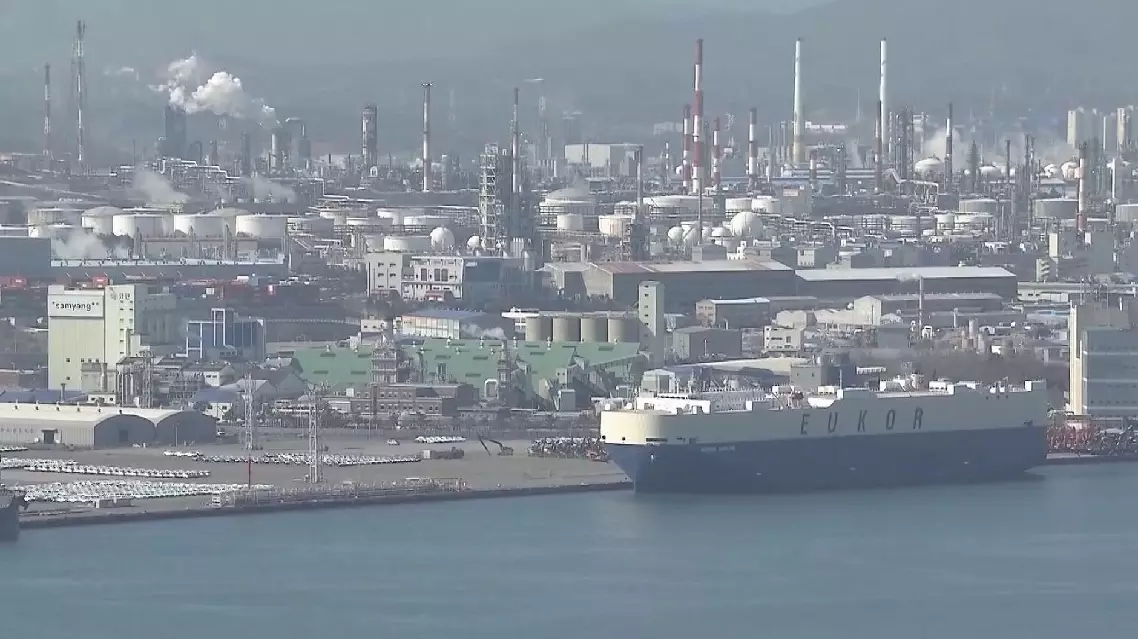
Premiums of int'l shipping surge in wake of Middle East conflict
China plays a vital role in the wave of artificial intelligence (AI) and the development of future industries, said government officials and business leaders attending the China Development Forum 2026 that opened in Beijing on Sunday.
Speaking at the Symposium on Technological Innovation and Future Industry Development, Minister of Industry and Information Technology Li Lecheng said China will accelerate the innovative development of industries of the future.
"Centering around key areas like artificial general intelligence, quantum sci-tech, and clean, low-carbon hydrogen, we have deployed over 100 innovative research projects of future industries, unveiled the list and appointed leaders for these projects. We will continue to leverage the principal role of enterprises, vigorously nurturing leading technology enterprises and high-tech enterprises that lead in core technologies and possess strong innovation capabilities to drive the industries to advance towards cutting-edge and high-end fields," Li said.
From quantum technology to 6G, China is sharing its sci-tech achievements with countries around the world, working together to promote the development of future industries.
Business leaders from across the world said China is leading the breakthrough in AI technologies and will be fertile ground for the growth of future industries.
"From new energy, electric vehicles and high-end manufacturing to breakthroughs in robotics and artificial intelligence, China is at the best moment to share the fruits of sci-tech development with the world. In 2025, downloads of open-source (AI) models from China led the world, allowing global developers to freely access, fine-tune, and deploy these powerful models, truly making smart technologies a public good for all humanity," said Joseph Tsai, Chairman of Alibaba Group.
"China's complete industrial ecosystem will be fertile ground for the growth of future industries. Take embodied AI robots for example, their development relies not only on breakthroughs in intelligent algorithms but also on supporting components like precision transmission and execution parts like reducers and servo motors. A rich diversity of innovation pathways, a complete industrial system, and robust industrial supporting capabilities will be the fertile ground for the development of future industries," said Lei Jun, founder and chairman of Xiaomi Group.
"Not only manufacturing. So it's AI plus in every space, in every sector, in every industry. For us, we are the company in the world that powers AI in supplying energy systems to AI factories across the world. And therefore for us, the challenge is to make sure that we go fast enough, strong enough to support all the computing that is used by Chinese companies or by Chinese stakeholders," said Jean-Pascal Tricoire, chairman of Schneider Electric.
"Brain-computer interfaces have been listed as one of the six major future industries in China's 15th Five-Year Plan period this year. We are now fully leveraging AI technologies to decode information within the brain, using this capability to better address many issues related to brain diseases. This enables people with disabilities who have lost hands or feet to control prosthetic limbs with their thoughts, allowing them to regain their normal daily life," said Han Bicheng, founder of BrainCo, a Chinese neurotech company.
The two-day China Development Forum 2026 is themed on "China in Its 15th Five-Year Plan Period: Advancing High-Quality Development and Creating New Opportunities Together."
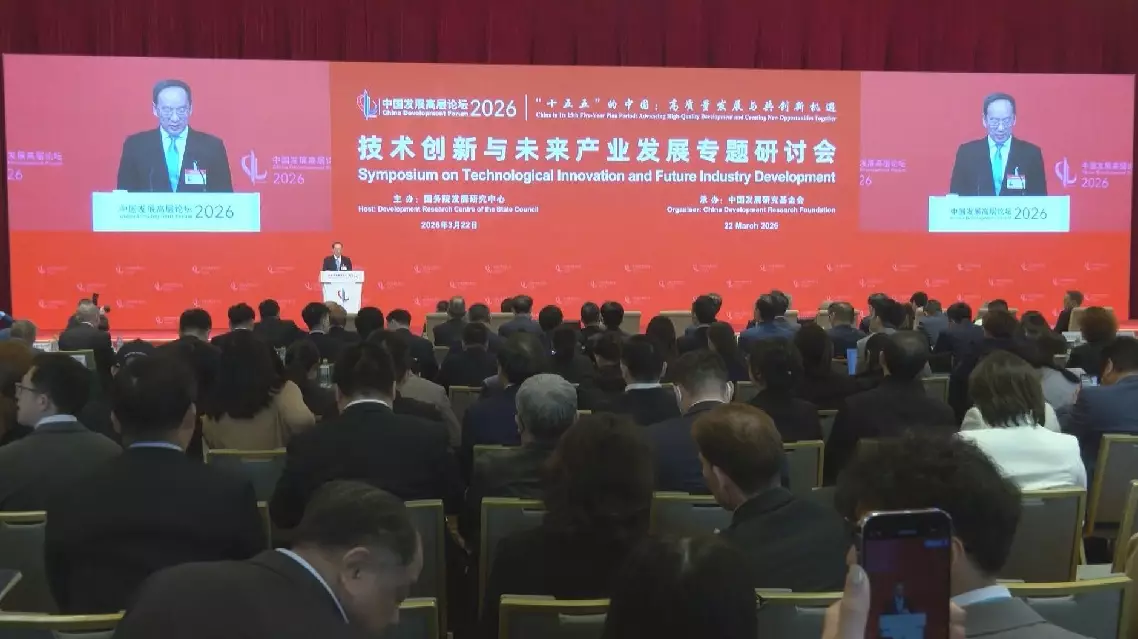
China to accelerate innovative development of future industries: official