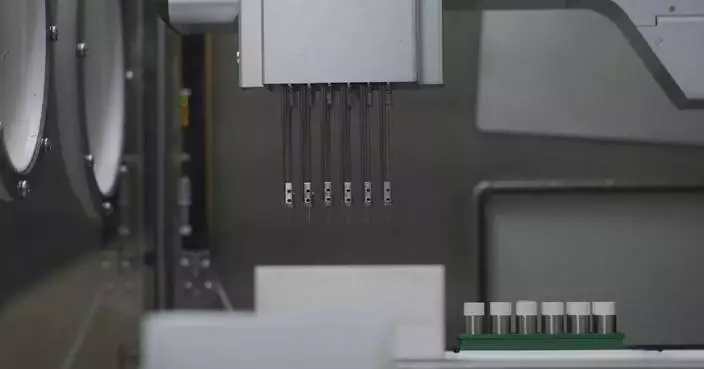
A sharp rise in consumption of tokens, or units of data processed by artificial intelligence (AI) models, is driving unprecedented demand for computing power across China, pushing rental prices higher and straining supply chains.
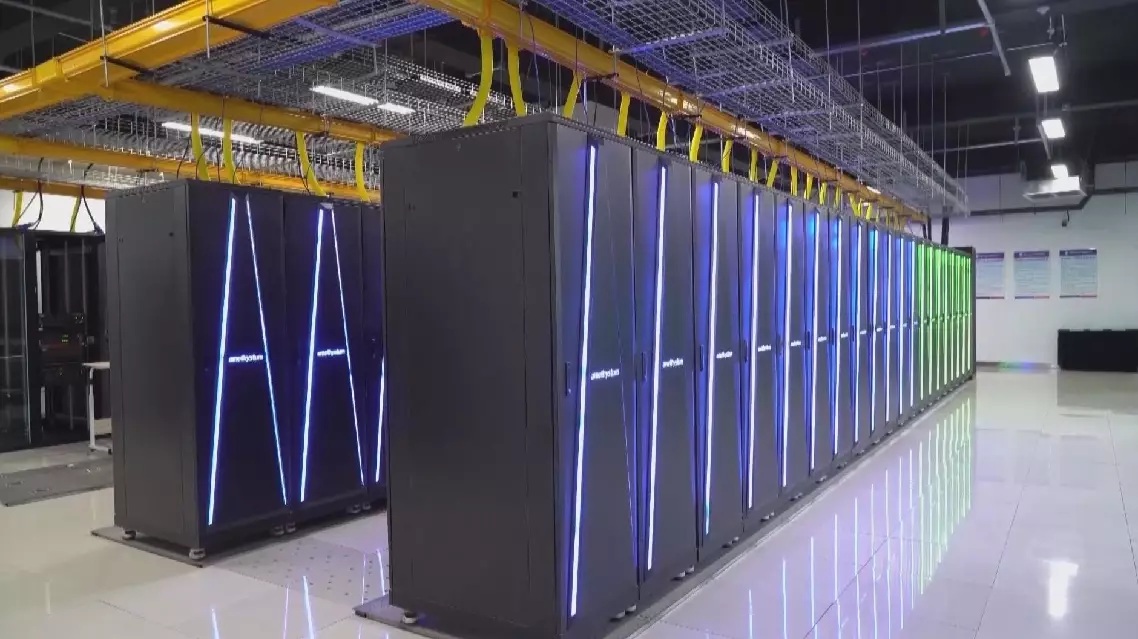
At the Mashan Computing Island in Wuxi City, east China's Jiangsu Province, an AI computing center is running at full capacity, operating around the clock to convert invisible tokens into tangible economic output.
"The sound we hear right now is the sound of 5,000 computing cards operating simultaneously. The sound signifies that under optimal conditions, 1.25 billion tokens can be generated every second. Based on current market value, it can generate 30,000 yuan (about 4,356.41 U.S. dollars) in economic value every minute," said Ji Lijun, general manager of New Power AI, a Wuxi-based technology company.
On a computing operation platform, different types of resources show varying levels of demand. Some of the most sought-after products are already sold out.
"This product has larger memory capacity. Customers prefer using this one for doing inference services with large models. So this type of resource is basically sold out now. It's unavailable for rental. Our customers are mostly from research institutions. There are also some university faculty or students who have their own computing power needs, or verification needs," said Jiang Dan, an AI computing product manager.
Rising downstream demand has pushed up rental prices. Since the third quarter of 2025, computing power rentals have climbed steadily.
In recent weeks, Alibaba Cloud and Baidu AI Cloud both announced price hikes for AI computing products, with increases reaching as high as 34 percent. Tencent Cloud has also adjusted pricing for certain models.
"We started doing computing power leasing in the second half of 2025. The total value of all contracts we signed over the past six months has amounted to 1 billion yuan. As of March, the new orders on hand for the entire 2026 fiscal year have already reached 1.4 billion yuan. Looking at the period from the third quarter of 2025 to now, overall computing power prices have risen by about 60 percent," said Sun Tao, chairman of CloudWorks Technology Holdings Limited.
Industry insiders said that China's AI sector is undergoing an unprecedented wave of commercialization in 2026, shifting from a price war of models to widespread application deployment.
"In terms of challenges, maybe the easy one is the AI compute that is always limited for everyone in the world and not just us. And especially for those companies like us, they are growing a lot and see a really strong customer demand. This really confirms the strong momentum of AI in general," said Giacomo Ficari, head of international business for Kimi, an AI chatbot of Chinese AI startup Moonshot AI.
Computing power demand soars as AI token usage surges
China has turned green technologies once confined to textbooks into everyday life, said Milla, a Kazakhstan student in Beijing, as she shared her experiences and perspectives on the country’s green development and the application of new energy in daily life.
Milla described how China's push for sustainability is visible not only in national policy but also in her everyday campus life at Tsinghua University. Navigating the historic grounds, the economics student relies on a bicycle to get between classes, a choice she finds both convenient and environmentally friendly.
She added that the university actively promotes sustainability through initiatives such as recycling systems and water-conservation reminders, noting that shared bicycles have become a practical feature of campus life.
"I really love seeing how Tsinghua University is trying to become greener. There are many small initiatives that encourage students to live more sustainably, such as recycling systems, reminding not to waste water, and shared bicycles all across campus," she said.
Milla's observation extend far beyond the university gates. She noticed the rapid proliferation of electric vehicles, identifiable by their distinctive green license plates. What has left Milla an even deeper impression is the emergence of hydrogen-powered vehicles, a technology she first encountered not on the street, but in a high school textbook.
"Another thing that amazed me even more was seeing hydrogen-powered buses. I was actually so surprised when I first saw one. Hydrogen energy is something I became interested in back in 10th grade, when I first saw it in a textbook. Hydrogen can be used as a clean fuel. When hydrogen is used to produce energy, the main byproduct is water instead of harmful emissions, which makes it one of the most clean energy sources scientists are developing today. Seeing how hydrogen-powered vehicles are working in real life made me realize that technologies we once only read about in textbooks are slowly becoming a part of everyday life," said Milla.
Milla said that witnessing these technologies in action has reinforced a broader understanding of solving environmental problems.
"For me, learning about these technologies is incredibly exciting. It shows that solving environmental problems is not only about reducing emissions but it's also about innovating and thinking about new ways, how to make energy. Studying economics while still being interested in environmental protection allows me to see how technology, policy and economic systems can work together to build a cleaner and a more sustainable future," she said.
Her remarks are also being vividly manifested at the upcoming Boao Forum for Asia Annual Conference 2026 prepares to be held in Hainan from March 24 to 27, when green and smart operations will be a key feature. All venues will be powered by 100 percent renewable electricity throughout the conference, with total power consumption expected to reach about two million kilowatt-hours, equivalent to reducing carbon dioxide emissions by around 1,200 tonnes. Meanwhile, a number of AI-powered systems will be deployed for the first time.
Thousands of representatives from government, business and academia will gather under the theme "Shaping a Shared Future: New Dynamics, New Opportunities, and New Cooperation." The conference will spotlight pressing topics and build consensus on cooperation through nearly 50 sub-forums, roundtables and dialogues.

Kazakh student commends China's green tech shift from textbooks to everyday life