Global business leaders from the consumer and health sectors attending the China Development Forum 2026 said on Sunday that they are excited by the potential of the Chinese consumer market and are now planning new business strategies.
China's 15th Five-Year Plan (2026-2030) includes increasing household consumption as a primary goal for the nation's economic and social development over the next five years.
On Sunday, a seminar on "New Trends and Opportunities in Consumption Growth" held at the forum highlighted a consensus among participants: China is currently undergoing a crucial phase in transforming and upgrading its consumption market. The prevailing view is that those who can grasp the new trends during this transitional period will be better positioned to seize the evolving "China opportunity."
"We really believe that the 15th Five Year Plan period should be a golden five-year plan for foreign-invested enterprises to share development opportunities, and achieve common growth with the Chinese market. The group will continue to increase investment. We will further expand production capacity in Sichuan, Guangxi," said Saravoot Yoovidhya, CEO of Thailand's TCP Group, which is a global leader in the beverage and snack industry.
"It's our biggest market, has been for 20 years. And then later this week, I'm actually headed to Sichuan Province, to Chengdu. We're opening a farm. Our five-year plan is to invest over 2.1 billion renminbi (about 305 million U.S. dollars) into the market," said Michael Nelson, CEO of Amway Corp., a multinational specializing in health and wellness.
Foreign enterprises are adjusting their strategies and increasing local investments in the Chinese food and beverage sectors and in the fast-moving consumer goods sector.
This investment expansion is also shifting geographically, moving from the eastern coastal regions towards the western parts of the country.
Meanwhile, the deepening advancement of the "Healthy China" initiative is also prompting more foreign companies to commit substantial financial resources and innovative research and development efforts, aiming for products developed and made in China for a global market.
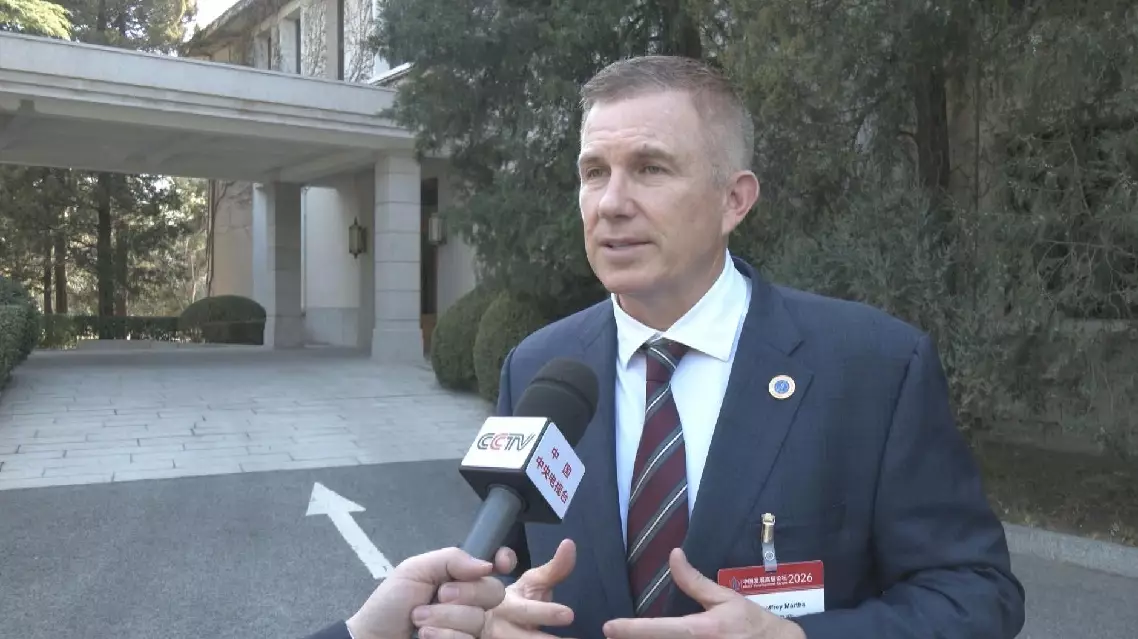
"With the innovation that we're seeing in China now, we need to build out our local capabilities (to) satisfy the global need. Also our local R and D center in Shanghai, we've produced 50 products out of there over the last couple of years that are global," said Geoff Martha, chairman and CEO of medical device company Medtronic.
The China Development Forum 2026 kicked off in Beijing on Sunday. The theme of this year's two-day forum is "China in Its 15th Five-Year Plan Period: Advancing High-Quality Development and Creating New Opportunities Together."
China's vast consumer market attracting increased foreign investment
China has turned green technologies once confined to textbooks into everyday life, said Milla, a Kazakhstan student in Beijing, as she shared her experiences and perspectives on the country’s green development and the application of new energy in daily life.
Milla described how China's push for sustainability is visible not only in national policy but also in her everyday campus life at Tsinghua University. Navigating the historic grounds, the economics student relies on a bicycle to get between classes, a choice she finds both convenient and environmentally friendly.
She added that the university actively promotes sustainability through initiatives such as recycling systems and water-conservation reminders, noting that shared bicycles have become a practical feature of campus life.
"I really love seeing how Tsinghua University is trying to become greener. There are many small initiatives that encourage students to live more sustainably, such as recycling systems, reminding not to waste water, and shared bicycles all across campus," she said.
Milla's observation extend far beyond the university gates. She noticed the rapid proliferation of electric vehicles, identifiable by their distinctive green license plates. What has left Milla an even deeper impression is the emergence of hydrogen-powered vehicles, a technology she first encountered not on the street, but in a high school textbook.
"Another thing that amazed me even more was seeing hydrogen-powered buses. I was actually so surprised when I first saw one. Hydrogen energy is something I became interested in back in 10th grade, when I first saw it in a textbook. Hydrogen can be used as a clean fuel. When hydrogen is used to produce energy, the main byproduct is water instead of harmful emissions, which makes it one of the most clean energy sources scientists are developing today. Seeing how hydrogen-powered vehicles are working in real life made me realize that technologies we once only read about in textbooks are slowly becoming a part of everyday life," said Milla.
Milla said that witnessing these technologies in action has reinforced a broader understanding of solving environmental problems.
"For me, learning about these technologies is incredibly exciting. It shows that solving environmental problems is not only about reducing emissions but it's also about innovating and thinking about new ways, how to make energy. Studying economics while still being interested in environmental protection allows me to see how technology, policy and economic systems can work together to build a cleaner and a more sustainable future," she said.
Her remarks are also being vividly manifested at the upcoming Boao Forum for Asia Annual Conference 2026 prepares to be held in Hainan from March 24 to 27, when green and smart operations will be a key feature. All venues will be powered by 100 percent renewable electricity throughout the conference, with total power consumption expected to reach about two million kilowatt-hours, equivalent to reducing carbon dioxide emissions by around 1,200 tonnes. Meanwhile, a number of AI-powered systems will be deployed for the first time.
Thousands of representatives from government, business and academia will gather under the theme "Shaping a Shared Future: New Dynamics, New Opportunities, and New Cooperation." The conference will spotlight pressing topics and build consensus on cooperation through nearly 50 sub-forums, roundtables and dialogues.

Kazakh student commends China's green tech shift from textbooks to everyday life