NEW YORK--(BUSINESS WIRE)--Mar 23, 2026--
Faruqi & Faruqi, LLP, a leading national securities law firm, is investigating potential claims against BellRing Brands, Inc. (“BellRing” or the “Company”) (NYSE: BRBR) and reminds investors of the March 23, 2026 deadline to seek the role of lead plaintiff in a federal securities class action that has been filed against the Company.
This press release features multimedia. View the full release here: https://www.businesswire.com/news/home/20260323607557/en/
Faruqi & Faruqi is a leading national securities law firm with offices in New York, Pennsylvania, California and Georgia. The firm has recovered hundreds of millions of dollars for investors since its founding in 1995. See www.faruqilaw.com.
As detailed below, the complaint alleges that the Company and its executives violated federal securities laws by making false and/or misleading statements and/or failing to disclose the strength, sustainability, and drivers of BellRing’s sales growth, as well as the impact of competition on the demand for the Company’s products.
On May 5, 2025, after market hours, BellRing revealed that starting in Q2 2025, "several key retailers lowered their weeks of supply on hand," which would create a headwind to Q3 2025 growth. The Company also announced it was expanding promotions to boost sales and "offset third quarter reductions in retailer trade inventory levels."
On this news, the price of BellRing stock declined $14.88 per share, or 19%, from $78.43 per share on May 5, 2025, to close at $63.55 per share on May 6, 2025, on unusually heavy trading volume.
Then, on August 4, 2025, after market hours, BellRing announced disappointing quarterly consumption of Premier Protein RTD Shakes, which had been expected to outpace shipments by a wider margin given previously announced retailer destocking, but instead came "more in line" with shipments.
On this news, the price of BellRing Brands stock fell $17.46 per share, or nearly 33%, from $53.64 per share on August 4, 2025, to $36.18 per share on August 5, 2025.
The court-appointed lead plaintiff is the investor with the largest financial interest in the relief sought by the class who is adequate and typical of class members who directs and oversees the litigation on behalf of the putative class. Any member of the putative class may move the Court to serve as lead plaintiff through counsel of their choice, or may choose to do nothing and remain an absent class member. Your ability to share in any recovery is not affected by the decision to serve as a lead plaintiff or not.
Faruqi & Faruqi, LLP also encourages anyone with information regarding BellRing’s conduct to contact the firm, including whistleblowers, former employees, shareholders and others.
To learn more about the BellRing Brands class action, go to www.faruqilaw.com/BRBR or call Faruqi & Faruqi partner Josh Wilson directly at 877-247-4292 or 212-983-9330 (Ext. 1310).
Follow us for updates on LinkedIn, on X, or on Facebook.
Attorney Advertising. The law firm responsible for this advertisement is Faruqi & Faruqi, LLP ( www.faruqilaw.com ). Prior results do not guarantee or predict a similar outcome with respect to any future matter. We welcome the opportunity to discuss your particular case. All communications will be treated in a confidential manner.

BRBR CLASS ACTION DEADLINE TONIGHT: Faruqi & Faruqi, LLP Reminds BellRing Brands Investors of the Securities Class Action Lawsuit Deadline Tonight March 23, 2026
WASHINGTON (AP) — The Supreme Court 's conservative majority on Monday sounded skeptical of state laws that allow the counting of late-arriving mail ballots, a persistent target of President Donald Trump.
The court heard arguments in a case from Mississippi that also could affect voters in 13 other states and the District of Columbia, which have grace periods for ballots cast by mail. An additional 15 states that have more forgiving deadlines for ballots from military and overseas voters also could be impacted.
A ruling is expected by late June, early enough to govern the counting of ballots in the 2026 midterm congressional elections.
The court challenge is part of Trump’s broader attack on most mail balloting, which he has said breeds fraud despite strong evidence to the contrary and years of experience in numerous states.
Several conservative justices gave voice to some of Trump's complaints. Justice Samuel Alito wondered about the appearance of fraud in situations where “a big stash of ballots” that arrive late “radically flipped” an election.
Defending the state law, Mississippi Solicitor General Scott Stewart pointed out that the Trump administration and its allies in the case have yet to submit a single case of fraud due to late-arriving mail ballots.
The court's liberal justices indicated they would uphold state laws with post-Election Day deadlines.
“The people who should decide this issue are not the courts, but Congress, the states and Congress,” Justice Sonia Sotomayor said.
Forcing states to change their practices just a few months before the election risks “confusion and disenfranchisement,” especially in places that have had relaxed deadlines for years, state and big-city election officials told the court in a written filing.
California, Texas, New York and Illinois are among the states with post-Election Day deadlines. Alaska, with its vast distances and often unpredictable weather, also counts late-arriving ballots.
Lawyers for the Republican and Libertarian parties, as well as Trump's administration, are asking the justices to affirm an appellate ruling that struck down a Mississippi law allowing ballots to be counted if they arrive within five business days of the election and are postmarked by Election Day.
Justices worried over the slippery-slope problems that could arise no matter who wins the case.
Ballots could be received until the start of the next Congress, two months after the election, Justice Neil Gorsuch suggested.
On the other side, Justice Elena Kagan said the logic of the challenge to late-arriving ballots also would be used to rule out early voting and absentee ballots.
Limits on early-voting also seemed to bother Chief Justice John Roberts, who seemed the conservative member of the court most likely to side with Mississippi.
The court also grappled with whether state laws allowing for late-arriving ballots from military and overseas ballots could survive.
Last year, Trump signed an executive order on elections that aims to require votes to be “cast and received” by Election Day. The order has been blocked in pending court challenges.
At the same time, four Republican-dominated states — Ohio, Kansas, North Dakota and Utah — eliminated grace periods last year, according to the National Conference of State Legislatures and Voting Rights Lab.
The issue at the Supreme Court is whether federal law sets a single Election Day that requires ballots to be both cast by voters and received by state officials.
In striking down Mississippi's grace period, Judge Andrew Oldham of the 5th U.S. Circuit Court of Appeals wrote that the state law allowing the late-arriving ballots to be counted violated federal law.
Oldham and the other two judges who joined the unanimous ruling, James Ho and Stuart Kyle Duncan, all were appointed by Trump during his first term.
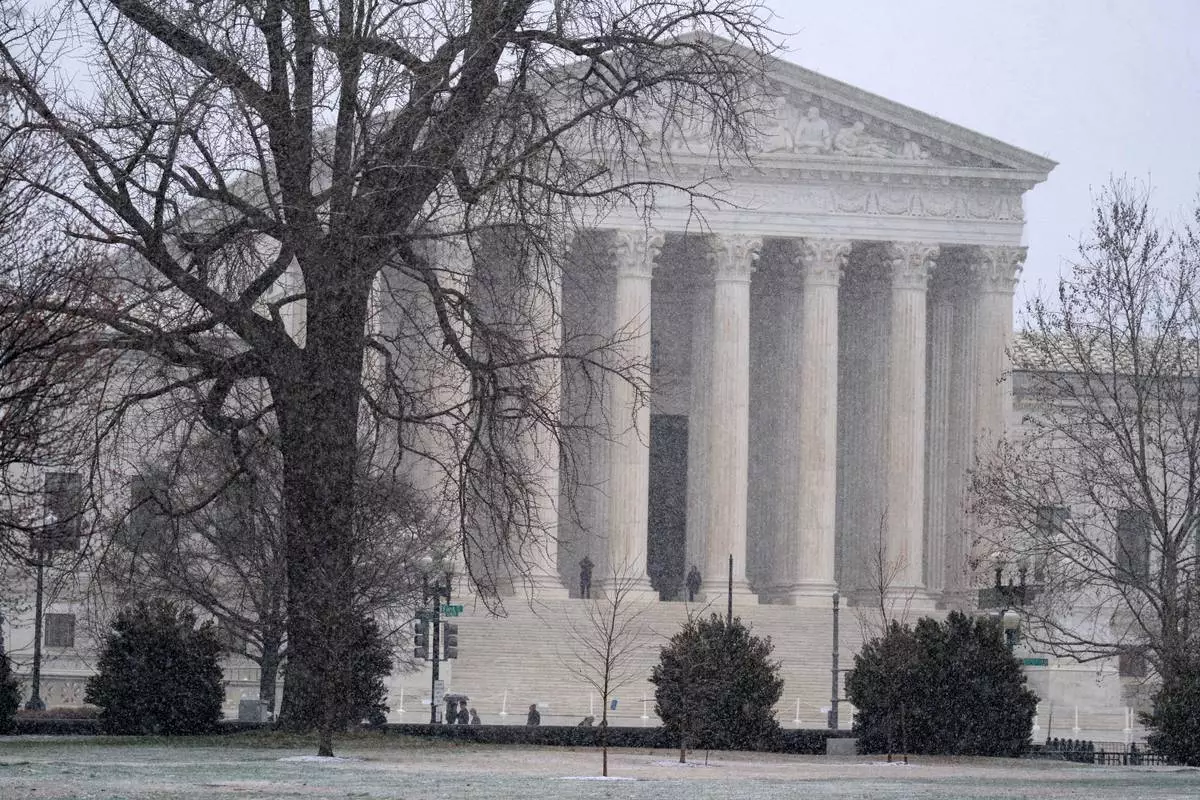
The U.S. Supreme Court is seen during a snowy day on Capitol Hill Thursday, March 12, 2026, in Washington. (AP Photo/Jose Luis Magana)
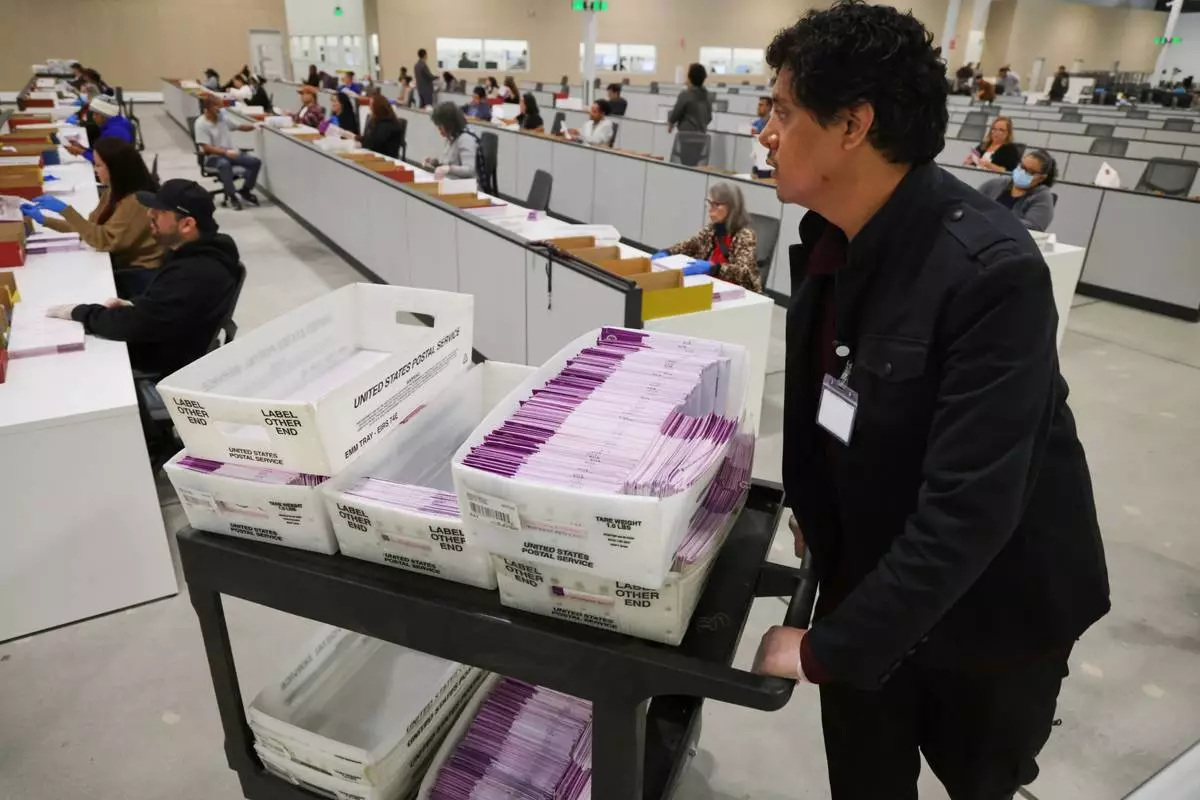
FILE - A worker pushes a cart of received mail ballots at the L.A. County Ballot Processing Center Nov. 4, 2025, in City of Industry, Calif. (AP Photo/Ethan Swope, File)
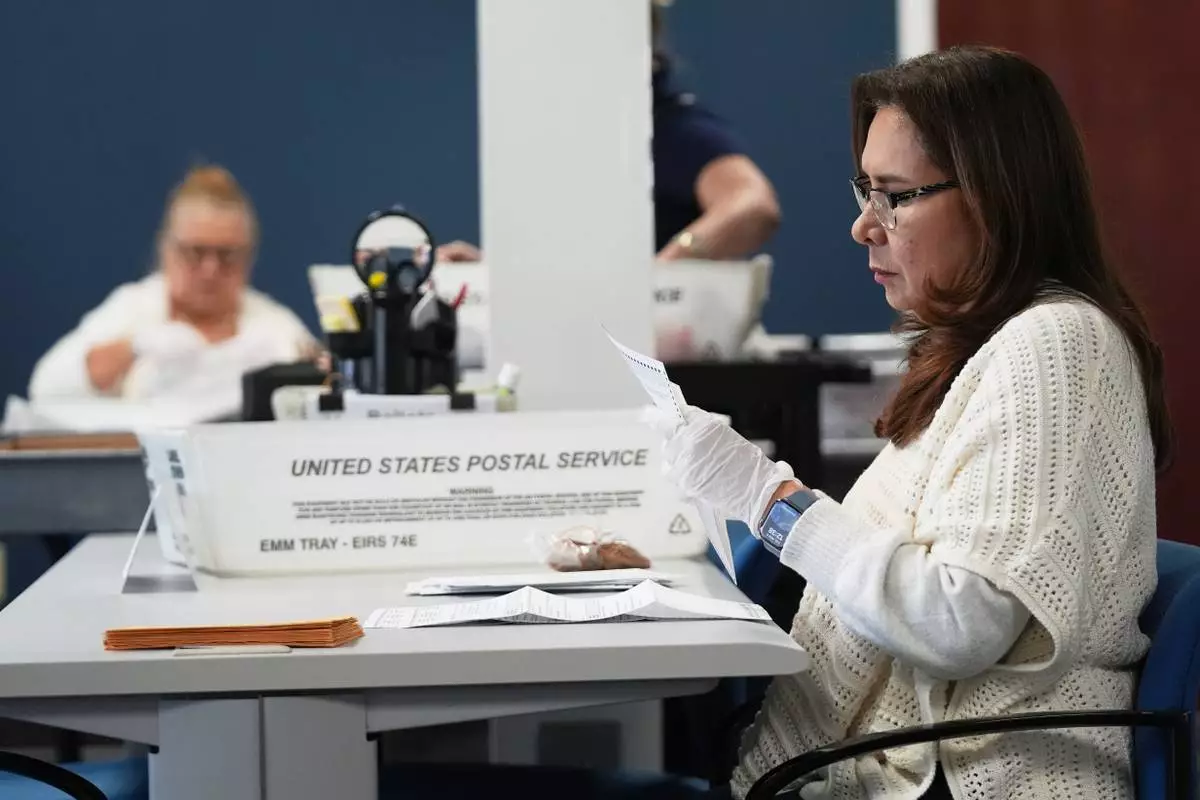
FILE - Employees sort vote-by-mail ballots from municipal elections on Election Day at the Miami-Dade County Supervisor of Elections Office, Nov. 4, 2025, in Doral, Fla. (AP Photo/Lynne Sladky, File)