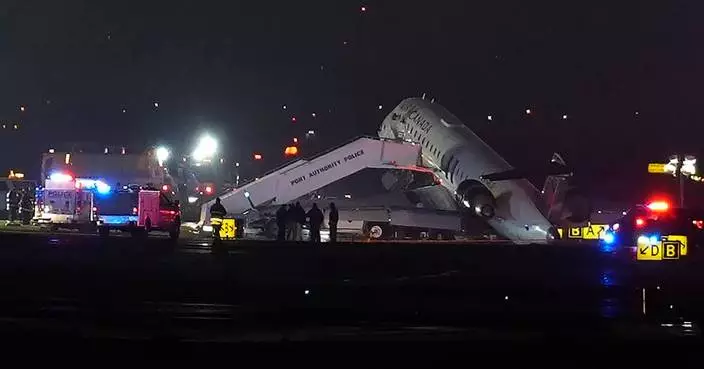
U.S. President Donald Trump extended his deadline for Iran to reopen the Strait of Hormuz on Monday, saying the U.S. will hold off striking Iranian power plants for five more days.
Trump said U.S. envoys have been holding talks with a “respected” Iranian leader, and Iran wants “to make a deal.” Iranian officials denied any such negotiations, and declared that the American leader had backed down “following Iran’s firm warning.”
Relief ripped through financial markets Monday as oil prices eased following severe losses prior to Trump’s announcement. Financial markets have had vicious swings, both up and down, since the war began because of uncertainty about how long it may last.
Trump also said the U.S. would seek to retrieve Iran’s enriched uranium and end its nuclear program as part of a deal, telling reporters: “We want to see no nuclear bomb, no nuclear weapon. Not even close to it.”
The death toll has risen to more than 1,500 people in Iran, more than 1,000 in Lebanon, 15 in Israel and 13 U.S. military members, as well as a number of civilians on land and sea in the Gulf region. Millions of people in Lebanon and Iran have been displaced.
Here is the latest:
Netanyahu says Israel will continue to strike Iran and Lebanon as the U.S. considers a ceasefire.
Netanyahu says he spoke to Trump, who told him “there is a chance” to leverage battlefield gains into an agreement that realizes the war's objectives.
“At the same time, we continue to strike, both in Iran and in Lebanon,” he said. “There’s more to come. We will protect our vital interests in any situation.”
Finance Minister Bezalel Smotrich says the war against Hezbollah must end with a “fundamental change” that includes control of Lebanon up to the Litani River, roughly 30 kilometers (20 miles) north of the Israeli border.
“The Litani must be our new border with the state of Lebanon,” he told members of his Religious Zionism party on Monday, comparing it to boundaries Israel has set in Gaza and the Golan Heights.
Israel already has sent thousands of troops into southern Lebanon as it moves to push Hezbollah militants north. Smotrich leads a small ultranationalist party and is a member of Prime Minister Benjamin Netanyahu’s policy-making Security Cabinet.
Four Jewish charity ambulances were set afire Monday in London. British police said they are investigating it as an antisemitic hate crime while detectives work to determine the authenticity of a claim of responsibility from a group with alleged links to Iran.
Although it has not been classified as a terrorist incident, counterterror officers are leading the investigation. No one was injured in the nighttime attack, which left the vehicles charred shells.
A video posted on Telegram, allegedly by an Islamist group called Harakat Ashab al-Yamin al-Islamia, showed a map of the location and video of the ambulances on fire. A group using the same name previously claimed responsibility for synagogue attacks in Belgium and the Netherlands.
“Establishing the accuracy of this claim is a priority for the investigating team,” Security Minister Dan Jarvis said.
Israel’s government has called it a recently founded group with suspected links to pro-Iran networks.
▶ Read more
During Monday’s phone call, Pakistan’s top diplomat emphasized the importance of dialogue and diplomacy in promoting “peace, security and stability in the region and beyond” according to the Ministry of Foreign Affairs.
Washington and Tehran exchanged the “messages” over the weekend through Egypt, Turkey and Pakistan, an Egyptian official said.
The exchanges aimed at averting strikes on energy infrastructure in Iran and the wider region, he said.
“This is the top priority now,” said the official, speaking on condition of anonymity because he was not authorized to speak to the media.
— By Samy Magdy
Pete Hegseth touted the need to boost defense manufacturing during a morale-boosting appearance last month at one of the U.S. Navy’s largest shipbuilding contractors. Now 627 designers, clerks and technicians at General Dynamics Bath Iron Works have gone on strike, just as the U.S. intensifies its war effort in Iran.
They voted to reject the shipyard’s proposed wage offer of 10.1% in the first year followed by 4% in each of the following three years.
General Dynamics “continues to make record profits off our labor,” union President Trent Vellella said in a statement. “We had hoped the company took to heart the statements made by Secretary Hegseth here at GD BIW on February 9th because, our membership certainly did.”
General Dynamics said it will continue operations at the shipyard, which has built naval ships for more than a century. Its total workforce is about 6,800.
Britain summoned Iran’s ambassador, Seyed Ali Mousavi, to protest what it called Tehran’s “reckless and destabilising actions” after two men were charged last week with spying on London’s Jewish community on behalf of Iran.
The Foreign Office said the U.K. takes threats from Iran and its proxies “extremely seriously.”
Trump said his administration has been negotiating with Iran “for a long time” and he believes a deal is close. But he didn't clarify who's been involved in the talks. Iran's parliament speaker and foreign minister denied again Monday that any such negotiations have happened.
“They want peace,” Trump said. “They’ve agreed they will not have a nuclear weapon, you know, et cetera, et cetera, but we’ll see.”
In his remarks in Memphis on Monday, Trump said there’s a “very good chance” of a deal this week. He credited his threat to blow up Iranian power plants, which he then paused for another five days. “Then we’re going to see where that takes us,” he said.
Pakistan’s Foreign Ministry said its top diplomat Ishaq Dar spoke with his Turkish counterpart on Monday, urging continued diplomacy as Islamabad steps up its outreach in the region.
Saudi Arabia and nuclear-armed Pakistan signed a mutual defense pact last year saying any attack on either nation is an attack on both.
Iranian Foreign Minister Abbas Araghchi said he spoke by phone with his Turkish counterpart, Hakan Fidan. Turkey has been an intermediary in past talks between Tehran and Washington.
Turkey’s Foreign Ministry declined to comment Monday on whether the country had relayed messages between Iran and the U.S. on Sunday, Turkish officials said Fidan had also spoken to his counterparts from Qatar, Saudi Arabia, Pakistan, Egypt, and the European Union, as well as with U.S. officials as part of efforts to end the war.
Egyptian President Abdel-Fattah el-Sissi said Cairo has delivered “clear messages” to Iran focusing on de-escalating the conflict, according to his office. Egypt’s Foreign Ministry said it was making “constant efforts and communications” with all parties.
British Prime Minister Keir Starmer said Monday that the U.K. was ware of talks between the U.S. and Iran, but told British lawmakers “we mustn’t fall into the false comfort of thinking that there will necessarily be a quick and early end to this.”
Without naming specific countries, the president of the International Committee of the Red Cross, Mirjana Spoljaric, said in a statement that “deliberate attacks on essential services and civilian infrastructure can amount to war crimes.”
She said the trend isn’t unique to the region or the current war, “but what we have seen in recent days in the Middle East risks reaching a point of no return.”
Earlier Monday, Jamal Abdi, head of the National Iranian American Council, said Trump “threatening to bomb Iran’s power plants is a threat to millions of civilians.”
“This is not a ‘targeted’ strike. This is collective punishment,” Abdi said.
The Lebanese Health Ministry said Monday that 10 people had been killed over the past 24 hours.
At least 118 children and 79 women were among those killed by Israeli strikes in Lebanon since the outbreak of a new Israel-Hezbollah war, the ministry said.
The ministry said 90 more people were also wounded, raising the total number of injured to at least 2,876.
The role of Israel’s hijacking of Iran’s street cameras in the killing of the country’s supreme leader shows how surveillance systems are increasingly being used for targeting in wartime.
Hundreds of millions of internet-connected and poorly secured cameras have been installed above shops, in homes and on street corners across the world. Artificial intelligence now enables militaries and intelligence agencies to search through vast amounts of data to identify targets.
On Feb. 28, Israel vividly demonstrated the potential by locating Iranian leader Ayatollah Ali Khamenei despite repeated warnings that Iran’s surveillance systems had been compromised, according to interviews and an Associated Press review of leaked data, public statements and news reports.
The use of hacked surveillance cameras among other intelligence to kill Khamenei was described to the AP by an intelligence official with knowledge of the operation and another person who was briefed on the operation. Neither was authorized to speak with the media and both shared information on condition of anonymity.
▶ Read more
“I think any attacks on infrastructure are causing chaos in the region and really escalating this war even further,” European Union foreign policy chief Kaja Kallas said at a news conference in Nigeria.
Surging energy prices have pushed EU leaders to consider cost-cutting steps, including expanding renewables, adjusting taxes, pursuing new trade deals and scrapping carbon credits.
Energy Secretary Chris Wright says disruptions in the global oil market are “temporary” and says price hikes caused by the Iran war are not yet steep enough to trigger a significant drop in demand.
“Prices have not risen high enough yet to drive meaningful demand destruction,” Wright said at the CERAWeek energy conference in Houston.
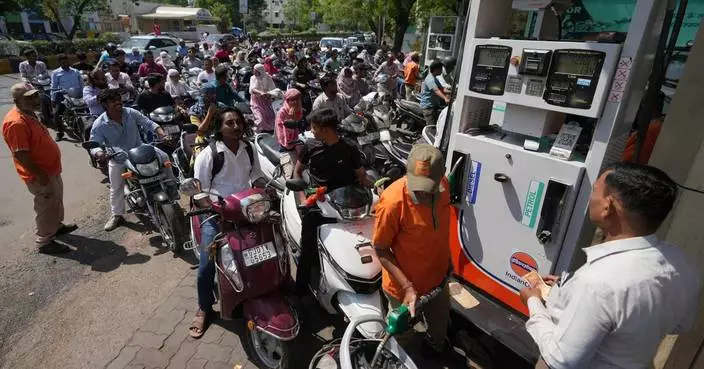
Oil prices have climbed to more than $100 a barrel and U.S. gasoline prices surged to nearly $4 a gallon. But Wright said “pragmatic solutions” to release oil from a strategic reserve and allow sanctioned oil already in transit to enter the market should help mitigate the price shocks.
He said Asia has been the most deeply affected by the supply disruptions.
Forty energy assets in nine countries have been “severely or very severely damaged,” Fatih Birol told Australia’s National Press Club on Monday. “No country will be immune to the effects of this crisis if it continues to go in this direction.”
The oil crises of 1973 and 1979 together lost 10 million barrels per day, causing “major economic problems around the world, the recessions. And today, only as of today, we lost 11 million barrels per day,” he said.
After Russia’s invasion of Ukraine, gas markets lost about 75 billion cubic meters, and have now lost about 140 BCM as a result of this crisis, he added.
The IEA released a historic 400 million barrels of stockpiled oil “to comfort the markets,” and is consulting with governments in Europe, Asia, North America and the Middle East about releasing more, he said.
▶ Read more
The U.K.’s air defense destroyer HMS Dragon was docked at Greece’s Souda Bay naval base, en route to help defend British military bases in Cyprus from Iranian drone or missile attacks.
The ship departed the U.K. on March 3, two days after an apparent Iranian drone launched from Lebanon struck the RAF Akrotiri air base, causing minor damage to an aircraft hangar. No timeline was given for HMS Dragon’s arrival off Cyprus. Reports suggest it had to complete trainings before deployment.
Meanwhile, the USS Gerald R. Ford aircraft carrier remains docked at the same naval base in Greece, 10 days after the military said it had a “not combat-related” fire while operating in the Red Sea. Its departure meant the U.S. has only one aircraft carrier supporting operations against Iran.
“All I’m saying is, we are in the throes of a real possibility of making a deal,” Trump said as he wrapped his extended exchange with reporters before boarding Air Force One.
“And I think, if I were a betting man I’d bet for it. But again, I’m not guaranteeing anything,” he said.
Speaking to reporters on Monday, Trump said the U.S. would retrieve Iran’s enriched uranium as part of a potential agreement with the Islamic Republic.
“It’s very easy, if we have a deal with them, we’re going down and we’ll take it ourselves,” Trump said as he departed from a weekend in Florida.
Trump said any deal with Iran would include ending the country’s nuclear capabilities.
“We want to see, no nuclear bomb, no nuclear weapon. Not even close to it,” he said.
Trump told reporters Monday his Middle East special envoy Steve Witkoff and Trump’s son-in-law Jared Kushner conducted talks Sunday into the evening.
He said talks would continue today.
Trump did not name any official or officials representing Tehran. Trump said the U.S. has not talked to Supreme Leader Ayatollah Mojtaba Khamenei.
Trump said if a deal is reached with Iran, the U.S. will move to take Iran’s enriched uranium critical to its disputed nuclear program.
The U.N. peacekeeping force in southern Lebanon, known as UNIFIL, said Monday that a building at its headquarters in the coastal town of Naqoura was struck by a projectile. The U.N. said it believes it “was fired by a non-state actor,” an apparent reference to the Lebanese militant group Hezbollah.
Hezbollah and Israeli forces have fought at multiple points along the border since Israel launched a renewed ground incursion into southern Lebanon. The UNIFIL statement said that “over the past 48 hours, peacekeepers have recorded intense gunfire and explosions” in the Naqoura area, and “bullets, fragments, and shrapnel have hit buildings and open areas inside our headquarters. ... As a result, peacekeepers have been restricted to shelters to avoid injury.”
UNIFIL spokesperson Kandice Ardiel said peacekeepers have also observed or heard ground combat around the villages of Khiam, Odaisseh, Mays al-Jabal, Markaba and Taybeh.
The head of Russia’s state nuclear corporation Rosatom said Monday it will evacuate more workers from Iran’s Russia-built nuclear power plant but will also keep some.
Alexei Likhachev, who said last week that Rosatom had 480 workers at the plant in Bushehr, announced that evacuations this week will leave just a few dozen Rosatom workers at the plant.
Last week, Likhachev reported a strike hit close to the working nuclear reactor without causing damage or injuries. Kremlin spokesman Dmitry Peskov told reporters that Russia had urged the U.S. to avoid hitting the plant, warning it could trigger “irreparable” consequences.
Two Iranian semiofficial news agencies close to the paramilitary Revolutionary Guard claimed that there had been no negotiations — direct or indirect — with Washington as described by Trump.
The Fars and Tasnim news agencies instead portrayed the American president as backing down due to Iran’s threats.
“Since the start of the war, messages have been sent to Tehran by some mediators, but Iran’s clear response has been that it will continue its defense until the required level of deterrence is achieved,” Tasnim’s report said. “No negotiations have taken place and none are underway. ... With this kind of psychological warfare, neither the Strait of Hormuz will return to prewar conditions nor will calm return to energy markets.”
Trump’s announcement of “productive conversations” with Iran and the postponement of a deadline for the country to reopen the strait is only the latest shift from a leader who has often been contradictory in his objectives.
Trump’s post on his Truth Social platform Monday said he would hold off on strikes for five days amid talks with Iran, roughly 12 hours ahead of the previous deadline he had set.
The president sometimes contradicts himself in the same speech, social media post or even sentence. His mixed signals about the Iran war Friday raised more questions about his administration’s strategy.
Oman’s top diplomat says his country, which has long mediated between the U.S. and Iran, is working to secure safe transit through the Strait of Hormuz. He did not elaborate.
Foreign Minister Bad Albusaidi also wrote in a social media post that Iran is not to be blamed for the war.
“Whatever your view of Iran, this war is not of their making. This is already causing widespread economic problems,” he wrote.
China’s Middle East envoy pinned the blame squarely on the U.S. and Israel for a war he said has dealt a heavy blow to the global economy and shipping lanes.
“We all know who started this war,” Zhai Jun told reporters in Beijing after a recent trip to Saudi Arabia, the UAE, Bahrain, Kuwait and Egypt.
Asked about the biggest obstacle to a ceasefire, he quoted a Chinese saying. “To untie a belt, the person who tied it is needed,” he said, repeating his government’s call for the U.S. and Israel to halt their military actions immediately and return to negotiations.
Zhai said the ongoing fighting made his delegation’s trip an unusual one, including witnessing missile interceptions above them. “We heard explosions and sirens for the first time in a real war, he said.
Trump made the announcement on his Truth Social website Monday, just hours ahead of a deadline later in the day.
Writing in all capital letters, he said the U.S. and Iran have had “very good and productive conversations” that could yield “a complete and total resolution” in the war. Talks will continue “throughout the week,” Trump said.
Speaking in Parliament, Prime Minister Narendra Modi on Monday compared the challenges caused by the war to those faced during the COVID-19 pandemic and said India needs to be equally prepared this time.
Modi said the country’s power plants have adequate coal reserves and that all power supply systems are being closely monitored as summer approaches and demand rises. He said India’s fertilizer stocks remain sufficient.
“This war is not in the interest of humanity. India is encouraging all sides to end war peacefully,” Modi said.
Associated Press journalists heard explosions across multiple points in Iran’s capital, Tehran, on Monday afternoon. It wasn’t immediately clear what was hit.
Bahrain's Defense Ministry said the projectiles were fired in the last 24 hours.
The Kremlin said Monday that any U.S. strikes on Iran’s Russia-built nuclear power plant could trigger “irreparable” consequences.
Asked about Trump’s warning to “obliterate” Iran’s power plants if it doesn’t fully open the Strait of Hormuz, Kremlin spokesman Dmitry Peskov told reporters that the “catastrophically tense” situation in the region could only be settled by political and diplomatic means.
Peskov warned that any strikes on nuclear facilities would be “extremely dangerous and fraught with possibly irreparable consequences,” adding that Russia has “conveyed relevant signals” to the U.S.
“The deliberate destruction of infrastructure in Lebanon represents a blatant Israeli policy of collective punishment,” the Egyptian Foreign Ministry said in a Monday statement.
It criticized Israel’s “systemic and deliberate” strikes, including on bridges on the Litani River in south Lebanon.
The wife of Prime Minister Benjamin Netanyahu flew to Washington early Monday for a meeting of dozens of first spouses organized by first lady Melania Trump.
According to the prime minister’s office, Netanyahu will be in the states for two or three days and is expected to return to Israel immediately afterward. The White House said the meeting of first spouses will focus on supporting children through the “safe and innovative use of technology.”
The strike on the bridge Monday in the southern village of Qaaqaaiyet al-Jisr cut a main link between the southern city of Nabatiyeh and al-Hujair valley region farther south.
The state-run National News Agency gave no further details about the latest strike on a bridge on the Litani river to be destroyed in recent days.
On Sunday, Israel struck the Qasmiyeh bridge near the southern port city of Tyre.
Lebanese President Joseph Aoun called Israel’s new targeting of bridges in the south “a prelude to a ground invasion.”
Iran’s Defense Council issued the statement as concern in Tehran grows about the potential arrival of U.S. Marines to the region.
“Any attempt by the enemy to target Iran’s coasts or islands will, naturally and in accordance with established military practice, lead to the mining of all access routes ... in the Persian Gulf and along the coasts,” the council said.
The U.S. has been trying to reopen the Strait of Hormuz, the narrow mouth of the Persian Gulf, to energy shipments. The Marines could come ashore to seize either islands or territory in Iran to support that mission. Israel also has suggested a ground operation could take part in the war.
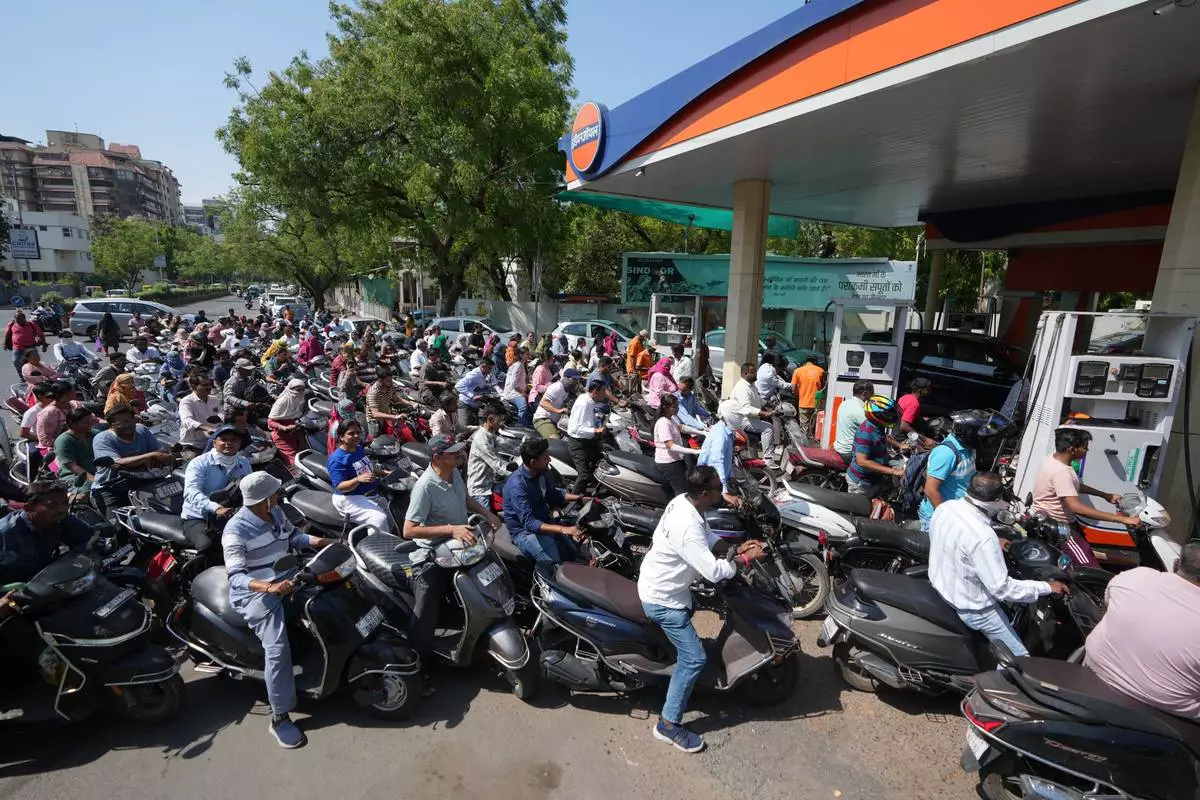
Motorists queue up to get fuel at a pump, fearing a possible fuel shortage due to the US Iran war, in Ahmedabad, India, Monday, March 23, 2026. (AP Photo/Ajit Solanki)
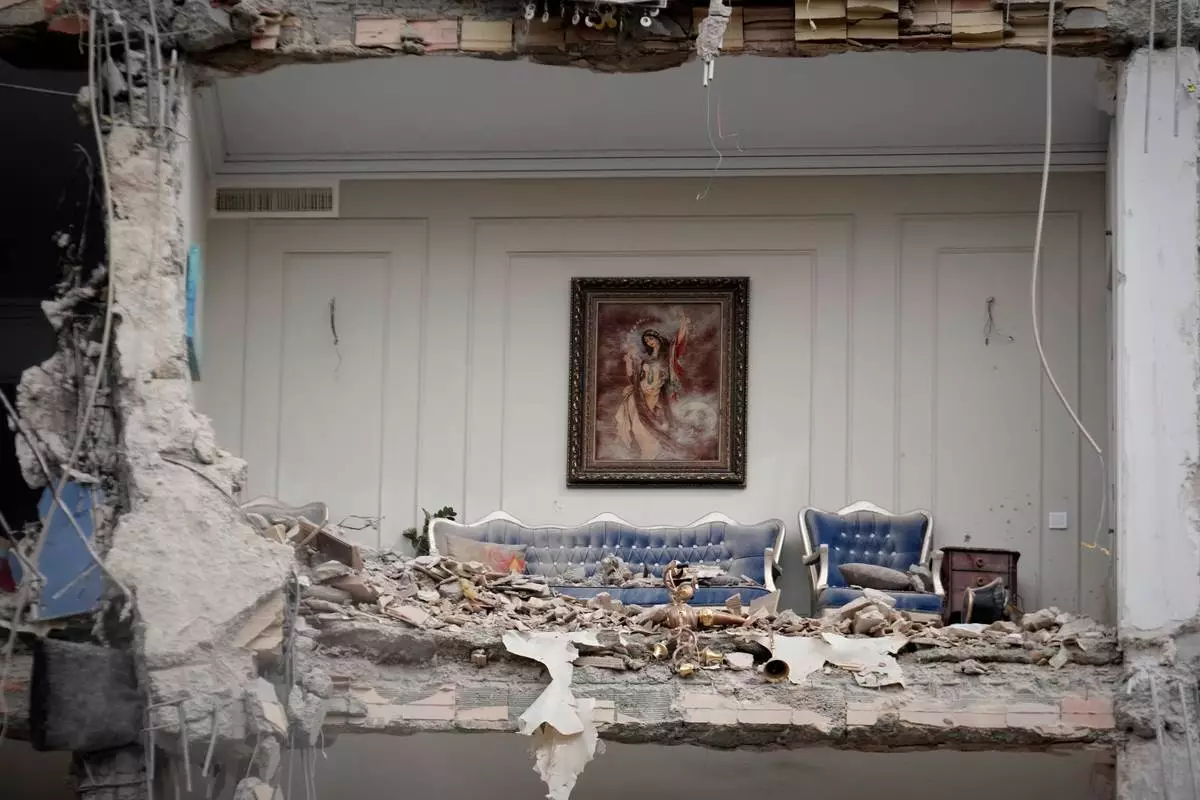
Rubble covers the furniture of a destroyed living room in a residential building hit in an earlier U.S.-Israeli strike in Tehran, Iran, Monday, March 23, 2026. (AP Photo/Vahid Salemi)
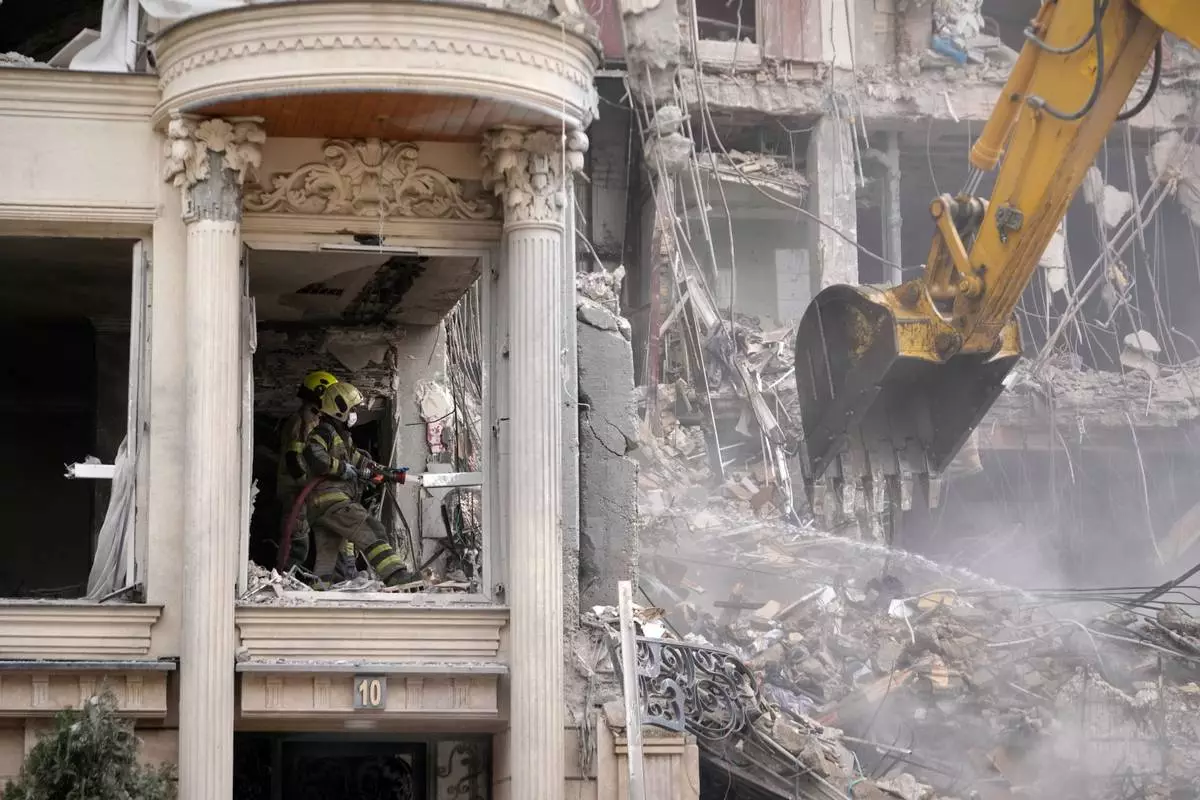
Rescue workers and first responders work at a residential building hit in an earlier U.S.-Israeli strike in Tehran, Iran, Monday, March 23, 2026. (AP Photo/Vahid Salemi)
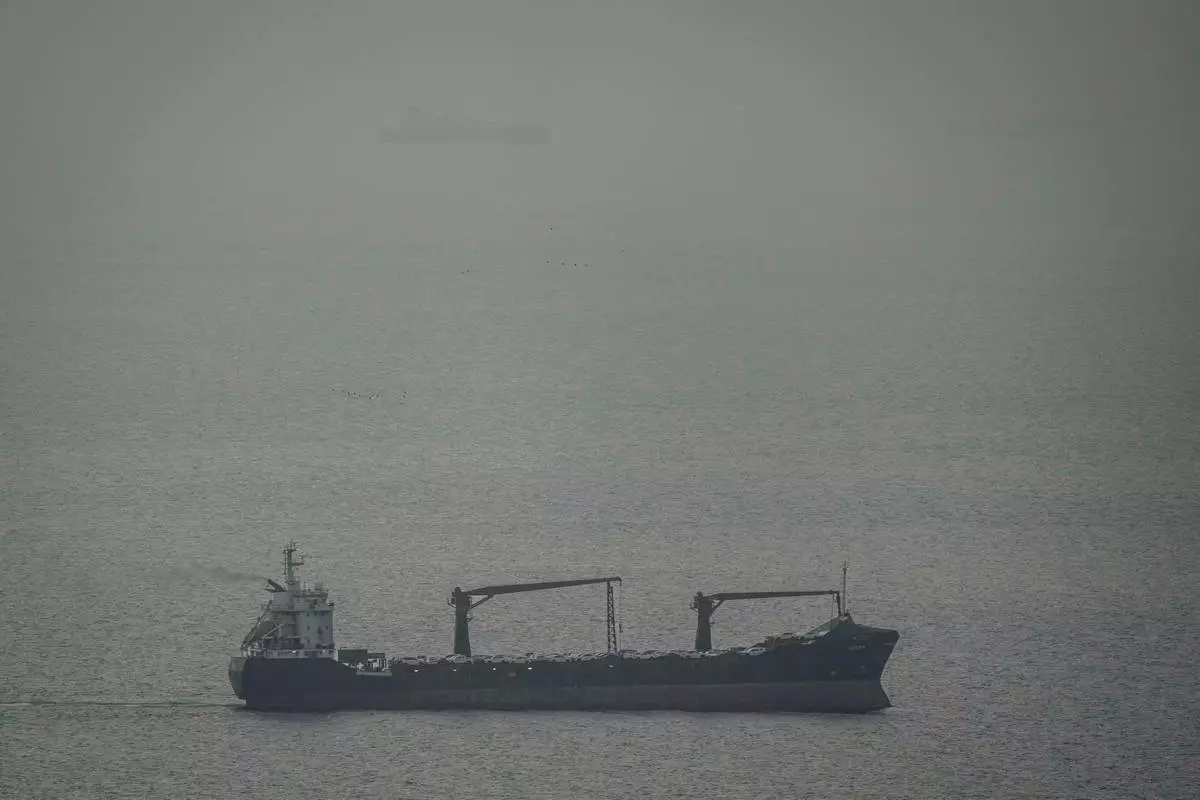
A cargo ship carrying vehicles sails through the Arabian Gulf toward the Strait of Hormuz in the United Arab Emirates, Sunday, March 22, 2026. (AP Photo)
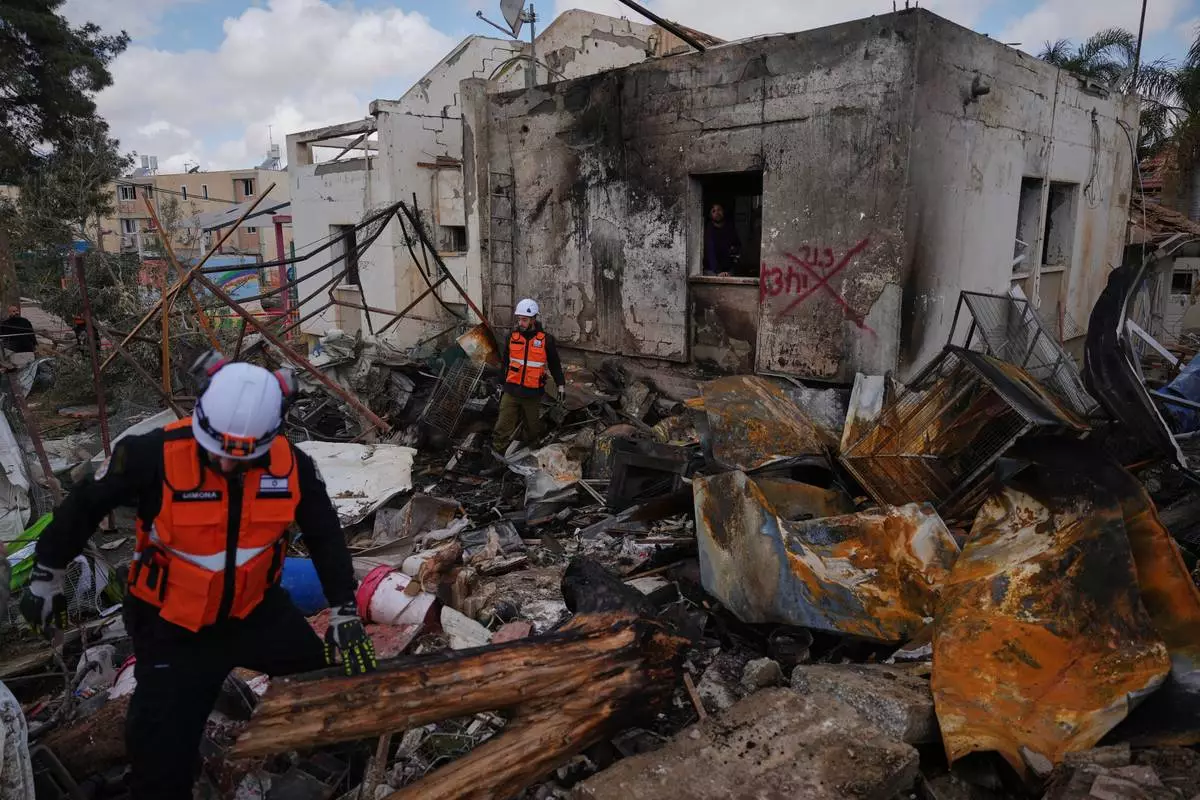
Israeli security forces survey the site that was struck by an Iranian missile in Dimona, southern Israel, Sunday, March 22, 2026. (AP Photo/Ariel Schalit)

A displaced girl feeds a baby as other children stand at tents sheltering people who fled Israeli airstrikes in Dahiyeh, in Beirut's southern suburbs, along the wall of the Pine Residence, the official residence of the French ambassador, in Lebanon. (AP Photo/Hassan Ammar)
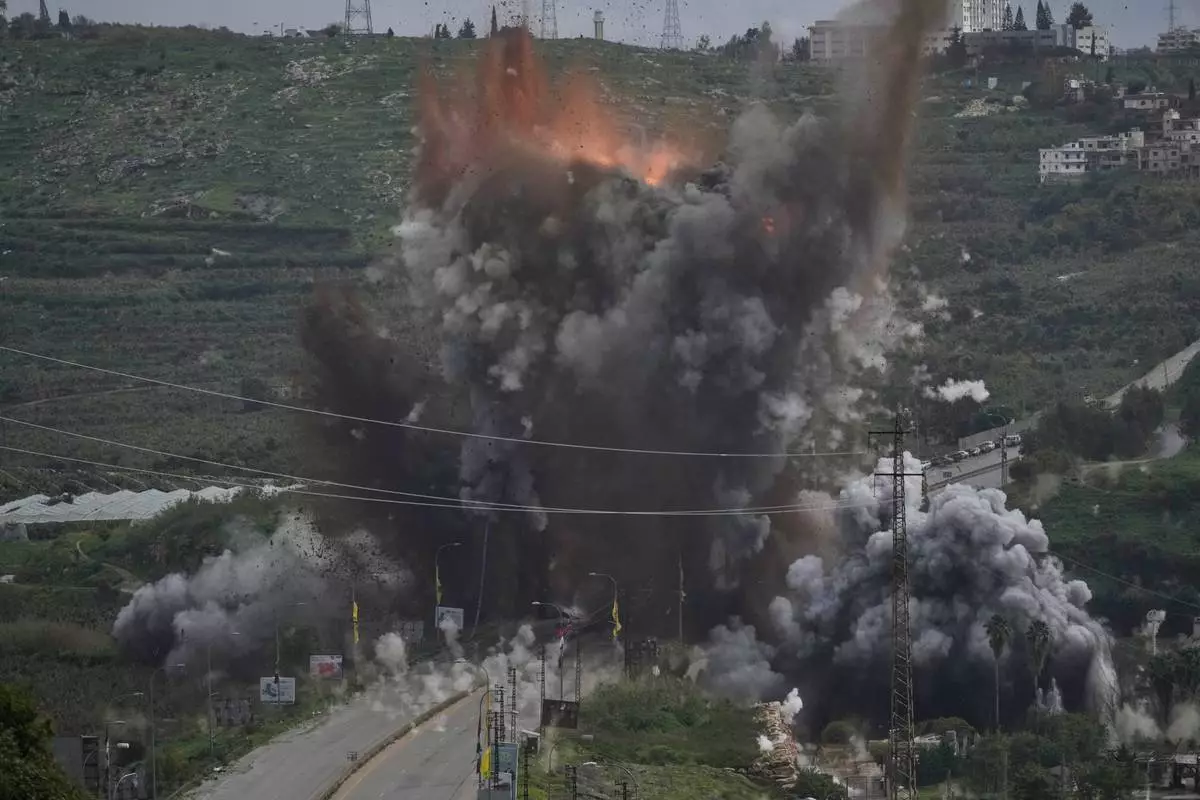
Smoke and flames rise from an Israeli airstrike that hit the Qasmiyeh Bridge near the coastal city of Tyre, Lebanon, Sunday, March 22, 2026. (AP Photo/Mohammad Zaatari)