|
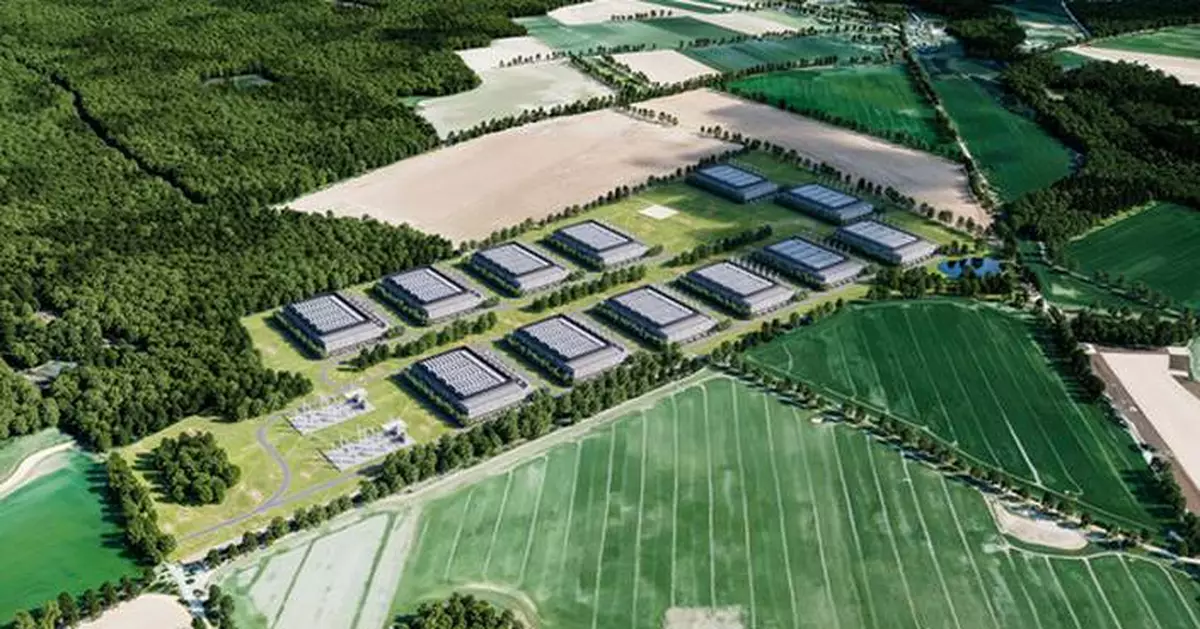
TOMASZÓW MAZOWIECKI, Poland, March 24, 2026 /PRNewswire/ -- A new hyperscale data center campus with a target capacity of 3.2 GW will be developed in Lublewo, in the municipality of Choczewo in northern Poland's Pomerania region. The project, named Baltic Data Center Campus, is being developed by WBS Power S.A., which has already secured grid connection conditions for the full 3.2 GW capacity.
"This will be the largest project of its kind in Poland and one of the largest in Europe," says Maciej Marcjanik, CEO of WBS Power.
WBS Power has taken a strategic step into the hyperscale data center sector, positioning itself as an energy infrastructure provider for AI. The company is responsible for designing, integrating and delivering large-scale, stable and low-emission energy infrastructure that will form the foundation for the development of AI, HPC and cloud infrastructure.
"This is a natural step in our growth strategy, enabling us to leverage the expertise and market experience we have developed over many years. We are building the infrastructure that will underpin the next phase of the global digital transformation," says Hubert Bojdo, CFO of WBS Power.
Preparations for the project have taken several months and included the development of the investment concept, the selection of an optimal location and the securing of suitable plot for the development. The chosen site allows the project to scale flexibly across different technological configurations while ensuring access to sufficient power sources. The company is now moving into the next phase of the project. The campus will be built in four phases, each with a planned capacity of 800 MW. Each phase will include:
- dedicated energy infrastructure for AI workloads,
- integration with renewable energy sources and battery energy storage systems (BESS),
- solutions meeting the highest ESG, energy efficiency and energy security standards,
- platforms designed to support cooperation with global hyperscalers and cloud providers.
Preparatory work for all four phases is expected to be completed by the end of 2027, with the first data center planned to become operational around 2028–2029.
"The rapid development of AI is driving demand for hyperscale data centers supported by advanced infrastructure and reliable access to large volumes of power. The integration of renewable energy and energy storage with digital infrastructure will be a key pillar of competitiveness for next-generation hyperscale projects," says Maciej Marcjanik.
The Baltic Data Center Campus will be located near one of the largest power substations in Poland. The power supplied to the campus will come from conventional sources complemented by renewable energy and, in the longer term, also nuclear power.
"The digital revolution requires infrastructure on an entirely new scale. We selected the location for the Baltic Data Center Campus very carefully, ensuring access to large power capacities, a diversified energy mix already in place today, and the long-term prospect of stable supply supported by future nuclear generation," adds Hubert Bojdo.
The Baltic Data Center Campus is not the first project of this type developed by WBS Power. The company is also advancing the Finsterwalde Data Center project in Germany, with capacity of 500 MW, designed in response to growing demand in the German market for hyperscale data centers efficiently integrated with the energy system.
WBS Power brings more than 15 years of experience in developing energy infrastructure, including renewable energy and BESS projects, high-voltage grid infrastructure and powered-land developments.
The company's activity in Poland and Germany reflects a broader trend of building a new European AI infrastructure landscape.
"We are proud that a Polish company can contribute to Europe's energy and digital transformation, strengthening its economic competitiveness and technological sovereignty," concludes Maciej Marcjanik.
CONTACT: Pola Królak, p.krolak@wbspower.com
TOMASZÓW MAZOWIECKI, Poland, March 24, 2026 /PRNewswire/ -- A new hyperscale data center campus with a target capacity of 3.2 GW will be developed in Lublewo, in the municipality of Choczewo in northern Poland's Pomerania region. The project, named Baltic Data Center Campus, is being developed by WBS Power S.A., which has already secured grid connection conditions for the full 3.2 GW capacity.
"This will be the largest project of its kind in Poland and one of the largest in Europe," says Maciej Marcjanik, CEO of WBS Power.
WBS Power has taken a strategic step into the hyperscale data center sector, positioning itself as an energy infrastructure provider for AI. The company is responsible for designing, integrating and delivering large-scale, stable and low-emission energy infrastructure that will form the foundation for the development of AI, HPC and cloud infrastructure.
"This is a natural step in our growth strategy, enabling us to leverage the expertise and market experience we have developed over many years. We are building the infrastructure that will underpin the next phase of the global digital transformation," says Hubert Bojdo, CFO of WBS Power.
Preparations for the project have taken several months and included the development of the investment concept, the selection of an optimal location and the securing of suitable plot for the development. The chosen site allows the project to scale flexibly across different technological configurations while ensuring access to sufficient power sources. The company is now moving into the next phase of the project. The campus will be built in four phases, each with a planned capacity of 800 MW. Each phase will include:
- dedicated energy infrastructure for AI workloads,
- integration with renewable energy sources and battery energy storage systems (BESS),
- solutions meeting the highest ESG, energy efficiency and energy security standards,
- platforms designed to support cooperation with global hyperscalers and cloud providers.
Preparatory work for all four phases is expected to be completed by the end of 2027, with the first data center planned to become operational around 2028–2029.
"The rapid development of AI is driving demand for hyperscale data centers supported by advanced infrastructure and reliable access to large volumes of power. The integration of renewable energy and energy storage with digital infrastructure will be a key pillar of competitiveness for next-generation hyperscale projects," says Maciej Marcjanik.
The Baltic Data Center Campus will be located near one of the largest power substations in Poland. The power supplied to the campus will come from conventional sources complemented by renewable energy and, in the longer term, also nuclear power.
"The digital revolution requires infrastructure on an entirely new scale. We selected the location for the Baltic Data Center Campus very carefully, ensuring access to large power capacities, a diversified energy mix already in place today, and the long-term prospect of stable supply supported by future nuclear generation," adds Hubert Bojdo.
The Baltic Data Center Campus is not the first project of this type developed by WBS Power. The company is also advancing the Finsterwalde Data Center project in Germany, with capacity of 500 MW, designed in response to growing demand in the German market for hyperscale data centers efficiently integrated with the energy system.
WBS Power brings more than 15 years of experience in developing energy infrastructure, including renewable energy and BESS projects, high-voltage grid infrastructure and powered-land developments.
The company's activity in Poland and Germany reflects a broader trend of building a new European AI infrastructure landscape.
"We are proud that a Polish company can contribute to Europe's energy and digital transformation, strengthening its economic competitiveness and technological sovereignty," concludes Maciej Marcjanik.
CONTACT: Pola Królak, p.krolak@wbspower.com
** This press release is distributed by PR Newswire through automated distribution system, for which the client assumes full responsibility. **
WBS Power Advances 3.2 GW Energy Infrastructure for Hyperscale Data Center Campus
SINGAPORE, March 24, 2026 /PRNewswire/ -- Hitem3D, developed by Math Magic, has recently been published as a callable Skill on OpenClaw's ClawHub, enabling developers to invoke image-to-3D generation through structured agent workflows. The release allows OpenClaw agents to execute 3D generation tasks via API-based Skill invocation, as demand grows for programmable and repeatable AI pipelines.
Packaging 3D Generation as a Callable Skill
The Skill encapsulates Hitem3D's generation capabilities into a standardized execution flow. Within OpenClaw, agents first verify API credentials, then detect task types—such as single-image, multi-view, batch processing, or portrait generation—before confirming parameters including model version, resolution, output format, and generation mode.
Once configured, the agent submits the generation job via API, polls execution status, and returns downloadable results along with a structured parameter summary. In cases of failure, workflows may include retry guidance, such as adjusting resolution or input quality.
Parameterization for Flexible Use Cases
The Skill exposes a defined capability matrix, allowing developers to control model variants, resolution tiers, output formats such as GLB, OBJ, STL, FBX, and USDZ, as well as generation modes including geometry-only or integrated texturing. This enables the same workflow to support use cases from previews to fabrication-oriented outputs.
At the model level, Hitem3D applies a structure-aware integrated texture generation approach, integrating geometry and texture generation within a unified workflow designed to improve surface consistency and downstream compatibility. This helps reduce visible seams and avoids many common texture-related issues.
Designed for Downstream Usability
The system reduces isolated or unsupported mesh elements, improving downstream usability. Outputs are compatible with common slicing software, where models can be prepared using standard repair tools.
Models may require minor adjustments before printing. In internal tests, most outputs were processed with minimal manual intervention, often using built-in auto-repair features. Wall thickness can be adjusted for typical FDM and resin printing requirements.
Developers can explore the Skill implementation and integrate it into their own agent workflows at: https://clawhub.ai/lihuihui-bj/hitem3d.
Hitem3D v2.0 is now available worldwide. Learn more about Hitem3D v2.0 and explore sample outputs at hitem3d.ai and hitem3d.ai/3dprinting/use-case.
About Hitem3D
Hitem3D, pioneered by Math Magic (founded 2024), converts single or multi-view images into production-ready 3D models for 3D printing, industrial design, and game asset creation. The platform serves users in more than 150 countries and integrates into professional digital production workflows.
** This press release is distributed by PR Newswire through automated distribution system, for which the client assumes full responsibility. **

Hitem3D Becomes Callable via OpenClaw Skills, Enabling Structured Image-to-3D Generation