HOUSTON--(BUSINESS WIRE)--Mar 24, 2026--
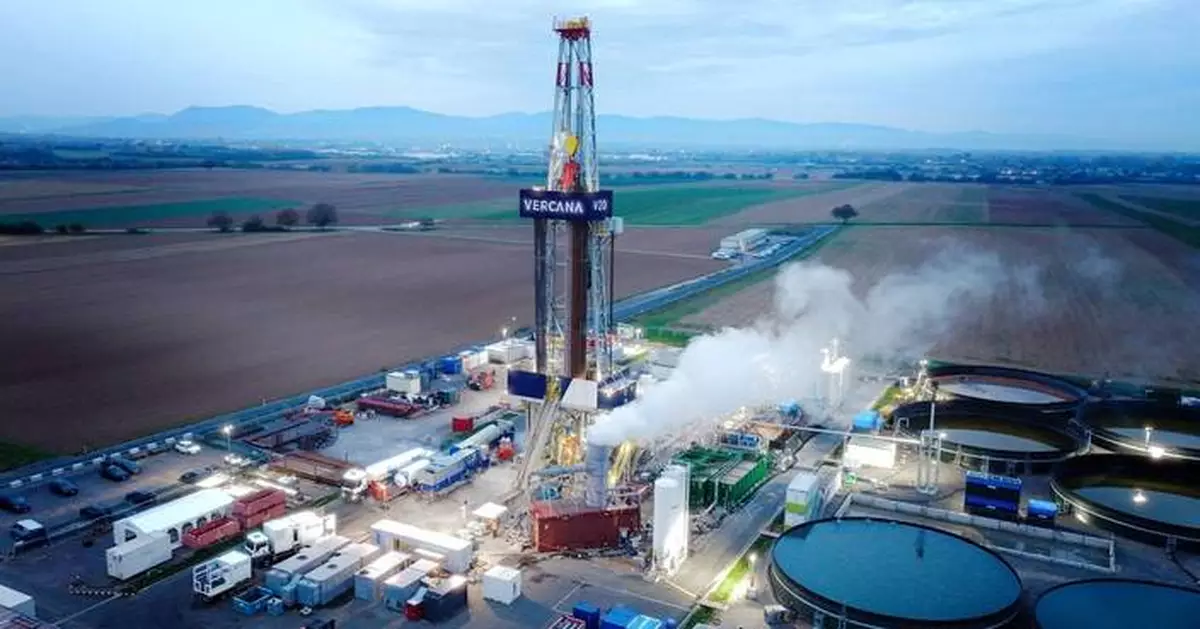
Expro (NYSE:XPRO) is set to deliver well testing services for the first Schleidberg well as part of Vulcan Energy’s Lionheart Project - one of Europe’s most significant geothermal and lithium extraction developments.
This press release features multimedia. View the full release here: https://www.businesswire.com/news/home/20260324347449/en/
The Lionheart Project, recently designated as a strategic initiative under the European Union’s Critical Raw Materials Act (CRMA), represents one of the largest geothermal and lithium extraction programs of its kind in Europe. The support further strengthens Expro’s position as a key delivery partner in the region’s growing sustainable energy sector.
Under the scope of work, Expro intends to provide a comprehensive suite of services, including its advanced GeoFlow™ Surface Well Testing package. These services support VERCANA GmbH’s and Vulcan Energy’s efforts to characterize the reservoir, assess fluid properties and develop high-performance geothermal energy and lithium extraction from its planned development.
Lionheart builds on Expro’s expanding geothermal portfolio in the region, following the recent successful well test delivery for a private developer of geothermal systems in Germany.
Expro, who have been servicing geothermal projects for over 40 years, plans to deliver the work through their European, Mediterranean and Caspian teams, leveraging expertise from across the company’s Well Flow Management and Well Intervention offerings. This aligns with Expro’s continued commitment to supporting Europe’s energy transition with scalable, high-impact solutions for low-carbon energy systems.
Andrei Ion, Managing Director for Europe, Mediterranean and Caspian, of Expro, commented: “We are proud to support VERCANA GmbH’s and Vulcan Energy on this landmark geothermal development. The Lionheart Project is not only strategically important for the region, but also a clear example of how innovation and adaptation of traditional oilfield services such as well testing and well intervention can help unlock the full potential of geothermal resources and critical raw materials like lithium.
“This partnership reflects the strength of Expro’s geothermal capabilities and our ongoing commitment to delivering safe, efficient, and future-focused services across Europe. We look forward to helping our clients achieve their energy transition ambitions.”
Marco Köpsel, managing director of VERCANA GmbH stated: “Partnering with Expro on the first Schleidberg well marks an exciting step forward in our mission to harness sustainable energy and critical raw materials. The expertise and innovative solutions provided by Expro will be instrumental in unlocking the geothermal and lithium potential of this pioneering initiative.”
Notes to Editors
Working for clients across the well life cycle, Expro is a leading provider of energy services, offering cost-effective, innovative solutions and what the Company considers to be best-in-class safety and service quality. The Company’s extensive portfolio of capabilities spans well construction, well flow management, subsea well access, and well intervention and integrity solutions.
With roots dating to 1938, Expro has approximately 7,000 employees and provides services and solutions to leading exploration and production companies in both onshore and offshore environments in more than 50 countries.
For more information, please visit and connect with Expro on Twitter @ExproGroup and LinkedIn @Expro.
SPECIAL NOTE REGARDING FORWARD-LOOKING STATEMENTS
This press release, and oral statements made from time to time by representatives of the Company, may contain certain "forward-looking statements" within the meaning of the Private Securities Litigation Reform Act of 1995. Forward-looking statements include statements regarding, among other things, the success, safety, efficiency and sustainability of the Company’s well testing and well intervention technologies, the Company’s environmental, social and governance goals, targets and initiatives, and future growth, and are indicated by words or phrases such as "anticipate," "outlook," "estimate," "expect," "project," "believe," "envision," "goal," "target," "can," "will," and similar words or phrases. These forward-looking statements involve known and unknown risks, uncertainties and other factors which may cause actual results, performance or achievements to be materially different from the future results, performance or achievements expressed in or implied by such forward-looking statements. Forward-looking statements are based largely on the Company's expectations and judgments and are subject to certain risks and uncertainties, many of which are unforeseeable and beyond our control. The factors that could cause actual results, performance or achievements to materially differ include, among others the risk factors identified in the Company’s Annual Report on Form 10-K, Form 10-Q and Form 8-K reports filed with the Securities and Exchange Commission. The Company undertakes no obligation to publicly update or revise any forward-looking statements, whether as a result of new information, future events, historical practice, or otherwise.
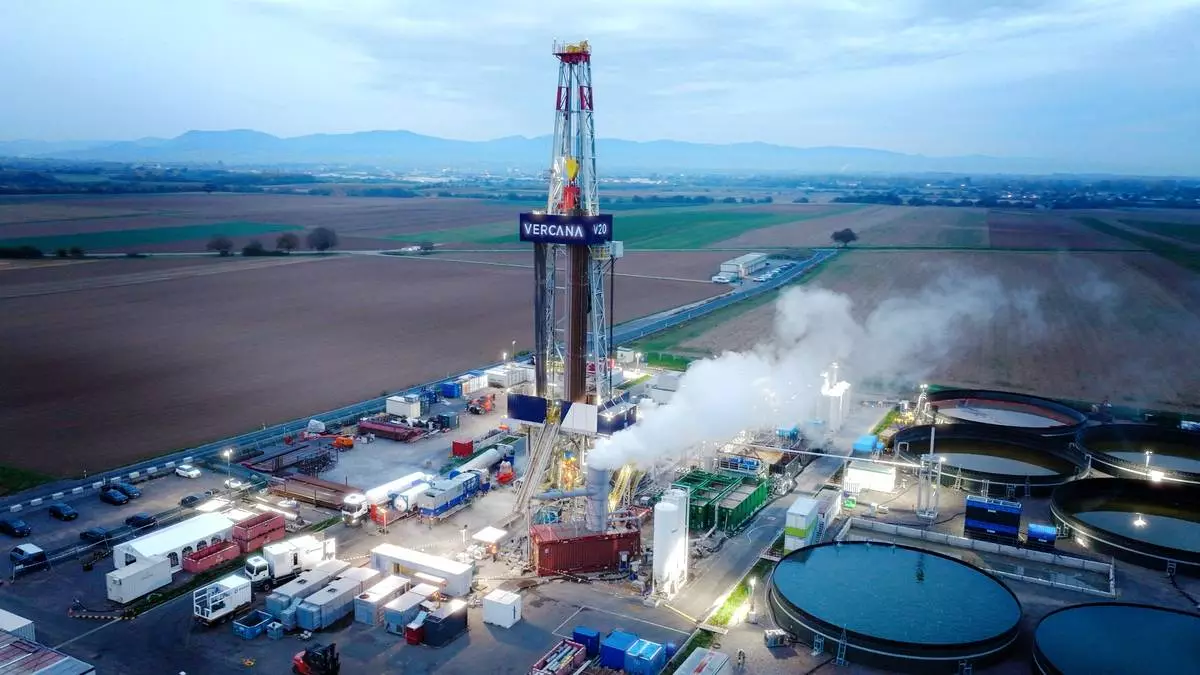
Expro partners with VERCANA GmbH to support first well in Europe’s largest geothermal and lithium cluster.
PREAH VIHEAR, Cambodia (AP) — It's been three months since a ceasefire ended bitter border fighting between Cambodia and Thailand, but signs of combat are cut deep in this 11th-century Hindu temple atop a 525-meter (1,722-foot) cliff in the Dangrek Mountains.
The neighboring Southeast Asian countries have been fighting over Preah Vihear temple on and off for decades, and that's putting the ancient holy site in danger.
Built by the same Khmer Empire that constructed Angkor Wat 160 kilometers (100 miles) southwest, the temple, which is dedicated to the Hindu god Shiva, was declared a UNESCO World Heritage site in 2008 and is held as an important cultural relic by Cambodians. The empire was Hindu, but gradually converted to Buddhism, the state religion of modern Cambodia.
But after two rounds of major combat last year, much of the structure is damaged and Cambodian officials say that parts of the temple may be in danger of collapse.
Where tourists once admired the weather-beaten structure's elaborate carvings and a magnificent view over the Cambodian plains, there is now stone debris, along with artillery craters and the ashes of burned vegetation.
“The temple has turned quiet, and its beauty looks so sorrowful because of the tragedy,” Hem Sinath, archaeologist and deputy director-general of the National Authority for Preah Vihear, told Associated Press journalists visiting earlier this month.
The site is closed to tourism due to unstable walls and concern about the presence of unexploded ordnance. Areas are roped off and dotted with signs warning of land mines, a hazard Cambodians know well after decades of Civil War that ended in the late 1990.
Conservation staff, groundskeepers and troops remain stationed in and around the temple, from which Thai soldiers can be seen just across the border.
All five of the temple’s notable gateway pavilions were damaged, three almost beyond recognition, according to a damage assessment issued in January by Cambodia’s Culture Ministry. An ancient northern staircase previously restored by a U.S.-funded conservation project sustained severe hits from repeated bombardment.
A statement issued last week by Cambodia’s Culture Ministry said the temple had suffered damage in 142 locations during the fighting in July, and at 420 more during heavier and more sustained combat in December.
“Experts have predicted that during the upcoming rainy season, some structures on the verge of collapsing could finally fall,” Hem Sinath said.
No independent outside evaluations of the damage are available.
Information Minister Neth Pheaktra accused the Thai military of relying on false information to justify incursions and of deliberately damaging the temple.
“Preah Vihear temple belongs to all humankind. It is not an enemy of Thailand,” he wrote.
International law forbids attacks on important historical sites like the temple, but Thailand has argued that Cambodia militarized the complex, voiding its wartime protection, by installing weapons systems, storing ammunition, and using the site as a base for surveillance equipment. This included a construction crane at the site, which the Thai army attacked after claiming it served as part of a military command and control system.
Thai Army spokesperson Maj. Gen. Winthai Suvaree has insisted that Thai forces directed their fire strictly at military targets.
Cambodia denies that its military ever used the temple, with its Culture Ministry writing in a statement that the temple is under civilian control and that any security forces present were there only to protect the cultural heritage site.
Each nation blames the other for starting the fighting that flared in July and December. Cambodia has reported that more than 640,000 people were displaced from border regions during the fighting, and almost 37,000 have yet to return to their homes.
The temple, known as Phra Viharn to Thais, has been at the center of a long-standing boundary dispute since the 1950s. In 1962, the International Court of Justice ruled that the temple and surrounding area of less than five square kilometers (two square miles) belong to Cambodia. The Court reaffirmed this ruling in 2013.
For years, it drew visitors from both sides of the border, with many foreign tourists arriving via Thailand before the border was closed.
Its designation by UNESCO as a Cambodian heritage site in 2008 rubbed salt into Thai wounds, and heightened nationalism stoked by domestic politics in Thailand contributed to sporadic armed conflict at the temple in 2008 and 2011.
Restoring the temple will be a major challenge. Hem Sinath fears that weakened structures could collapse during the rainy season, which normally begins in late May or early June and continues through October.
India, China and the United States have been involved in previous renovation efforts, but funding has been on hold since fighting broke out.
Hem Sinath said that new and urgent projects needed to keep the temple from deteriorating further are being hindered by concerns for safety and security while the ceasefire remains fragile.
“We have a plan; we want to do a repair — the sooner the better, but as you see, it depends on the situation along the border,” he said.
Associated Press writer Grant Peck in Bangkok contributed to this report.
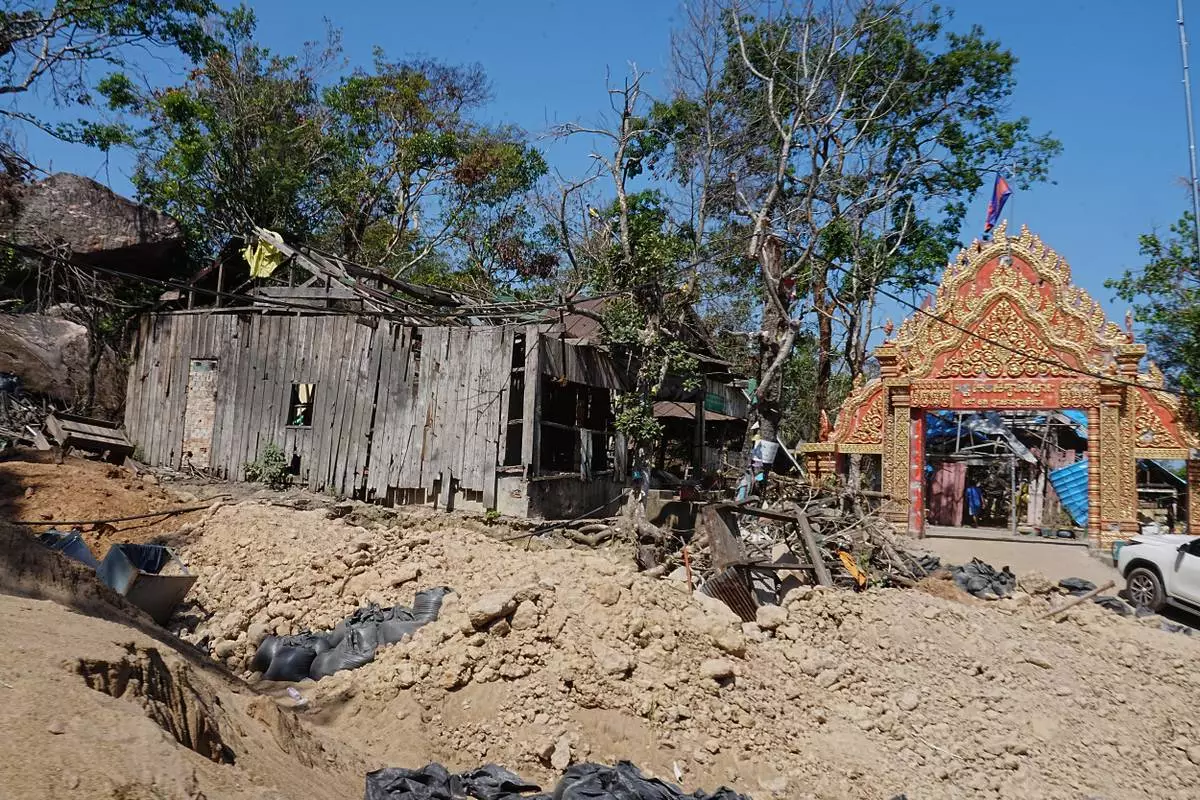
A Buddhist pagoda located beside Preah Vihear temple is seen damaged after border clashes with Thailand, at Preah Vihear province, Cambodia, Saturday, March 14, 2026. (AP Photo/Heng Sinith)
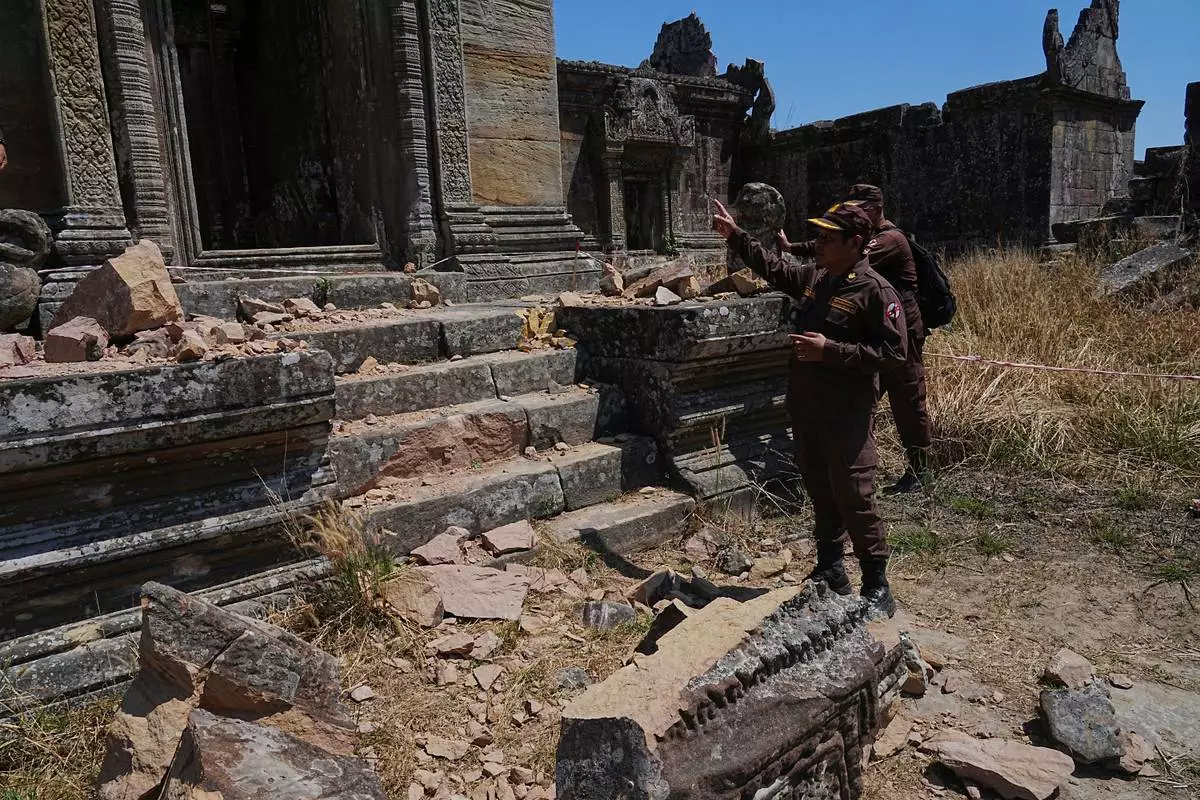
Cambodian Mine Action Center, CMAC, members stand near a temple damaged during border clashes with Thailand, at Preah Vihear province, Cambodia, Saturday, March 14, 2026. (AP Photo/Heng Sinith)
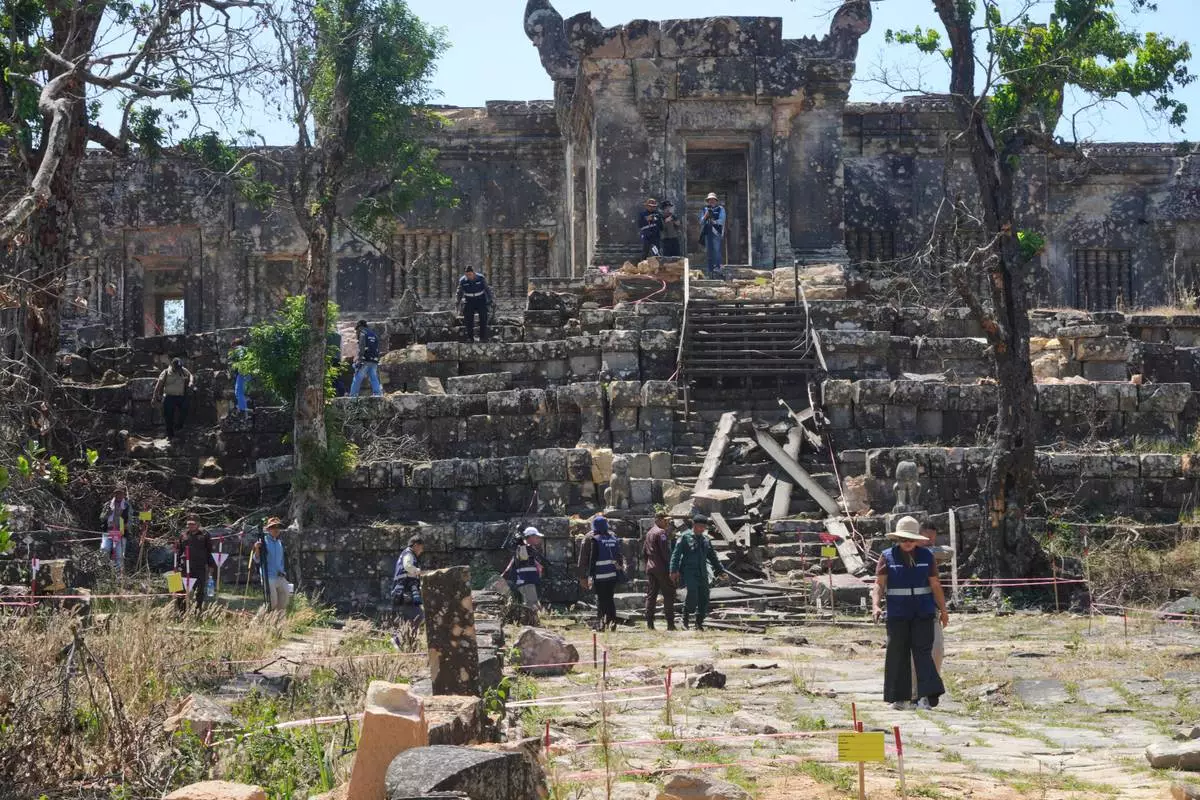
Journalists visit the Preah Vihear temple, damaged during border clashes with Thailand, at Preah Vihear province, Cambodia, Saturday, March 14, 2026. (AP Photo/Heng Sinith)
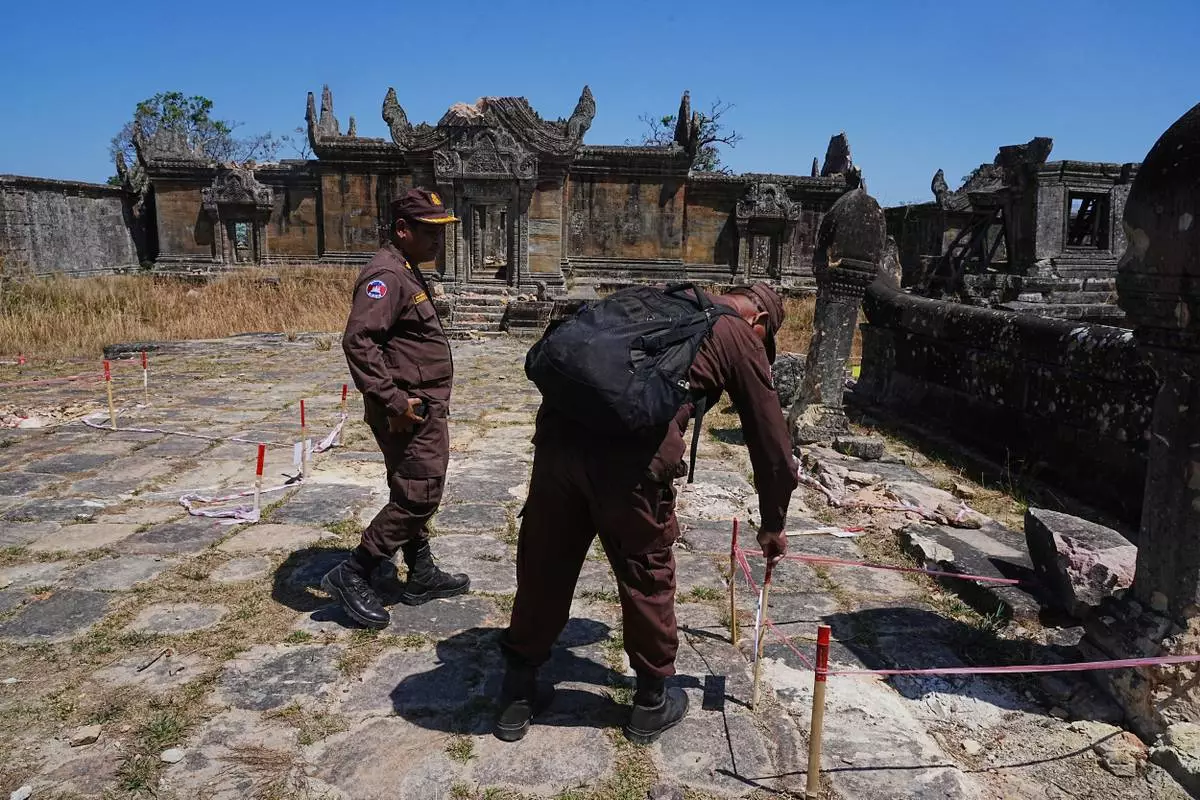
A deminer from the Cambodian Mine Action Center, CMAC, secures an area at Preah Vihear temple's pathway that was damaged during border clashes with Thailand, in Cambodia, Saturday, March 14, 2026. (AP Photo/Heng Sinith)
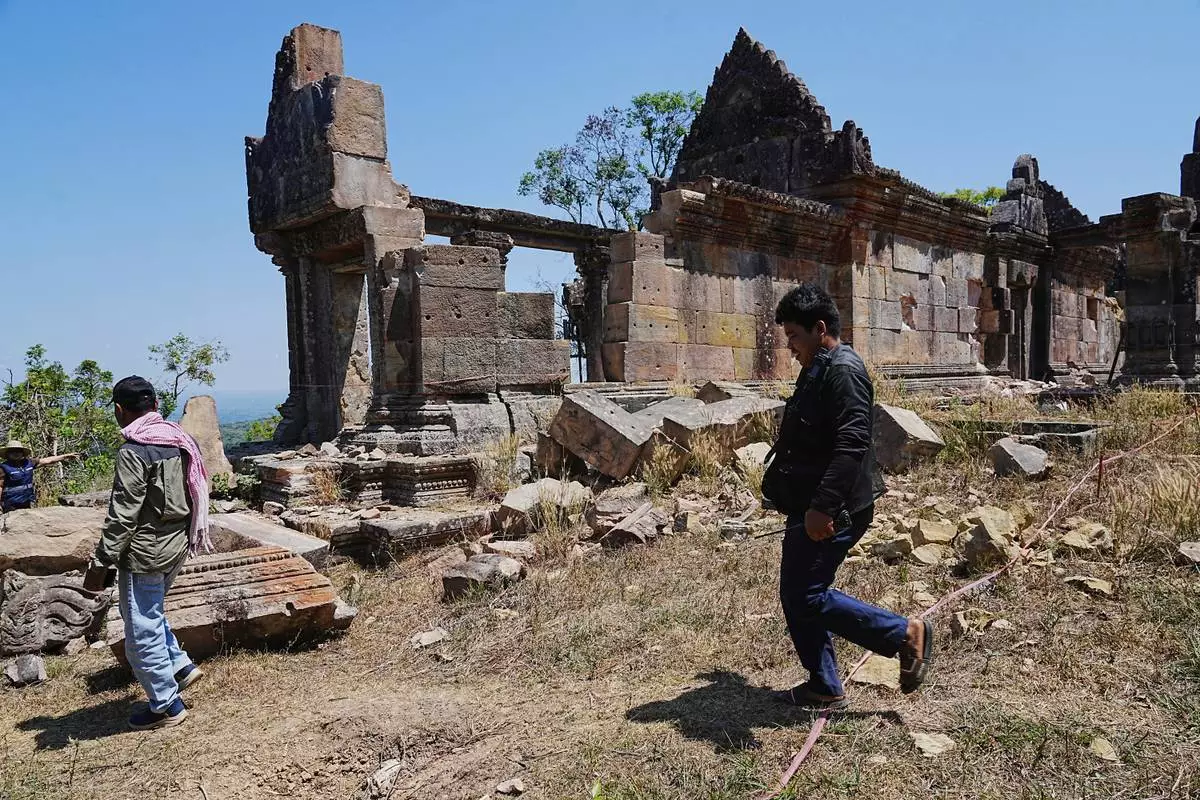
Cambodian police officers walk past a temple damaged during border clashes with Thailand, at Preah Vihear province, Cambodia, Saturday, March 14, 2026, (AP Photo/Heng Sinith)