PERTH, Australia, March 24, 2026 /PRNewswire/ -- Global Finance & Technology Network (GFTN), The University of Western Australia's Quantum Information, Simulation and Algorithms (QUISA) research group, and ST Engineering today announced a strategic partnership to jointly advance Q-FINEX, a quantum-enabled financial infrastructure initiative designed to accelerate the financial sector's readiness for the quantum era.
Unveiled at the Black Swan Summit Australia 2026 in Perth, Q-FINEX represents a significant milestone in translating quantum computing from scientific promise into real-world financial applications. The initiative is designed as a dedicated Quantum Finance Industry Experimentation testbed, bringing together three critical enablers: specialised research capability, a global network facilitating the gathering of use cases and an ecosystem, and a proven implementation partner.
"These elements work together to bridge the gap between research, real-world use cases, and implementation pathways," said Sopnendu Mohanty, Group CEO of GFTN, adding, "This collaboration is strengthened by ST Engineering, our global implementation partner that will help translate the test of experiments to real world implementations in the financial industry and contributing crucial domain expertise."
Through this collaboration, GFTN and ST Engineering will bridge the gap between quantum research and practical deployment, enabling financial institutions to experiment, validate and implement quantum-enabled solutions in a structured, real-world environment. The partnership combines GFTN's global network of central banks, financial institutions, regulators and fintech innovators with ST Engineering's deep expertise in secure digital infrastructure, cybersecurity and advanced technologies. GFTN will facilitate engagement with ecosystem partners to identify and develop real-world financial use cases, where ST Engineering's capabilities can be applied, accelerating pathways to adoption and deployment of quantum-safe solutions.
Said Tan Bin Ru, President of Enterprise Digital at ST Engineering, "Quantum is not only about chasing the future; it is also about preparing for it. Our innovations and expertise in delivering secured, mission-critical systems empower us to partner with financial institutions as they transition to achieve quantum resilience."
About Q-FINEX
Q-FINEX is designed to address three topical challenges facing the financial sector today:
- Rising market complexity, through advanced quantum-enabled modelling for faster and more precise decision-making;
- Evolving cybersecurity threats, via quantum-safe encryption to safeguard financial systems against future risks;
- The rapid growth of digital assets, enabling enhanced pricing, risk management, and security of digital asset exposures.
At its core, Q-FINEX enables financial institutions to test real-world use cases, experiment with hybrid classical and quantum algorithms using actual financial data, and evaluate the infrastructure required for a quantum-enabled future.
"This initiative aims to bridge the gap between quantum computing research and real-world deployment by transforming cutting-edge quantum algorithms into practical use cases. The testbed will support financial institutions worldwide in evaluating quantum-enabled solutions using real-world data," said Professor Jingbo Wang, Founder and Director of the Quantum Information, Simulation and Algorithms (QUISA) research group at The University of Western Australia.
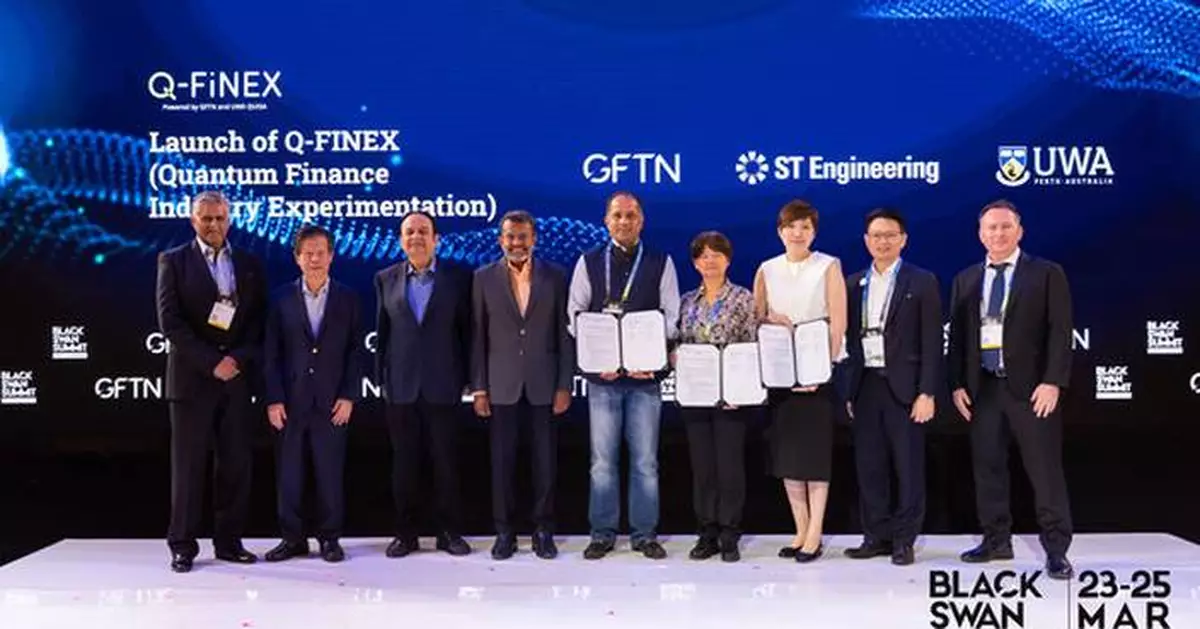
The partnership, formalised at the launch ceremony held at the second edition of the Black Swan Summit Australia at Winthrop Hall, The University of Western Australia, was attended by representatives from the key partners, including:
- Mr. Ravi Menon, Chairman, GFTN
- Professor Amit Chakma, Vice-Chancellor, The University of Western Australia
- Mr. Sopnendu Mohanty, Group CEO, GFTN
- Professor Jingbo Wang, Director, UWA QUISA
- Ms. Tan Bin Ru, President of Enterprise Digital at ST Engineering
Advancing Quantum Readiness in Finance
The partnership underscores the growing global urgency for quantum readiness as financial institutions prepare for the transformative impact of next-generation computing on encryption, risk modelling, optimisation and digital trust frameworks.
Through Q-FINEX, GFTN continues to catalyse collaboration across financial services, academia, and technology providers, shaping trusted, quantum-safe digital infrastructure for the next era of finance.
About the Global Finance & Technology Network (GFTN)
Global Finance & Technology Network (GFTN) is a Singapore-headquartered not-for-profit organisation established by the Monetary Authority of Singapore (MAS) in 2024. With offices Tokyo and Berlin, GFTN's mission is to bridge policy, capital, and technology to build financial systems that are resilient, efficient, and inclusive. GFTN operates through its commercial subsidiaries, GFTN Services and GFTN Capital. GFTN Services, through GFTN Connect, hosts global forums across five continents that bring together market makers and policymakers from over 130 countries, and GFTN Solutions offers comprehensive advisory, technology solutions, and capacity building to governments and the private sector. GFTN Capital will be a venture capital firm investing in growth-stage FinTechs globally. For more information, please visit www.gftn.co
About QUISA
The Research Centre for Quantum Information, Simulation and Algorithms (QUISA), hosted at The University of Western Australia, fosters collaboration and entrepreneurship, bringing together academic staff, research students, government and industrial partners to develop innovative quantum solutions to tackle otherwise intractable problems and complex phenomena.
About ST Engineering
ST Engineering is a global technology, defence and engineering group with a diverse portfolio of businesses across the aerospace, smart city, defence and public security segments. The Group harnesses technology and innovation to solve real-world problems, enabling a more secure and sustainable world. Headquartered in Singapore, it has operations spanning Asia, Europe, the Middle East and the U.S., serving customers in more than 100 countries. ST Engineering reported revenue of over $12b in 2025 and ranks among the largest companies listed on the Singapore Exchange. It is a component stock of MSCI Singapore, FTSE Straits Times Index and Dow Jones Best-in-Class Asia Pacific Index. Follow ST Engineering on LinkedIn.
** This press release is distributed by PR Newswire through automated distribution system, for which the client assumes full responsibility. **
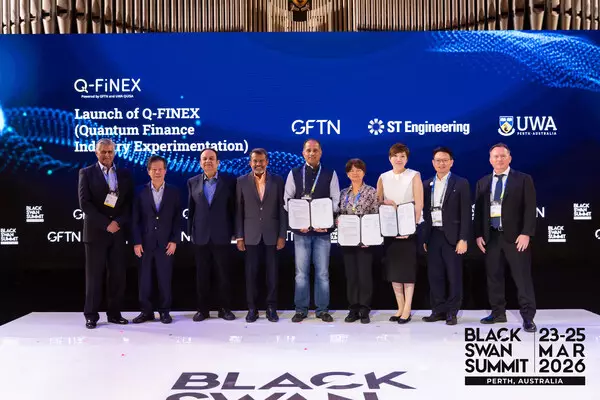
GFTN, The University of Western Australia's QUISA Research Centre, and ST Engineering Partner to Advance Quantum-Safe Financial Infrastructure through Q-FINEX