Chinese President Xi Jinping on Monday called for efforts to build the Xiong'an New Area in north China's Hebei Province into an innovation hub in the new era and a model of promoting high-quality development.
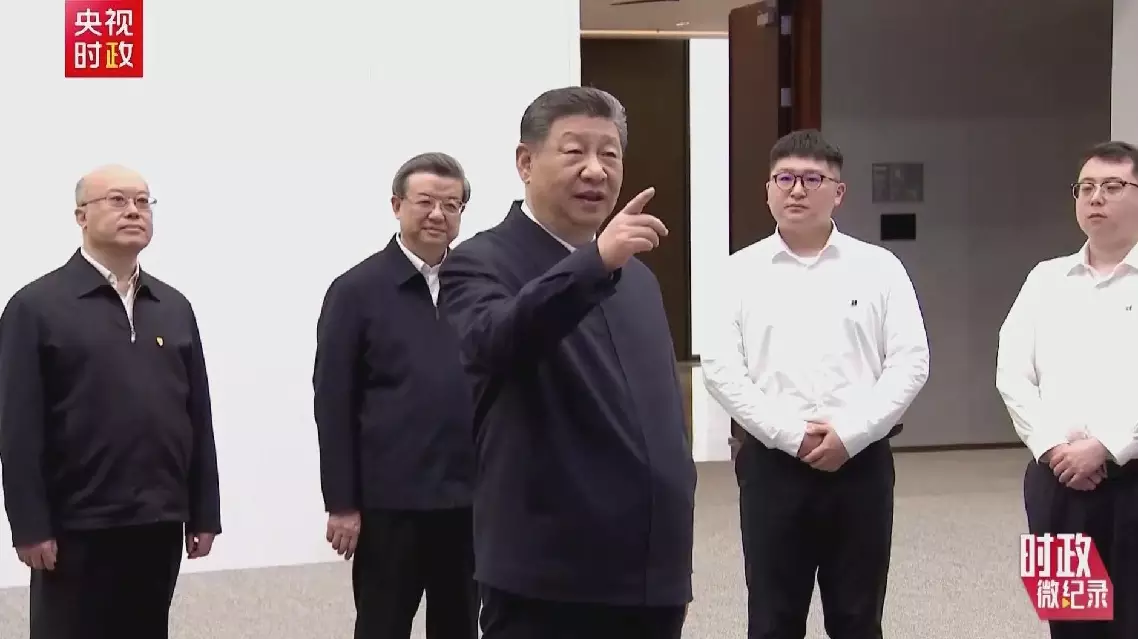
Xi, also general secretary of the Communist Party of China Central Committee and chairman of the Central Military Commission, inspected the Xiong'an New Area on Monday, where he also chaired a symposium on further advancing the high-quality construction and development of the new area.
He emphasized the need to firmly uphold Xiong'an New Area's primary functional positioning as the major recipient of functions relieved from Beijing that are non-essential to its role as China's capital.
The new area should strengthen endogenous development momentum through reform and innovation, and unlock vitality via reasonable concentration of production factors and resources, Xi said.
On Monday morning, Xi arrived in Xiong'an and traveled by vehicle to inspect construction progress in the start-up zone. He then visited China Huaneng Group Co., Ltd., which moved over 1,000 employees to Xiong'an in October 2025, and heard briefings on the company's relocation, industrial layout and innovative development.
At the company, he had a cordial exchange with representatives of officials and staff from relocated organizations already operating in the new area and those currently under construction, to learn about their life and work.
Xi also visited the Xiong'an campus of Beijing No. 4 High School, where he conversed with teachers and students in the classroom to learn about the teaching situation there. In the school canteen, he examined the dining environment and the variety of dishes available.
On Monday afternoon, Xi chaired the symposium and delivered an important speech. He acknowledged that important progress has been achieved in the construction and development of the Xiong'an New Area.
It has been fully proved that the CPC Central Committee's decision to develop the new area is entirely correct, and all related work has been solid and effective, he added.
Xi stressed efforts to relieve Beijing of functions non-essential to its role as the national capital and integrate them into the new area in a more vigorous and orderly manner, and advance the construction of relocation projects for state-owned enterprises directly administered by the central government, universities and hospitals in an active, steady and phased manner.
Xi stressed systematic planning and the integrated advancement of high-quality development and efficient governance, urging efforts to improve the public service system, safeguard and enhance people's well-being, and actively explore future-oriented smart city management models.
Xiong'an must develop a modern industrial system suited to its realities, Xi said, noting that it should advance the high-standard development of a science park to accelerate the application of scientific and technological achievements.
The new area should cultivate clusters of emerging industries and industries of the future, pioneer the implementation of innovative policies in science and technology, finance and other fields, and create a market-oriented and law-based business environment that is up to international standards, he added.
Xi further urged the new area to strengthen Party leadership and Party building while firmly establishing and practicing a correct understanding of governance performance.
Xi was accompanied by Premier Li Qiang, Cai Qi, director of the General Office of the CPC Central Committee, and Vice Premier Ding Xuexiang, who are all members of the Standing Committee of the Political Bureau of the CPC Central Committee.
Xi urges efforts to build Xiong'an New Area into innovation hub, model of high-quality development