From front-page news to powerful moments you may have missed, this gallery showcases today’s top photos chosen by Associated Press photo editors.

A cyclist rides on a coastal road at sunrise in Panama City, Wednesday, March 25, 2026. (AP Photo/Matias Delacroix)

Presidential Guards also known as Evzones, take part in a military parade to commemorate the start of Greece's 1821 war of independence against the 400-year Ottoman rule, in Athens, on Wednesday, March 25, 2026. (AP Photo/Thanassis Stavrakis)

Kaori Sakamoto from Japan skates during the women¥s short program at the Figure Skating World Championships in Prague, Czech Republic, Wednesday, March 25, 2026. (AP Photo/Petr David Josek)

American Dennis Coyle, who was released by Afghanistan's Taliban authorities who had held him for over a year, arrives in San Antonio, Wednesday, March 25, 2026. (AP Photo/Eric Gay)

Britain's Kate, Princess of Wales, and Prince William leave after the installation of Sarah Mullally as archbishop of Canterbury in Canterbury, England, Wednesday, March 25, 2026, the first woman ever to lead the Church of England. (AP Photo/Alastair Grant)

Sarah Mullally waves as she leaves after the Enthronement Ceremony installing her as archbishop of Canterbury in Canterbury, England, Wednesday, March 25, 2026, the first woman ever to lead the Church of England. (AP Photo/Alastair Grant)

A paramedic scatters flower petals on the grave of his comrade who was killed in an Israeli airstrike, at a temporary mass grave in Tyre, south Lebanon, Wednesday, March 25, 2026. (AP Photo/Hussein Malla)

Dog salon workers take cover with the dogs in a bomb shelter as air raid sirens warn of incoming Iranian missile strikes in Ramat Gan, Israel, Wednesday, March 25, 2026. (AP Photo/Oded Balilty)

An Israeli bomb drops toward a target next to a tent camp in Deir al-Balah, central Gaza Strip, Wednesday, March 25, 2026. (AP Photo/Abdel Kareem Hana)

Members of the displaced Abd el-Hajj family, and two of their cousins, right, who fled Israeli strikes in southern Lebanon, sit inside a tent used as a shelter in Beirut, Lebanon, Wednesday, March 25, 2026. (AP Photo/Emilio Morenatti)

Migrants, some carrying children, walk on the highway through the municipality of Huehuetan, Chiapas state, Mexico, Wednesday, March 25, 2026, after leaving Tapachula the previous night. (AP Photo/Edgar H. Clemente)

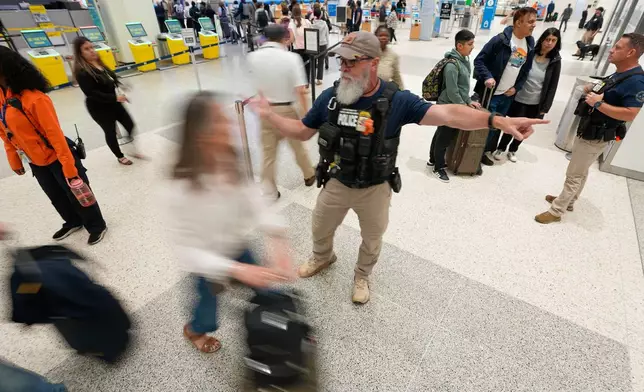
A Federal immigration officer directs passengers through a security checkpoint line at George Bush Intercontinental Airport Wednesday, March 25, 2026, in Houston. (AP Photo/David J. Phillip)

People jog among the cherry blossom trees along the tidal basin at sunrise, on Wednesday, March 25, 2026, in Washington. (AP Photo/Tom Brenner)
Click to Gallery
A cyclist rides on a coastal road at sunrise in Panama City, Wednesday, March 25, 2026. (AP Photo/Matias Delacroix)
Presidential Guards also known as Evzones, take part in a military parade to commemorate the start of Greece's 1821 war of independence against the 400-year Ottoman rule, in Athens, on Wednesday, March 25, 2026. (AP Photo/Thanassis Stavrakis)
Kaori Sakamoto from Japan skates during the women¥s short program at the Figure Skating World Championships in Prague, Czech Republic, Wednesday, March 25, 2026. (AP Photo/Petr David Josek)
American Dennis Coyle, who was released by Afghanistan's Taliban authorities who had held him for over a year, arrives in San Antonio, Wednesday, March 25, 2026. (AP Photo/Eric Gay)
Britain's Kate, Princess of Wales, and Prince William leave after the installation of Sarah Mullally as archbishop of Canterbury in Canterbury, England, Wednesday, March 25, 2026, the first woman ever to lead the Church of England. (AP Photo/Alastair Grant)
Sarah Mullally waves as she leaves after the Enthronement Ceremony installing her as archbishop of Canterbury in Canterbury, England, Wednesday, March 25, 2026, the first woman ever to lead the Church of England. (AP Photo/Alastair Grant)
A paramedic scatters flower petals on the grave of his comrade who was killed in an Israeli airstrike, at a temporary mass grave in Tyre, south Lebanon, Wednesday, March 25, 2026. (AP Photo/Hussein Malla)
Dog salon workers take cover with the dogs in a bomb shelter as air raid sirens warn of incoming Iranian missile strikes in Ramat Gan, Israel, Wednesday, March 25, 2026. (AP Photo/Oded Balilty)
An Israeli bomb drops toward a target next to a tent camp in Deir al-Balah, central Gaza Strip, Wednesday, March 25, 2026. (AP Photo/Abdel Kareem Hana)
Members of the displaced Abd el-Hajj family, and two of their cousins, right, who fled Israeli strikes in southern Lebanon, sit inside a tent used as a shelter in Beirut, Lebanon, Wednesday, March 25, 2026. (AP Photo/Emilio Morenatti)
Migrants, some carrying children, walk on the highway through the municipality of Huehuetan, Chiapas state, Mexico, Wednesday, March 25, 2026, after leaving Tapachula the previous night. (AP Photo/Edgar H. Clemente)
A Federal immigration officer directs passengers through a security checkpoint line at George Bush Intercontinental Airport Wednesday, March 25, 2026, in Houston. (AP Photo/David J. Phillip)
People jog among the cherry blossom trees along the tidal basin at sunrise, on Wednesday, March 25, 2026, in Washington. (AP Photo/Tom Brenner)
LOS ANGELES (AP) — A jury found Meta and YouTube liable Wednesday in a first-of-its-kind lawsuit that aimed to hold social media platforms responsible for harm to children using their services, awarding the plaintiff $3 million in damages.
After more than 40 hours of deliberation across nine days, California jurors decided Meta and YouTube were negligent in the design or operation of their platforms. The jury also decided each company’s negligence was a substantial factor in causing harm to the plaintiff, a 20-year-old woman who says she became addicted to social media as a child and that this addiction exacerbated her mental health struggles. This is the second verdict against Meta this week after a jury in New Mexico determined the company harms children’s mental health and safety, violating state law.
The multimillion-dollar verdict will only grow since the jury decided the companies acted with malice, oppression or fraud. This means the jurors will hear new evidence then decide on punitive damages.
Meta and Google-owned YouTube issued statements disagreeing with the verdict and vowing to explore their legal options, which includes appeals.
Google spokesperson Jose Castañeda said in the company's statement that the case “misunderstands YouTube, which is a responsibly built streaming platform, not a social media site.”
The jury determined that Meta and YouTube knew the design or operation of their platforms was dangerous or was likely to be dangerous when used by a minor. They also said the platforms failed to adequately warn of the danger, which further contributed to the plaintiff's harm.
Only nine of the 12 jurors had to agree on each claim against each defendant. Two jurors consistently disagreed with the other 10 on whether the companies should be held liable.
The jurors also decided Meta held more responsibility for harm to the plaintiff, who has been identified by her initials KGM. The jury said Meta shouldered 70% of the responsibility while YouTube bore the remaining 30%.
Meta and YouTube were the two remaining defendants in the case. TikTok and Snap settled before the trial began.
Jurors listened to about a month of lawyers’ arguments, testimony and evidence, and they heard from KGM, or Kaley as her lawyers called her during the trial, as well as Meta leaders Mark Zuckerberg and Adam Mosseri. YouTube’s CEO, Neal Mohan, was not called to testify.
Kaley says she began using YouTube at age 6 and Instagram at age 9. She told the jury she was on social media “all day long” as a child.
Lawyers representing Kaley, led by Mark Lanier, were tasked with proving that the respective defendants’ negligence was a substantial factor in causing Kaley’s harm. They pointed to specific design features they said are designed to “hook” young users, like the “infinite” nature of feeds that allowed for an endless supply of content, autoplay features, and notifications.
The jurors were told not to take into account the content of the posts and videos Kaley viewed because tech companies are shielded from legal responsibility for posted content, based on Section 230 of the 1996 Communications Decency Act.
Meta consistently argued that Kaley's struggles with mental health were not connected to her social media use, often pointing to her turbulent home life. Meta also said “not one of her therapists identified social media as the cause” of her mental health issues. But the plaintiffs did not have to prove that social media caused Kaley’s struggles — only that it was a “substantial factor” in causing her harm.
YouTube focused less on Kaley’s medical records and mental health history and more on her use of YouTube and the nature of the platform. They argued that YouTube is not a form of social media, but rather a video platform akin to television, and pointed to her declining YouTube use as she got older. According to their data, she spent about one minute a day on average watching YouTube Shorts since its inception. YouTube Shorts, which launched in 2020, delivers short-form, vertical videos with the “infinite scroll” feature that plaintiffs argued was addictive.
Lawyers representing both platforms also consistently pointed to the safety features and guardrails they each have available for people to monitor and customize their use.
The case, along with several others, has been randomly selected as a bellwether trial, meaning its outcome could impact how thousands of similar lawsuits filed against social media companies play out.
While the cases in Los Angeles and New Mexico both focused on the harms inflicted on children, there were key differences between the two. New Mexico’s lawsuit was filed by state Attorney General Raúl Torrez in 2023. State investigators built their case by posing as children on social media, then documenting sexual solicitations they received as well as Meta’s response. The jury was asked to determine if Meta violated New Mexico’s consumer protection law.
The Los Angeles case was filed by a single plaintiff against Meta, YouTube, TikTok and Snap. After the latter two settled, she argued that Meta and YouTube were addictive by design, and that they especially target young users.

Laura Marquez-Garrett, attorney for SMVLC (Social Media Victims Law Center), embraces Julianna Arnold, right, parent, outside Los Angeles Superior Court on Thursday, March 12, 2026. (AP Photo/Damian Dovarganes)

Plaintiffs attorney Mark Lanier arrives for closing arguments in a landmark trial over whether social media platforms deliberately addict and harm children on Thursday, March 12, 2026, in Los Angeles. (AP Photo/Damian Dovarganes)