The Federal Emergency Management Agency on Wednesday opened applications for a major resilience grant program that the agency canceled last year, less than three weeks after a federal judge ordered FEMA to make the funding available.
FEMA will make $1 billion available for the Building Resilient Infrastructure and Communities program, which helps states, local governments, territories and tribes take on preparedness projects to harden against natural hazards like fires, floods, earthquakes and hurricanes.
“When done correctly, mitigation activities save lives and reduce the cost of future disasters,” Karen S. Evans, FEMA's acting leader, said in a statement announcing the resumption.
The Trump administration has slashed disaster preparedness dollars across multiple FEMA programs. It’s been one year since President Donald Trump approved any state or tribe’s request for hazard mitigation funding, a typical add on to major disaster declarations.
Still, a FEMA document outlining the grant opportunity signals the administration might now be embracing aspects of mitigation to safeguard against disasters, stating that “BRIC aims to shift the focus of federal investments away from reactive post-disaster spending towards proactive infrastructure-focused hazard mitigation."
The funding announcement comes after FEMA under a previous acting leader, Cameron Hamilton, canceled the BRIC program last April, calling it “wasteful and ineffective.” That decision drew blowback from Republican and Democratic lawmakers as roughly $3.6 billion was halted for what amounted to several years’ worth of projects to protect infrastructure, communities and homes across the U.S.
A federal judge last December ruled that FEMA could not eliminate BRIC and ordered FEMA to reverse course after a coalition of 22 Democratic-led states and the District of Columbia sued the Trump administration over the cancellation. After the agency failed to release funding, U.S. District Judge Richard G. Stearns again ordered FEMA this month to take steps toward restoring the program.
Last week, FEMA announced it would resume program support for BRIC awards when the DHS shutdown ended, saying that it had finished evaluating the program that was originally signed into law during Trump's first term. Under former President Joe Biden, BRIC became too bureaucratic and “focused on ‘climate change’ initiatives,” FEMA said in a statement.
States will have 120 days to apply for the new funding opportunity, which covers fiscal years 2024 and 2025, since FEMA rescinded last year's opportunity.
While the resumed funding restores access to badly needed assistance for some areas, FEMA imposed new rules that are in line with the Trump administration’s attempt to push more responsibility for disaster management on states.
The new rules, which include the cessation of funding for hazard mitigation planning and non-financial direct technical assistance, could impact smaller communities with fewer resources and expertise.
“The program now maximizes state and local responsibility for resilience and risk reduction rather than federal investing in a wide range of activities,” a FEMA statement said.
However, the new grants also include certain caps on how much any single recipient can receive, and prioritize new applicants and “impoverished communities.” Those changes could be nods to past critiques that the BRIC program favored coastal states and was difficult for rural areas to access.
Additional changes include prioritizing major infrastructure projects that “are ready to implement,” according to FEMA, and that incentivize “the latest hazard-resistant building codes.”
Meanwhile, it's still unclear how quickly they can expect resumption of the grants they were already awarded.
BRIC’s cancellation held up construction of a flood wall in his Washington district, Rep. Rick Larsen, a Democrat and House Transportation and Infrastructure Committee ranking member, said in a statement Wednesday. “Slowing states’ ability to prepare for disasters was shortsighted, and communities like Aberdeen paid the price," Larsen said.
In the last decade, there have been almost as many weather- and climate-related disasters causing $1 billion in damages or more as there were in the 35 years preceding that, according to a Climate Central database.
Multiple studies have shown that preemptive investments in disaster readiness can yield significant savings. A 2024 study funded by the U.S. Chamber of Commerce found every $1 invested in disaster preparation saved $13 in economic impact, damage and cleanup costs.
Former FEMA officials, lawmakers and disaster survivors have expressed cautious hope that newly sworn in Homeland Security Secretary Markwayne Mullin could bring more stability to the agency after Kristi Noem’s tumultuous tenure. Mullin endorsed FEMA’s mission at his Senate confirmation hearing last week and said he backed efforts to make FEMA more effective, speed up payments to state and local jurisdictions and better serve rural communities.
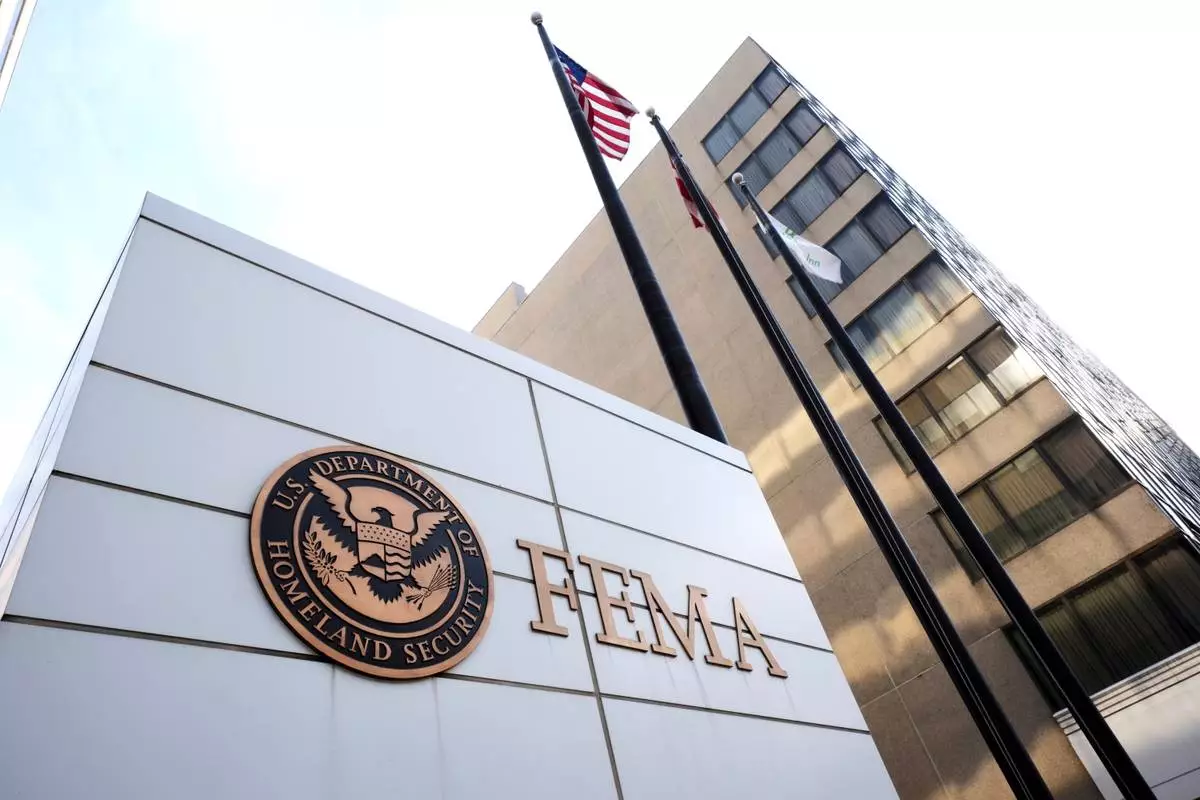
FILE - The Federal Emergency Management Agency headquarters is photographed in Washington, May 5, 2025. (AP Photo/Gene J. Puskar, File)