MEXICO CITY (AP) — Samara Martínez has written countless letters to the illness that weakens her body.
“Dear cursed one,” the Mexican activist once wrote. “I hate you because you have taken things away from me, but I love you because you have been my greatest teacher.”
At 31, Martínez is among the most prominent voices pushing to decriminalize euthanasia in Mexico. The topic has long been debated by advocacy groups, politicians and academics. However, her case has shifted that conversation into the public spotlight as lawmakers weigh possible policy changes.
Martínez developed early signs of chronic kidney failure at age 17. Despite chemotherapy, two kidney transplants, dialysis and frequent hospitalizations, her prognosis estimates she has about five years left to live.
Neither the physical toll nor the personal losses caused by the illness have broken her spirit. Martínez has told her more than half a million social media followers that her life experience has given her resilience and purpose. She often meets with politicians, hosts conferences and keeps her job as an academic in her hometown of Chihuahua, in northern Mexico.
“I would not have taken up this fight unless I had to endure what I’ve had to, so I’ve found in it my purpose,” she said.
Though not explicitly addressed in the Mexican Constitution, the General Health Law defines euthanasia as “mercy killing” and bans it along with assisted suicide.
Under federal law, assisting or inducing someone to take their own life is punishable by one to five years in prison. If a person directly causes the death, the penalty can increase to 12 years.
Colombia is the only Latin American country where euthanasia is fully legal and regulated. Ecuador decriminalized it in 2024, and Uruguay approved legislation in 2025 that is expected to be implemented.
The proposal pushed by Martínez is known as the Transcendence Law.
It was presented in 2025 by lawmakers from several political groups including Morena, the party of President Claudia Sheinbaum.
The legislation proposes to remove the explicit ban and redefine euthanasia as a legal, voluntary medical procedure. It frames it as a right tied to dignity and autonomy, arguing that life should not be understood as an obligation to prolong suffering.
If approved, the proposal would allow adults to request the procedure. It includes conscientious objection for health workers, but requires public institutions to provide willing staff.
One lawmaker supporting Martínez is Patricia Mercado, a longtime advocate for women’s reproductive and labor rights.
“Samara’s emergence — her struggle, her authenticity — brings the possibility of passing legislation closer,” Mercado said. “A testimony speaks louder than a thousand data points.”
Martínez often revisits her letters. Writing is cathartic, she said. And reading how her past self confronted her pain helps her recognize the strength she didn’t know she had.
“Today I read things I wrote four years ago and think: I was so wrong,” Martínez said. “But it’s nice to see how there’s more wisdom.”
She recalls a letter from 2021. Her doctor told her that her kidneys could no longer function on their own and she had two options: a transplant or relying on treatments that take over the kidneys’ role of removing waste and excess fluid from the body.
Back then Martínez saw the latter as unthinkable. “I thought I could never live connected to a machine,” she said. But she now undergoes peritoneal dialysis every night, connected for hours to a piece of medical equipment about the size of a printer that she must carry with her wherever she goes.
“An illness like this isn’t for everyone and it’s hard to embrace the pain,” Martínez said. “You can stop living and just exist, but I don’t want that.”
There was a time when Martínez loved sports. She played soccer and was careful with her diet, thinking she was on track to live a healthy life.
She met her husband in 2013 at university, where she became a journalist. The couple married five years later despite Martínez’s warnings regarding her health.
“Are you sure you want to do this?” she asked him soon after being diagnosed with a broader set of health complications including lupus, an autoimmune disease. He answered that no adversity would ever take him from her side.
By the time the marriage crumbled in 2024, Martínez had lost more than love. After more than a decade of severe illness, she had also lost her dream job at a publishing house after telling her boss she would undergo a transplant and might need a week to recover. Debt piled up, forcing her to sell her home and leading her parents to take out loans. Long-time friends vanished.
Vomiting, weight gain from steroids used in her treatment and hospitalization became part of her routine. Martínez has actively avoided presenting herself as a victim and strongly rejects pity. But she said that at certain stages, anger and doubt became unavoidable.
“I consider myself agnostic, but there are moments when you look up at the sky and question God — why me?” she said. “Now I practice stoicism and live each day with gratitude.”
Critics of her stance often flood Martínez with abusive messages online. “I’ve been told that if God wants me to suffer, then I should suffer,” she said.
Opposition to euthanasia remains strong among conservative and religious groups in Mexico. Following the presentation of Martínez’s proposal, the Catholic Church echoed Pope Leo’s call to uphold the sanctity of life.
Rodrigo Iván Cortés, president of a conservative advocacy group, said they view life as something that must be protected from the womb through old age. “For us, the value of life spans every stage,” he said.
Among the few religious leaders supporting Martínez’s cause is the Rev. Héctor Reyes, who collaborates with the organization “For the Right to Die with Dignity.” The group has defended euthanasia for almost two decades.
“Transcendence has everything to do with the God I believe in,” said Reyes, who added that people should not remain trapped in the image of a judgmental and punishing God. “For me, transcendence lies in the hope that life doesn’t end with physical death.”
Martínez has said she has no intention of giving up. Yet when her body gives out, she dreams of saying her farewells by the sea.
It is not cowardice that drives her, she has said, but the belief that choosing how to die is the most courageous decision of her life.
Her parents struggled the day she told them she would spend her remaining days fighting for euthanasia. “That meant beginning to grieve while I was still alive,” she said. “When my father asked me why I had to fight for this, I told him that if I didn’t do it, no one else would.”
Martínez says she’s aware that she might not live to see the outcome of her fight. But pushing for change, she says, has already been worth it.
When the end is near she wishes for a sunset far from a hospital bed. A gathering to celebrate her life, surrounded by family and friends.
“That’s what my life deserves,” she said. “A proper time to say goodbye, to laugh and cry, and leave in peace.”
Associated Press religion coverage receives support through the AP’s collaboration with The Conversation US, with funding from Lilly Endowment Inc. The AP is solely responsible for this content.
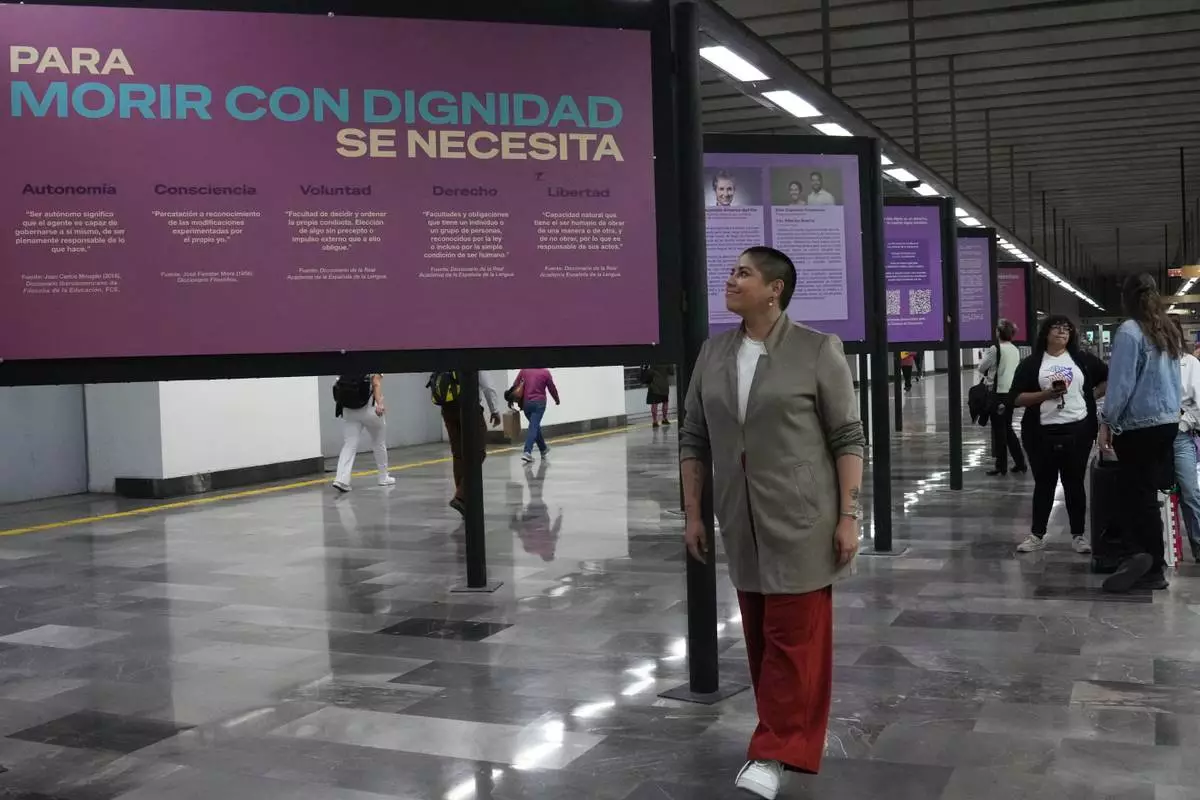
Samara Martínez, a supporter of a law to decriminalize euthanasia, stands next to the "Muerte Digna," or Dignified Death, exhibition at the Ermita metro station in Mexico City, Monday, March 23, 2026. (AP Photo/Marco Ugarte)
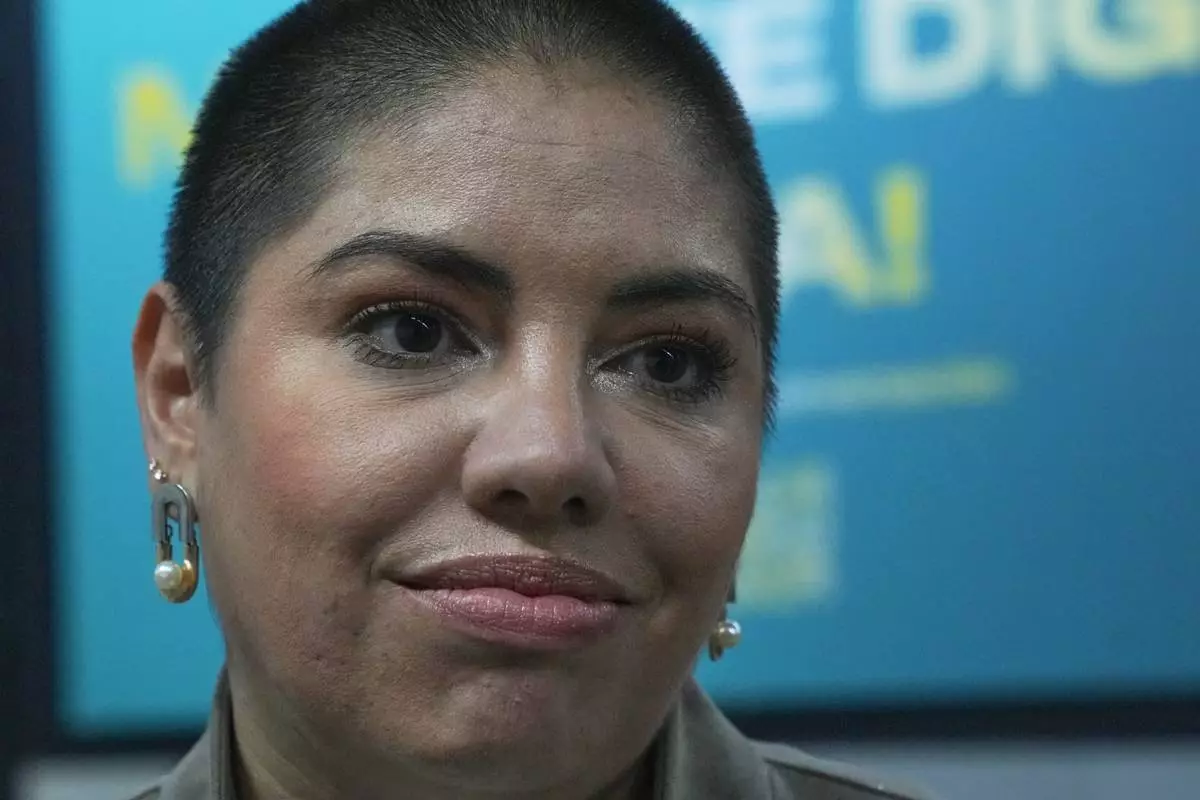
Samara Martínez, a supporter of a law to decriminalize euthanasia, looks on during the "Muerte Digna" exhibition at the Ermita metro station In Mexico City, Monday, March 23, 2026. (AP Photo/Marco Ugarte)
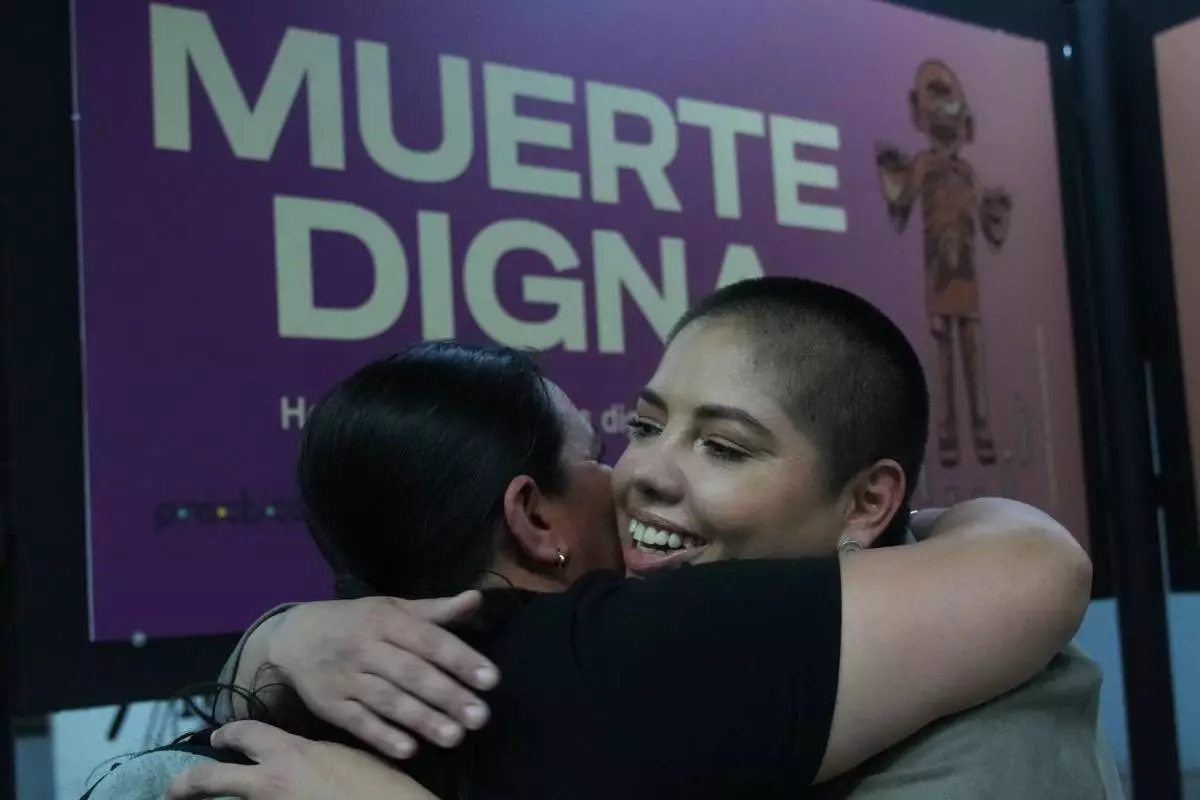
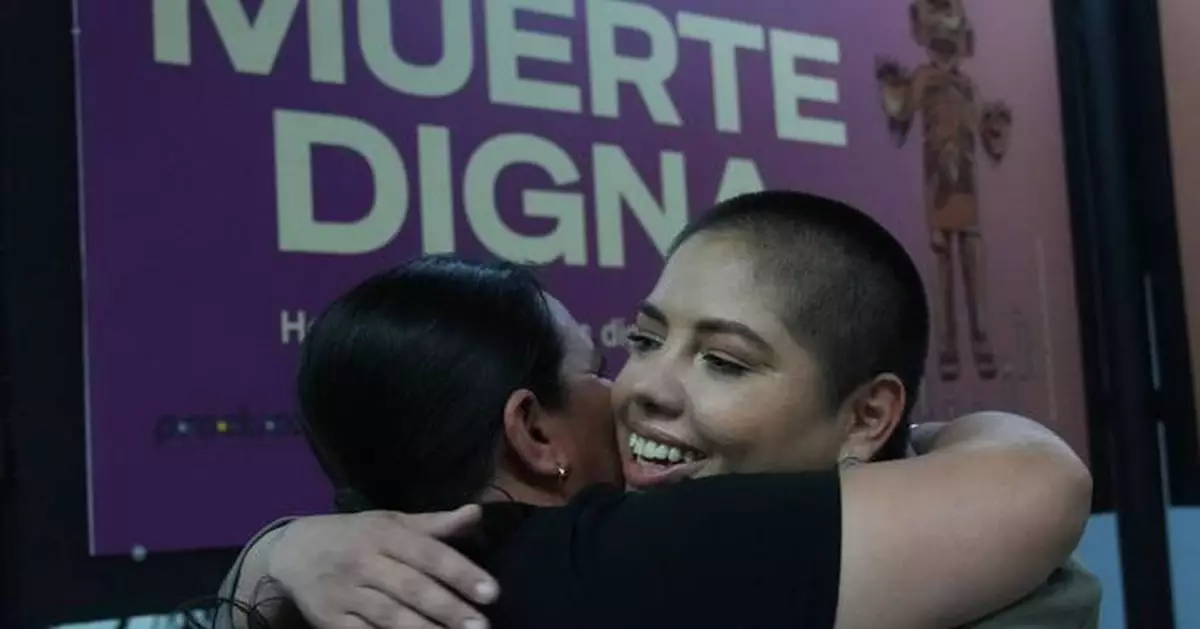
Samara Martínez, a supporter of a law to decriminalize euthanasia, hugs a friend during the "Muerte Digna," or Dignified Death, exhibition at the Ermita metro station in Mexico City, Monday, March 23, 2026. (AP Photo/Marco Ugarte)

VATICAN CITY (AP) — Pope Leo XIV called Monday for robust regulation of artificial intelligence and for its developers to work for the common good rather than profit, issuing a sweeping manifesto on safeguarding humankind as the technology impacts everything from work to war.
“Magnifica Humanitas” (Magnificent Humanity), Leo’s first encyclical, has been eagerly awaited ever since history’s first U.S.-born pope announced days after his election that he considered AI to be the biggest challenge facing humanity today.
In the text, Leo denounced the “culture of power” driving the AI race, especially in developing ever more sophisticated methods of remote warfare. He declared that it was “not permissible” to entrust irreversible, lethal decisions to AI systems, setting up another flash point between the American pope and the Trump administration, which has worked aggressively to deregulate AI development.
“Artificial Intelligence now demands to be disarmed, freed from logics that turn it into an instrument of domination, exclusion and death,″ the pope told a special Vatican presentation of the encyclical, one of the most authoritative types of teaching documents a pope can issue.
Experts in the tech industry, academia and Catholic morality said the document will likely become a benchmark in the debate over AI, a point of reference for policymakers, researchers and ordinary folk alike. It comes as the near-daily developments in the technology trigger concerns over AI replacing human jobs and even human intelligence.
Taylor Black, a Microsoft AI executive and director of Catholic University of America’s AI institute, said the document would prompt people “at the forefront of these tools” to ask questions such as “What does it mean to be human?”
The Vatican launch also included remarks by the co-founder of Anthropic, which is currently locked in a legal battle with the Trump administration over access to its AI technology. The Vatican decided to involve Anthropic as part of its decade-long effort to engage Silicon Valley in dialogue over the human cost of AI.
And yet in his text, Leo repeatedly blasted the concentration of power and data in the hands of so few people in the private sector as a danger, especially to children and the most vulnerable, and called for external regulation of their work.
“It is not enough to invoke ethics in the abstract; robust legal frameworks, independent oversight, informed users and a political system that does not abdicate its responsibility are required,” he wrote. “A more moral AI is not enough if that morality is determined by a few.”
Leo appealed to AI developers and political leaders responsible for regulating them to slow down and reflect on what they are doing. He urged them to use ethical and spiritual guidelines to make the choice to work not for their own profit or power, but the betterment of humanity.
AI competitors OpenAI and Anthropic are the second- and third-most valuable U.S. private companies, each valued at hundreds of billions of dollars, more than the GDP of many nations. Both companies are heading toward near-trillion dollar IPOs.
Anthropic co-founder Christopher Olah welcomed Leo's criticism and concern. He said such external checks were fundamental to the technology “going well” for humankind since there is so much at stake — “a real possibility that AI will displace human labor at a very large scale.”
“We need more of the world — religious communities, civil society, scholars, governments — to do what His Holiness has done here: to take this seriously, to look closely, and to push events in a better direction,” Olah said. “We need moral voices that the incentives cannot bend.”
In a methodical text, the math major pope traced the history of the Catholic Church’s social teaching and applied its core concepts — justice, solidarity, the dignity of work and the universal destination of resources — to the digital revolution.
“I am convinced that this will prove to be a defining document for our era, a profound and prophetic document,” said Paolo Carozza, law professor at Notre Dame Law School and chair of the Meta Oversight Board.
“Pope Leo is offering a clear, comprehensive, and coherent voice urging us to take responsibility for constructing a world in which technology will serve humans rather than degrade them,” he said.
In its strongest chapters, Leo denounced how AI had helped accelerate the “normalization of war” by desensitizing people to its cost. He didn’t name specific conflicts, but cited “opposing imperialisms, between powers that wish to preserve their supremacy, and those that aspire to seize that supremacy.”
He demanded transparency and accountability by AI developers so that the chain of decision-making command in ordering strikes with AI weaponry is always known. He declared that the Catholic Church’s “just war” theory, which provides specific criteria for when force can be justified, was now “outdated” given the technological advances of warfare.
Leo signed the text May 15, the 135th anniversary of the publication of “Rerum Novarum” (Of New Things), the most important teaching document of Leo’s hero and namesake, Pope Leo XIII. That document addressed workers’ rights, the limits of capitalism, and the obligations that states and employers owed workers as the Industrial Revolution was underway.
It became the foundation of modern Catholic social thought, and the current pope cited it at the start of his pontificate in relation to the AI revolution, which he believes poses the same existential questions that the Industrial Revolution posed over a century ago. “Magnifica Humanitas” thus becomes the latest chapter in a century-long history of popes adapting “Rerum Novarum” to the social questions of their times, often dwelling on the dignity of work for human flourishing.
AI is evoking both existential fears and utopian vision amid an intensifying debate on whether it will become a catalyst that enriches humanity or a technological toxin that dulls human intelligence while wiping out millions of high-paying jobs.
“The pursuit of greater profits cannot justify choices that systematically sacrifice jobs, because the human person is an end, not a means, and the economic order must remain subordinate to human dignity and the common good,” Leo wrote.
Leo extended his concern for upholding human dignity in labor to issue the first-ever papal apology for the Holy See’s own role in legitimizing slavery by giving European sovereigns explicit authority to subjugate and enslave “infidels.”
Vatican officials declined to say who contributed to Leo’s encyclical. But Vatican and church officials have been engaged in a dialogue with Silicon Valley tech firms for a decade.
The decision to include Anthropic at the Vatican launch was criticized by some who considered it a papal stamp of approval of the AI firm, which is currently suing the Trump administration after it ordered all U.S. agencies to stop using Anthropic’s technology for its refusal to allow the U.S. military unrestricted use of it.
Brian Boyd, U.S. faith liaison for the nonprofit Future of Life Institute, read the inclusion of Anthropic’s co-founder Olah as a recognition of its prominence in the field and as similar to a papal audience with a head of state: not an endorsement.
Anthropic is an “enormous corporation that is taking onto itself an enormous risk and responsibility,” Boyd said, adding that the company has “demonstrated genuine goodwill and integrity and interest in dialogue.”
Winfield reported from Middletown, Connecticut, and Huamani reported from Los Angeles. Associated Press writers Kelvin Chan in London and Colleen Barry in Milan contributed to this report.
Associated Press religion coverage receives support through the AP’s collaboration with The Conversation US, with funding from Lilly Endowment Inc. The AP is solely responsible for this content.
Pope Leo XIV, left, attends the presentation of his first encyclical, "Magnifica humanitas: On Safeguarding the Human Person in the Time of Artificial Intelligence," at the Vatican, Monday, May 25, 2026. (AP Photo/Alessandra Tarantino)
Anthropic co-founder Christopher Olah speaks during the presentation of Pope Leo XIV's first encyclical, "Magnifica humanitas: On Safeguarding the Human Person in the Time of Artificial Intelligence," at the Vatican, Monday, May 25, 2026. (AP Photo/Alessandra Tarantino)
Pope Leo XIV attends the presentation of his first encyclical, "Magnifica humanitas: On Safeguarding the Human Person in the Time of Artificial Intelligence," at the Vatican, Monday, May 25, 2026. (AP Photo/Alessandra Tarantino)
Pope Leo XIV, left, greets Anthropic co-founder Christopher Olah during the presentation of the Pope's first encyclical, "Magnifica humanitas: On Safeguarding the Human Person in the Time of Artificial Intelligence," at the Vatican, Monday, May 25, 2026. (AP Photo/Alessandra Tarantino)
Pope Leo XIV waves to faithful at the end of the Pentecost Mass in St. Peter's Basilica, at the Vatican, Sunday, May 24, 2026. (AP Photo/Gregorio Borgia)