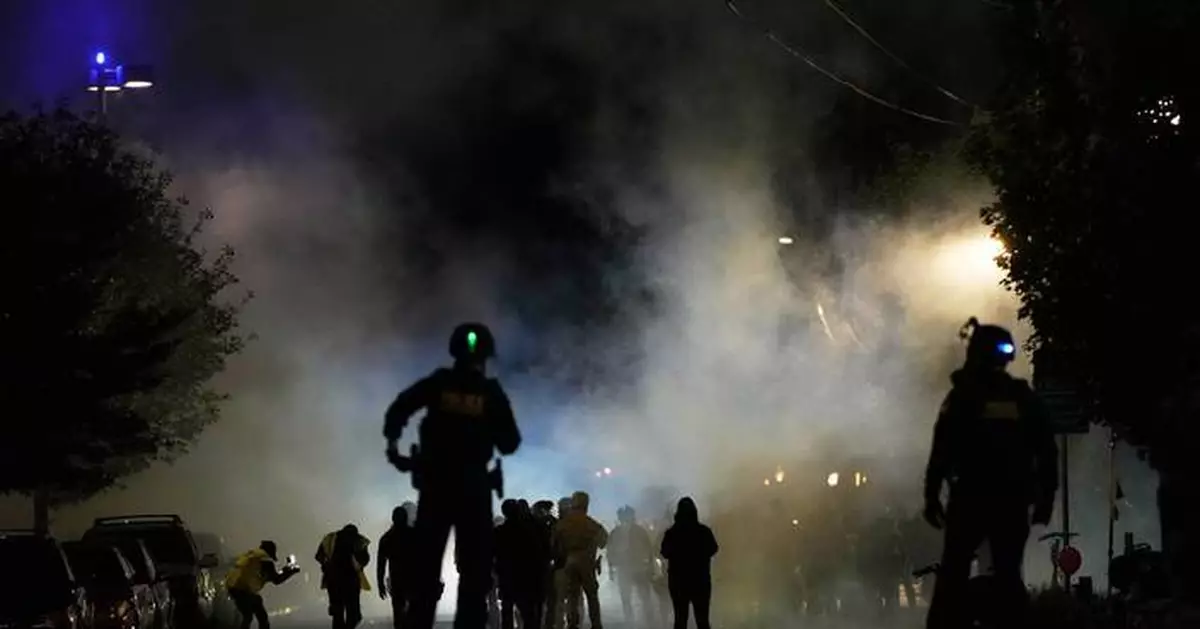
PORTLAND, Ore. (AP) — An appeals court has paused lower court rulings in Oregon that restricted federal officers' use of tear gas during protests at the U.S. Immigration and Customs Enforcement building in Portland.
A three-judge panel at the 9th U.S. Circuit Court of Appeals granted the Trump administration's request for temporary administrative stays in two cases on Wednesday. The 2-1 decision came from two judges appointed by President Donald Trump, with the dissenting judge appointed by former President Joe Biden.
The building has been the site of persistent protests over the administration's aggressive deportation practices since last June, including months of nightly demonstrations and repeated efforts by federal authorities to disperse even small crowds with chemical munitions. At a large-scale demonstration in late January, they fired tear gas at hundreds of people, including children, during a daytime march.
The federal responses prompted one lawsuit by the ACLU of Oregon on behalf of protesters and freelance journalists, and another by residents of an affordable housing complex across from the Portland ICE building. The lawsuits argue that federal officers' use of chemical and projectile munitions has violated the rights of protesters and residents.
The Department of Homeland Security, a defendant in both cases, has said it is authorized to do what is appropriate and necessary to defuse violence against officers.
Earlier this month, the federal judges in Portland overseeing the separate cases both issuedpreliminary injunctions limiting federal agents from using chemical munitions unless someone poses an imminent threat. The Trump administration appealed the rulings.
In its order, the 9th Circuit panel said oral arguments in the two cases will be consolidated and scheduled for April 7.
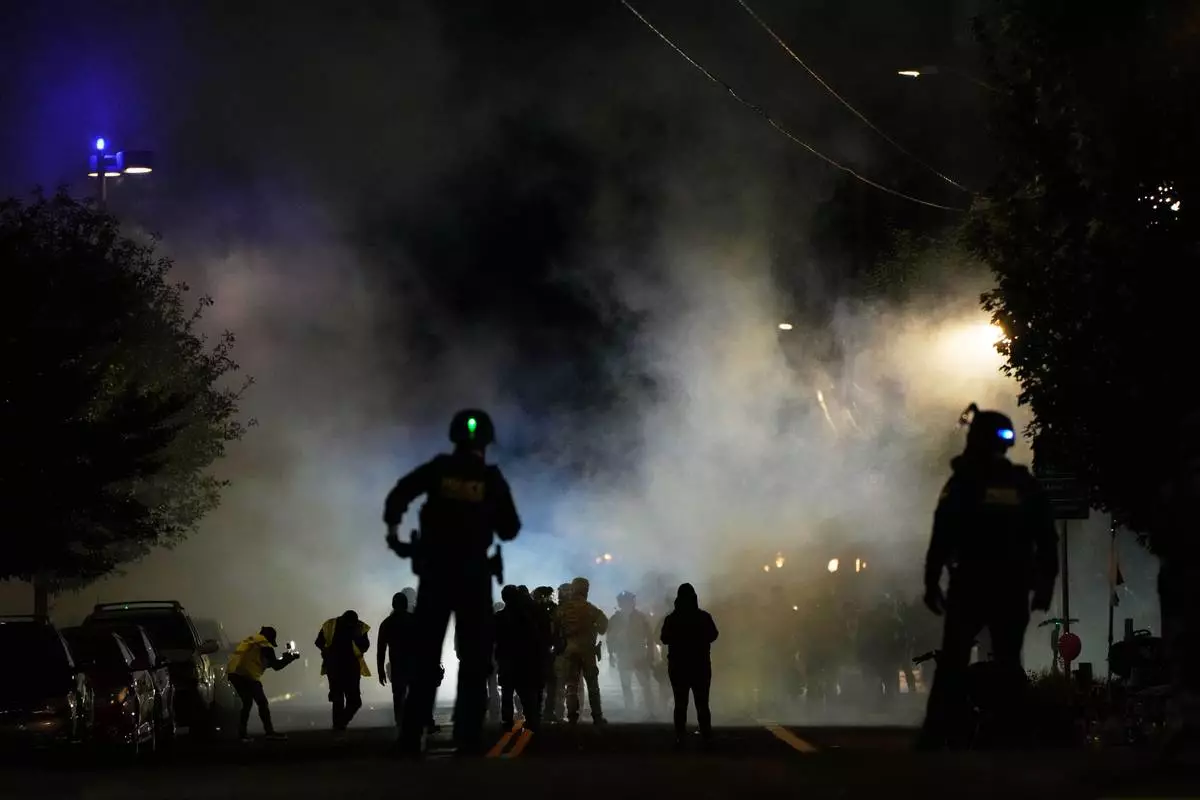
FILE - Law enforcement officers stand after deploying tear gas outside a U.S. Immigration and Customs Enforcement facility during a protest on Oct. 4, 2025, in Portland, Ore. (AP Photo/Jenny Kane, File)
The U.S. can continue to detain immigrants without bond, an appeals court ruled Wednesday, handing a victory to the Trump administration's crackdown on immigration.
The opinion from a panel of the 8th U.S. Circuit Court of Appeals in St. Louis overturned a lower court ruling that required that a native of Mexico arrested for lacking legal documents be given a bond hearing before an immigration judge.
It’s the second appeals court to rule in favor of the administration on this issue. The 5th U.S. Circuit Court of Appeals in New Orleans ruled last month that the Department of Homeland Security’s decision to deny bond hearings to immigrants arrested across the country was consistent with the Constitution and federal immigration law.
Both appeals court opinions counter recent lower court decisions across the country that argued the practice is illegal.
In November, a district court decision in California granted detained immigrants with no criminal history the opportunity to request a bond hearing and had implications for noncitizens held in detention nationwide.
Under past administrations, most noncitizens with no criminal record who were arrested away from the border had an opportunity to request a bond hearing while their cases wound through immigration court. Historically, bond was often granted to those without criminal convictions who were not flight risks, and mandatory detention was limited to recent border crossers.
In the case before the 8th Circuit, Joaquin Herrera Avila of Mexico was apprehended in Minneapolis in August 2025 for lacking legal documents authorizing his admission into the United States. The Department of Homeland Security detained Avila without bond and began deportation proceedings.
He filed a petition seeking immediate release for a bond hearing. A federal judge in Minnesota granted the petition, saying the law authorized detention without bond when a person seeking admission is not clearly and beyond a doubt entitled to being admitted. The judge found this was not the case for Avila because he had lived in the country for years without seeking naturalization, asylum or refugee status and thus wasn't “seeking admission.”
Circuit Court Judge Bobby E. Shepherd wrote for the majority in a 2-1 opinion that the law was “clear that an ‘applicant for admission’ is also an alien who is ‘seeking admission,’” and so Avila couldn't petition on these grounds.
Circuit Court Judge Ralph R. Erickson dissented, saying that Avila would have been entitled to a bond hearing during his deportation hearings if he had been arrested during the past 29 years. Now, he wrote, the Circuit Court has ruled that Avila and millions of others would be subject to mandatory detention under a novel interpretation of “alien seeking admission” that hasn’t been used by the courts or five previous presidential administrations.
The American Civil Liberties Union, which is representing Avila, didn't immediately return an email message seeking comment.
Attorney General Pam Bondi hailed the ruling, writing in a social media post: “MASSIVE COURT VICTORY against activist judges and for President Trump’s law and order agenda!”
At question is the issue of whether the government is required to ask a neutral judge to determine whether it is legal to imprison someone.
It's based on habeas corpus, which is a Latin legal term referring to the constitutional right for people to legally challenge their detention by the government.
Immigrants have filed more than 30,000 habeas corpus petitions in federal court alleging illegal detention since Trump took office, according to a tally by The Associated Press. Many have succeeded.
FILE - The Department of Homeland Security logo during a news conference in Washington, Feb. 25, 2015. (AP Photo/Pablo Martinez Monsivais, File)