STOWE, Vt. (AP) — Looking back, gubernatorial candidate Dean Roy says his political ambitions started in the eighth grade. And by that he means, last year.
After working as a legislative page at the Vermont Statehouse, the 14-year-old freshman at Stowe High School now has his sights set on the corner office. In November, he'll be the first candidate for governor under age 18 to appear on the state's general election ballot.
“I don't expect necessarily to win,” he said. “What I do expect is to start the movement, and get more young people to come in behind me and say, ‘Yeah, we also want to make change.’”
Another eighth-grader, Ethan Sonneborn, sought the Democratic nomination for governor in 2018 but finished last in a four-way primary. Roy secured his spot in the general election by creating his own third party, the Freedom and Unity party. Both were able to run because the state constitution sets no minimum age for gubernatorial candidates, requiring only that candidates have resided in the state for four years.
“I know it sounds crazy, a 14-year-old running for governor, but honestly, look at the people in charge right now,” Roy said in a post on his campaign’s Instagram page. “They’ve been doing this forever and things still aren’t working.”
Nearly all other states set minimum age requirements for governor, often 30 years old. In Kansas, lawmakers added a requirement that gubernatorial candidates be at least 25 years old in 2018 after six teenagers ran for office.
Peter Teachout, a professor at Vermont Law and Graduate School, has a different take than Roy on Vermont's constitution. He points to a section in the document referring to what qualifies someone to be “entitled to the privileges of a voter,” and that is that they must be 18 years of age. Even under Roy's interpretation, Teachout doesn't predict a win for the teenager.
“In theory, a 4-year-old could run for governor. Should we be worried about it? No,” he said. “Vermonters can be a little cantankerous and provocative just for the fun of it, but it is not something they are likely to support in this context.”
But Roy's former history teacher, James Carpenter, said he thinks it's great that Roy is giving it his all. Though most 14-year-olds aren’t concerned with property taxes or health care, Carpenter describes Roy as an “old soul” with endless curiosity.
“It just really shows what type of kid Dean is. He’s very earnest in what he’s doing. There’s no gimmick behind this,” he said. “I think he blends that youthful optimism with some pragmatism that few kids have.”
Roy, who said he doesn't identify with either major party, said housing is the most important issue facing the state. He's also thought about how he'd juggle school with a full-time job as governor, saying he'd consider online classes and would do his homework at night after work.
The current governor, Republican Phil Scott, applauds Roy’s interest in politics and public service but questions whether someone so young is ready for the responsibilities that come with running a state.
“He believes it’s important for our youth to get involved,” said press secretary Amanda Wheeler. “But the Governor also believes that a teenager may not be best suited to serve in that role given the lack of experience and lived perspectives youth have at that point in their lives.”
Roy disagrees that age has anything to do with whether a candidate is fit to run for office.
“What I’m aiming for is that these career politicians look at me and they say, ‘Oh my God, he actually has a chance to disrupt things,’” he said. “If I can get people to think that I am a threat to them, then I know that’s been a success. Because what I want is to show them that the youth have a voice. We’re gonna make change. The future is now.”
Associated Press reporter Holly Ramer contributed to this report from Concord, New Hampshire.
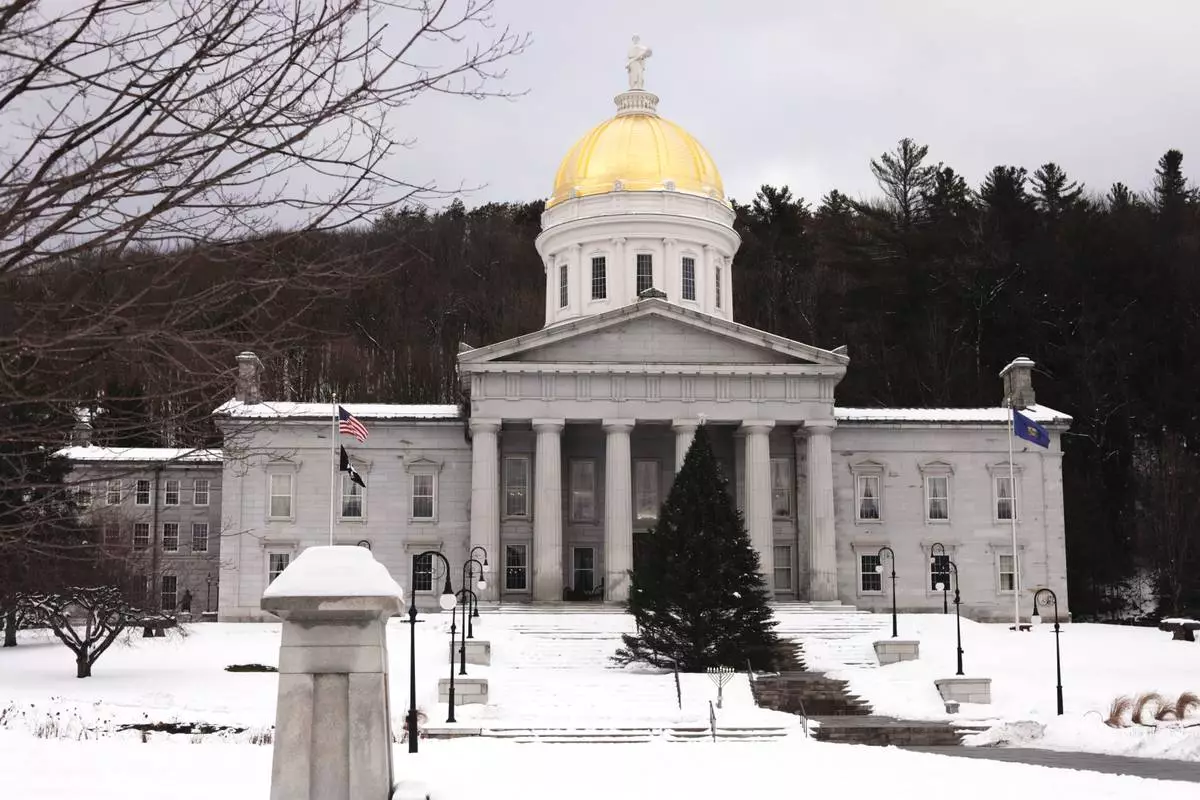
The Vermont State House is seen on Jan. 8, 2026, in Montpelier, Vt. (AP Photo/Amanda Swinhart)
WASHINGTON (AP) — Thea Price anticipated changes under the second Trump administration, but she never expected her life to be thrown into such disarray.
Along with the 300 other employees of the United States Institute of Peace, Price was fired, rehired and then fired again as part of President Donald Trump's crusade to shrink the federal government, a chaotic effort that cut tens of thousands of jobs and shrank or dismantled entire agencies.
One year later, many of those impacted are left wondering whether their pain was worth it.
"Nobody was prepared for the complete destruction,” said Price, a former program operations manager. “And for what?”
The Department of Government Efficiency, or DOGE, led by then-Trump adviser Elon Musk, instigated purges of federal agencies with the expressed mission of rooting out fraud, waste and abuse.
USIP, a congressionally funded independent nonprofit, became a symbol of the upheaval. DOGE staffers entered the USIP building early last year, setting off a battle over who controls the institute, which later saw Trump plant his name on its Washington headquarters.
The blow to its workers came on March 28, 2025, when they were fired, a decision a judge later reversed and then another one reinstated — whiplash that still weighs on the former staffers.
A year on, DOGE's toll on people’s lives is clear — what was actually saved in the process of upending them is not.
Musk set a target of $2 trillion in savings. The DOGE website says it has saved about $215 billion through job cuts, contract and lease cancellations and asset sales, as well as grant rescissions.
More than 260,000 workers left federal service due to Trump administration initiatives in 2025, according to the Office of Management and Budget, including reductions in force, early retirement, deferred resignations and a hiring freeze.
“President Trump was given a clear mandate to eliminate waste, fraud and abuse from the federal government,” said White House spokesperson Davis Ingle when asked how much was saved. "In just a year, he has made significant progress in making the federal government more efficient to better serve the American taxpayer.”
Organizations that have examined elements of the DOGE operation, along with the Government Accountability Office, a congressional watchdog of how taxpayer dollars are spent, have not been able to pinpoint how much was saved, or lost, by the reform efforts. Many challenge the Republican administration's numbers.
Dominik Lett, a budget analyst at the Cato Institute, a libertarian think tank, said there were basic mistakes on the DOGE pages tracking savings, leading him to believe the numbers were too high. He said Cato and other organizations have shied away from trying to arrive at a number because of the complexity of the moves.
“Who is getting fired matters. How they’re getting fired, will there be lawsuits?” was among the questions Lett has. Even terminating leases and contracts wasn’t as simple as it sounds.
In the end, he said, “we don’t know how much DOGE has saved.”
In her analysis of media reports and public sources, Elaine Kamarck, a senior fellow at the Brookings Institution think tank, found that about 25,000 people who were fired were rehired because they were deemed to be essential.
“What DOGE did is it cut so big and so deep and so randomly that when the Cabinet secretaries came in, and Elon Musk was gone, they realized that they had to bring some of these people back,” Kamarck said.
With that, Kamarck estimated the savings might hit between $100 billion and $200 billion, though final figures remain highly uncertain.
A GAO analysis found layoffs in the Education Department’s civil rights division may have cost $38 million, with employees paid months after termination.
The impacts of DOGE’s work are the subject of ongoing litigation. More than a dozen lawsuits have been filed against the Trump administration for DOGE’s actions over the past year, which challenge everything from the cancellation of grants, mass firings and buyouts, to access to sensitive U.S. Treasury data and payment systems, to the closure of massive federally funded programs.
Musk, in an interview with conservative influencer Katie Miller, said last December that his efforts leading DOGE were only “somewhat successful” and he would not do it again.
Created by Congress during the Reagan administration, USIP was meant to promote peace and prevent global conflict. At the time it was shuttered, the institute operated in more than two dozen conflict zones, including Pakistan and Afghanistan.
Employees watched as DOGE dismantled another organization, the U.S. Agency for International Development. Then, DOGE staffers showed up multiple times at USIP and ultimately took over the headquarters. Most of the institute's board and the acting president were fired.
On the evening of March 28, 2025, termination notices began showing up in employees' personal emails. Within two hours, most of the 300-plus staffers were gone.
USIP leaders and employees sued, arguing it was independent of the executive branch. A federal judge ruled Trump had acted outside his authority, in a decision that restored control of the institute and reinstated workers with backpay — though few returned as operations resumed gradually.
In June, an appeals court stayed that decision. And for the second time, the staff was fired.
The case is suspended now, awaiting a U.S. Supreme Court decision in another personnel-related case, which could expand the president’s control over federal agencies that have long been considered independent of the executive branch.
Depending on that decision and what the appeals court does, the staff could be due back pay and benefits again, despite not having worked for months.
While the original iteration of DOGE has dissipated from the public view, its presence is still felt in parts of the government. High-ranking DOGE officials have been hired as permanent staffers in federal agencies, including at the Treasury Department.
For the people who worked at USIP, the past year has been a whirlwind.
Some have found jobs, but many have faced headwinds in a market flooded with skilled labor. Some meet regularly and update one another on job searches and the suspended court cases they still hope might revive their former employer.
Price came off maternity leave one day before she was fired. When she was fired for the second time, she and her husband, who had lost his job as a contractor at a museum when his project’s funding was cut, lived on their reserves and applied for the Supplemental Nutrition Assistance Program, which took months to be approved.
She was forced to use a food pantry when the government shutdown last year stopped her SNAP payments. After filing dozens of job applications, her family left the capital region and moved to the Seattle area.
She now works for a nonprofit that focuses on affordable housing. It is meaningful, but she misses the institute, its mission and her team.
Liz Callihan, who worked in communications at USIP, has applied for 140 jobs since being fired. She often wonders why her former professional home, with a noble mission and a relatively small annual budget of $50 million, became a target of DOGE.
“I absolutely ask myself every day what all this was for,” she said.
Associated Press writer Fatima Hussein contributed.

FILE - Thea Price, top right, whose family is moving away from the Washington region and back to her hometown of Seattle after losing their jobs and relying on savings and food assistance programs like SNAP, poses for a photo on a playground with her husband Nikita and 10-month old boy Nikolai, in Arlington, Va., Nov. 7, 2025. (AP Photo/Nathan Ellgren, file)

FILE - The headquarters for the U.S. Institute of Peace near the National Mall are seen, June 10, 2025, in Washington. (Pablo Martinez Monsivais, File)

FILE - U.S. Institute of Peace employees hold an impromptu celebration on the steps of the U.S. Institute of Peace, May 19, 2025, in Washington. (AP Photo/Gary Fields, file)
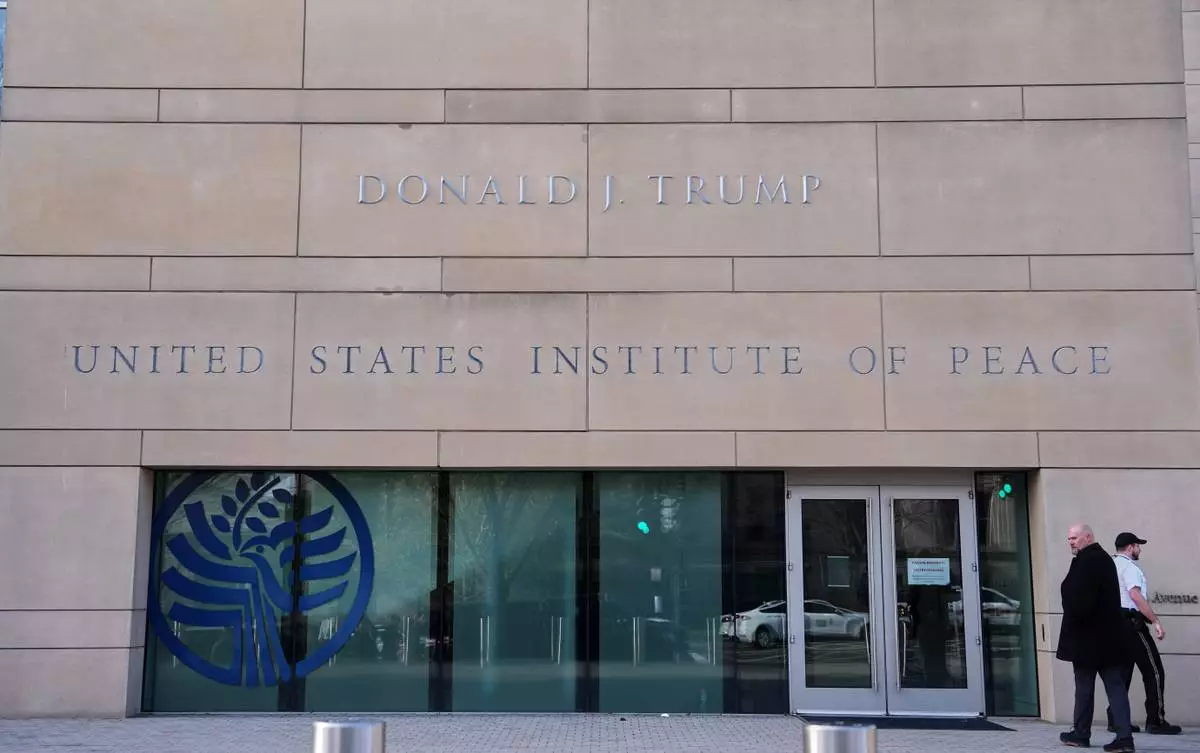
FILE - President Donald Trump's name is seen on the U.S. Institute of Peace building, Dec. 4, 2025, in Washington. (AP Photo/Evan Vucci, File)