China's new wave of culture-driven shows is attracting visitors nationwide, combining tradition and technology to deliver immersive experiences that redefine how audiences engage with heritage.
A large scale real scene musical drama premiered in March at the foot of Tianmen Mountain in Zhangjiajie, Hunan Province. Integrating Sangzhi folk songs, western Hunan customs and Huagu opera with music, dance, aerial stunts and visual effects, the show tells a legendary love story between a fox fairy and a woodsman.
This year's production features upgraded stage design, lighting and storytelling, with expanded immersive zones, dazzling light effects and folklore inspired headpieces that transform audiences from passive viewers into active participants.
"The story is very moving. I think it's a love story that could be passed down for more than 1,000 years. The lighting and the stage design were absolutely breathtaking," said Huang, a visitor from Hong Kong.
In Wuyi Mountain, a landscape of great beauty in east China's Fujian Province, a captivating live performance has attracted a large number of visitors.
Featuring a large indoor water curtain stage, the show recreates the aesthetic of traditional ink wash painting through digital controls and lightings. The performance presents tea culture and thoughts of Zhu Xi, a Confucian scholar of the Southern Song Dynasty (1127-1279) in a cinematic style, immersing audiences in the natural landscape.
"I found it absolutely breathtaking. It's full of technological marvels. The fusion of modern technology with traditional culture and Zhu Xi's Neo-Confucianism is incredibly well done," said Xiao Kaiyuan, an audience member.
"Through the coordinated presentation of ultra-wide high-definition imagery and naked-eye 3D effects, we achieve a 270-degree panoramic visual spectacle. By leveraging technologies, we allow audiences to immerse themselves in the charm of Wuyi Mountain as a site of world natural and cultural heritage," said Zhong Baiyi, project director of the performance.
With new technologies such as virtual reality (VR), traditional activities like shopping, moviegoing, and visit to museums are being reinvented with new possibilities, significantly enhancing visitors' engagement and participation.
The Hubei Provincial Museum in central China, the country's first cinematic-level digital artifact VR experience has become a major attraction.
The VR experience, titled "Bronze Era Odyssey," can accommodate 100 spectators simultaneously in a 30-minute immersive visualization of the museum's iconic artifacts such as the 2,500-year-old Sword of Goujian, which was named after the king of the state of Yue during the Spring and Autumn Period (770-476 BC).
"Through such a vivid and dynamic approach, cultural relics are no longer cold containers. It makes history speak, and it makes artifacts speak," said Zhao Nan, a visitor.
From mountain stages to museum halls, China's cultural tourism is being reshaped by the fusion of heritage and technology. With immersive performances, cinematic spectacles and VR experiences breathing new life into traditions, audiences are no longer just watching, they are stepping inside the stories.

Culture-driven performances across China fuse tradition, innovation to boost tourism
With the Pinglu Canal set to open within the year, the new river-sea shipping corridor is poised to reshape the logistic landscape for the Guangxi Zhuang Autonomous Region and southwest China while spurring industrial and infrastructural upgrades, as its economic ripple effects have already spread beyond the region.
The Pinglu Canal, currently under construction in south China's Guangxi, stretches more than 134 kilometers, aiming to link the Xijiang River, a major waterway in southwest China, with ports in the Beibu Gulf.
Regarded as the shortest and most economical and convenient waterway route from Guangxi and southwest China to the region of the Association of Southeast Asian Nations (ASEAN), the project is already beginning to generate growing economic spillover effects.
In Pingtang Village, located at the canal's starting point, local residents are seeking to leverage the area's geographic advantage by building a cultural and tourism brand as the "first village of the canal," hoping to give the local economy a fresh start.
Moreover, the canal's benefits are extending to more regions and industries.
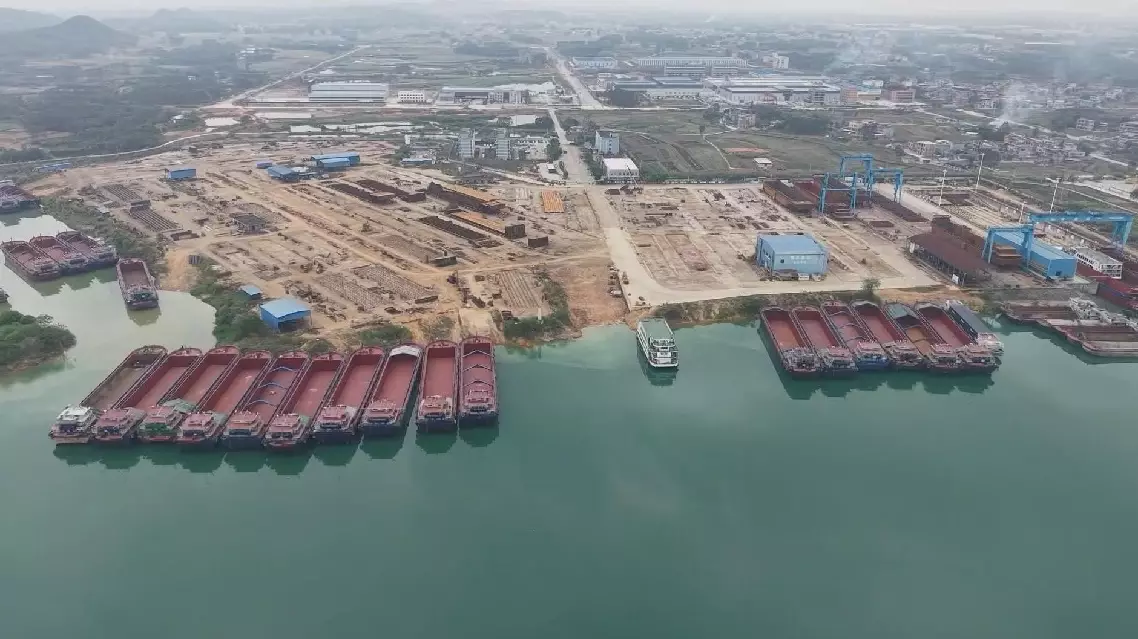
At the Xijiang Heavy Industry shipbuilding base, about 110 kilometers from the canal's starting point, the construction of a 5,000-ton river-sea direct shipping demonstration vessel for the Pinglu Canal has completed several key procedures.
The new generation of ships, designed to support the canal's core transport capacity, features greener and smarter technologies.
"The ship is equipped with an LNG clean-energy power system as well as seven functional modules including an intelligent engine room, reducing carbon dioxide emissions by 23 percent and sulfur compounds by 99 percent. The Pinglu Canal will not only change the shipping routes, but also drive the transformation and upgrading of our shipbuilding industry. This is an unprecedented opportunity," said Wei Mingliu, assistant general manager of the shipbuilder.
Meanwhile, Qinzhou Port, located at the canal's sea outlet, has completed renovations of multiple berths to meet demands for large-tonnage, multi-cargo and high-efficiency multimodal transport which is soon to emerge after the canal opens.
In addition, nearby ports are also accelerating upgrades of port infrastructure and cargo distribution systems.
"After the Pinglu Canal opens, it will rewrite the history of inland shipping in Guangxi and southwest China that relies on 'detours through Guangdong to reach the sea', reshape the regional cargo transport pattern, and greatly expand the service radius of the Beibu Gulf Port, enabling its leap from a port to a 'transportation hub' in overall capacity," said Yu Shuoxian, an engineer from Qinzhou automated container terminal.
In fact, the canal's influence has already extended beyond Guangxi.
In a petrochemical industrial park less than three kilometers from Qinzhou Port, a new plant is being built by a new energy company from southwest China's Sichuan Province. It is expected to add 300,000 tons of annual capacity upon completion next year.
According to a senior executive, the company is attracted by the logistics cost advantage brought by the Pinglu Canal.
"Qinzhou Port is the nearest seaport outlet port to the Sichuan-Chongqing region. Our raw materials mainly come from the Sichuan-Chongqing region, but our products are primarily sold to Europe. After the Pinglu Canal opens, both raw materials and products can be transported by waterway. Just in terms of raw material transportation costs, it is expected to drop directly by 10 percent to 20 percent, which directly enhances our market competitiveness," said Xia Diqiang, CFO of the company.
In addition to Sichuan, companies from Yunnan, Chongqing, Guizhou and other southwestern regions within the canal's reach are accelerating their entry into the canal's prime shipping route.
Bulk cargo shipped via the Pinglu Canal directly to the Beibu Gulf and onward to global routes is expected to significantly reduce logistics costs.
At the same time, industrial coordination is also taking shape. Port-adjacent, water-oriented industries including AI, next-generation information technology, modern green chemical engineering, and nonferrous metals are being planned along the canal route.
Authorities in Guangxi said they are strengthening industrial cooperation with eastern coastal regions and provinces along the New International Land-Sea Trade Corridor, a key logistics network connecting China's western regions to global markets, promoting integration of cross-border industrial and supply chains, and fully leveraging the Pinglu Canal's comprehensive benefits as a backbone project of the corridor.
Ports, shipbuilders, industries race to seize opportunities from Pinglu Canal construction