China's expanded visa‑free transit program is transforming inbound tourism, with international travelers increasingly bypassing Beijing and Shanghai for smaller inland cities and regional hubs, highlighting the policy's impact and rising appeal of cultural and natural heritage sites.
Official data shows that during this year's Spring Festival holiday, from Feb 15 to March 23, foreign tourists booked flights to 107 Chinese cities. Instead of traditional metropolitan destinations such as Guangzhou and Shenzhen, visitors are opting for lower‑tier cities and towns, seeking unique adventures, cultural experiences and authentic local encounters.
Previously lesser-known regions are seeing surging inbound traffic, according to the China Tourism Group. Datong in Shanxi Province, home to the Yungang Grottoes, a legacy of Buddhist art, has become a magnet for travelers. Additionally, Mount Wuyi in Fujian, celebrated for biodiversity and tea culture, Altay in northwest China's Xinjiang, famed for ski resorts, and Wuzhen in Zhejiang, a historic water town, are all drawing international crowds.
Chongqing Municipality, a densely populated mountainous region in southwest China, is also drawing swarms of international tourists with its unique blend of cyberpunk-inspired architecture, neon-lit nighttime scenes, and traditional charm.
"I cannot believe the amount of people that they live here, and how everything works so smoothly. It's amazing," Fermin Durand, a tourist from Argentina, said in an interview with China Central Television (CCTV), when visiting the iconic Raffles City complex, a "horizontal skyscraper" connecting four 250-meter towers with an open-air glass observation deck offering panoramic views of Chongqing's mountains, rivers, city and bridges.
China first launched a 240‑hour visa‑free transit program for eligible foreign passport holders in December 2024, and the scheme now covers 55 countries. In 2025, inbound visits exceeded 150 million, a year‑on‑year increase of more than 17 percent, with travelers’ total spending surpassing 130 billion U.S. dollars, according to the Ministry of Culture and Tourism.

China's visa-free transit policy reshapes inbound tourism, driving visitors to smaller cities

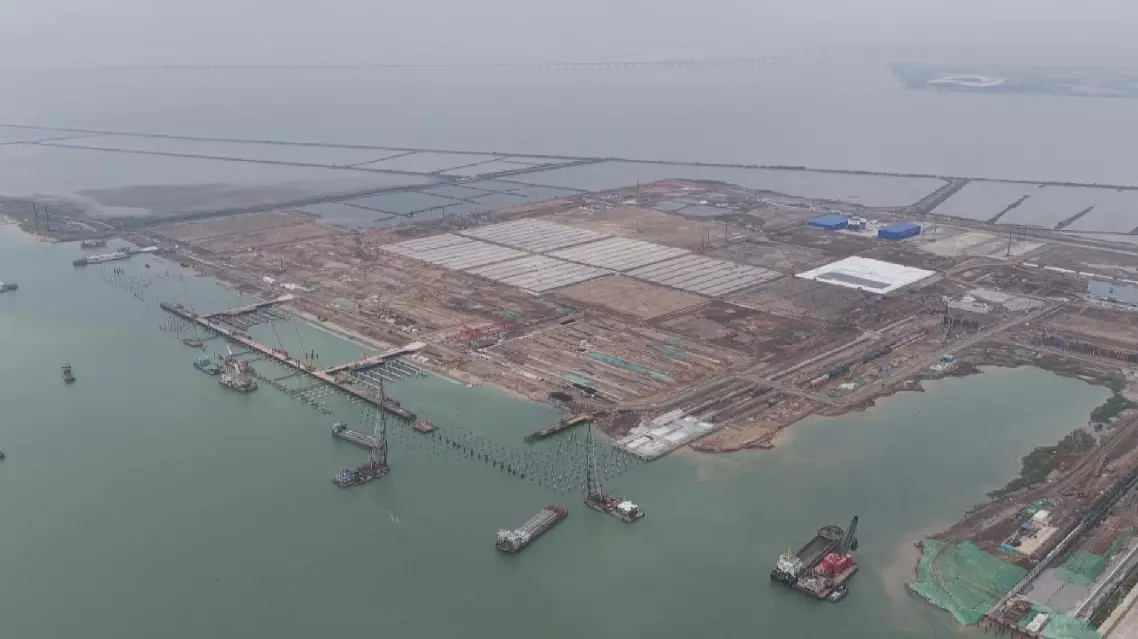
With the Pinglu Canal set to open within the year, the new river-sea shipping corridor is poised to reshape the logistic landscape for the Guangxi Zhuang Autonomous Region and southwest China while spurring industrial and infrastructural upgrades, as its economic ripple effects have already spread beyond the region.
The Pinglu Canal, currently under construction in south China's Guangxi, stretches more than 134 kilometers, aiming to link the Xijiang River, a major waterway in southwest China, with ports in the Beibu Gulf.
Regarded as the shortest and most economical and convenient waterway route from Guangxi and southwest China to the region of the Association of Southeast Asian Nations (ASEAN), the project is already beginning to generate growing economic spillover effects.
In Pingtang Village, located at the canal's starting point, local residents are seeking to leverage the area's geographic advantage by building a cultural and tourism brand as the "first village of the canal," hoping to give the local economy a fresh start.
Moreover, the canal's benefits are extending to more regions and industries.
At the Xijiang Heavy Industry shipbuilding base, about 110 kilometers from the canal's starting point, the construction of a 5,000-ton river-sea direct shipping demonstration vessel for the Pinglu Canal has completed several key procedures.
The new generation of ships, designed to support the canal's core transport capacity, features greener and smarter technologies.
"The ship is equipped with an LNG clean-energy power system as well as seven functional modules including an intelligent engine room, reducing carbon dioxide emissions by 23 percent and sulfur compounds by 99 percent. The Pinglu Canal will not only change the shipping routes, but also drive the transformation and upgrading of our shipbuilding industry. This is an unprecedented opportunity," said Wei Mingliu, assistant general manager of the shipbuilder.
Meanwhile, Qinzhou Port, located at the canal's sea outlet, has completed renovations of multiple berths to meet demands for large-tonnage, multi-cargo and high-efficiency multimodal transport which is soon to emerge after the canal opens.
In addition, nearby ports are also accelerating upgrades of port infrastructure and cargo distribution systems.
"After the Pinglu Canal opens, it will rewrite the history of inland shipping in Guangxi and southwest China that relies on 'detours through Guangdong to reach the sea', reshape the regional cargo transport pattern, and greatly expand the service radius of the Beibu Gulf Port, enabling its leap from a port to a 'transportation hub' in overall capacity," said Yu Shuoxian, an engineer from Qinzhou automated container terminal.
In fact, the canal's influence has already extended beyond Guangxi.
In a petrochemical industrial park less than three kilometers from Qinzhou Port, a new plant is being built by a new energy company from southwest China's Sichuan Province. It is expected to add 300,000 tons of annual capacity upon completion next year.
According to a senior executive, the company is attracted by the logistics cost advantage brought by the Pinglu Canal.
"Qinzhou Port is the nearest seaport outlet port to the Sichuan-Chongqing region. Our raw materials mainly come from the Sichuan-Chongqing region, but our products are primarily sold to Europe. After the Pinglu Canal opens, both raw materials and products can be transported by waterway. Just in terms of raw material transportation costs, it is expected to drop directly by 10 percent to 20 percent, which directly enhances our market competitiveness," said Xia Diqiang, CFO of the company.
In addition to Sichuan, companies from Yunnan, Chongqing, Guizhou and other southwestern regions within the canal's reach are accelerating their entry into the canal's prime shipping route.
Bulk cargo shipped via the Pinglu Canal directly to the Beibu Gulf and onward to global routes is expected to significantly reduce logistics costs.
At the same time, industrial coordination is also taking shape. Port-adjacent, water-oriented industries including AI, next-generation information technology, modern green chemical engineering, and nonferrous metals are being planned along the canal route.
Authorities in Guangxi said they are strengthening industrial cooperation with eastern coastal regions and provinces along the New International Land-Sea Trade Corridor, a key logistics network connecting China's western regions to global markets, promoting integration of cross-border industrial and supply chains, and fully leveraging the Pinglu Canal's comprehensive benefits as a backbone project of the corridor.
Ports, shipbuilders, industries race to seize opportunities from Pinglu Canal construction