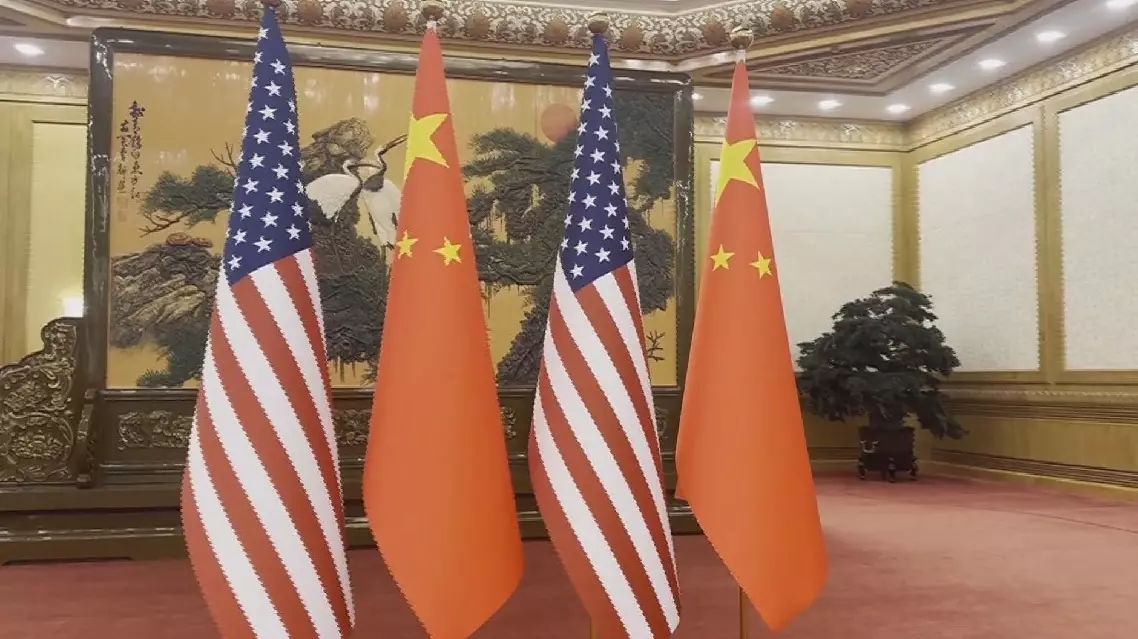
Politicians and scholars around the world have agreed that a stable and constructive dialogue between Washington and Beijing is essential for the global community, as U.S. President Donald Trump's just-concluded three-day state visit to China has captured global attention.
Trump on Friday wrapped up his state visit to China at the invitation of Chinese President Xi Jinping, marking the first visit by a U.S. president to China in almost nine years, since President Xi hosted Trump in the Chinese capital in November 2017.
On Thursday morning, Xi and Trump held talks at the Great Hall of the People in Beijing, during which the two leaders agreed on a new vision of building a constructive bilateral relationship of strategic stability, and steering the giant ship of China-U.S. relations in the right direction.
Fernando Reyes Matta, former Chilean ambassador to China, hailed the crucial meeting as the start of a paradigm in major-country relations.
"I believe the significance of this meeting is that the United States is saying: 'China, I want to understand -- from who you are -- how we can build a relationship that involves interests and differences, but above all, shared perspectives on destiny and the future.' It seems to me that a new phase in global relations is opening, based on a different style of dialogue -- one that puts on the table the pros, the cons, and the implications of everything," said Reyes Matta.
Ali El-Hefny, secretary general of the Egyptian Council for Foreign Affairs, highlighted the need to address customs barriers and ensure the smooth flow of trade between the two nations.
"Bilateral relations, particularly in their economic aspects, especially with regard to customs barriers and tariffs, require the smooth flow of trade between China and the United States, as both parties have a clear interest in it," he said.
Ousmane Sene, director of the Senegal-based West African Research Center, stressed that genuine peace requires both countries to engage as equals, without any sense of superiority or inferiority.
"I think all nations in the world deserve to be treated on an equal footing, and I think because of what China represents in the world, and what the United States represents in the world, they should be able to sit at the table and discuss without any feeling of superiority or inferiority, so that easily they may create a continuous situation conducive to a peaceful settlement of differences," he said.
Andrey Koshkin, a professor of Plekhanov Russian University of Economics, emphasized the summit's broader significance, particularly its potential to stabilize global energy markets and reinforce the international economic system.
"The visit of the U.S. president to China is, without a doubt, an important event aimed at stabilizing the extremely tense situation in the world. And we see that the mutual steps taken by both sides should help strengthen both the global economy and the global supply of energy products. In my view, that is the strength of the meeting between the two leaders. After all, these are two great powers that serve as the backbone of the planet, and the entire world will benefit. So, as we see it today, this visit and the meeting of the two leaders of the great powers reflect a desire to stabilize the global situation, thereby assisting other states in their development and in establishing mutually beneficial ties," he said.
Int'l observers highlight importance of China-U.S. dialog for world