China's prehistoric Shimao ruins in northwestern Shaanxi Province have displayed advanced planning and construction techniques of ancient Chinese people, according to archeologists.
The four-million-square-meter Shimao site, located in Shenmu City of the province, was a massive Neolithic walled settlement that thrived around 4,300 years ago, but was abandoned about 500 years later.
Its sophisticated fortifications, including pyramid-like platform, cyclopean stone walls, palatial complexes and stone carving, along with high-status artifacts like exquisite jades, point to a highly complex, stratified society.
"The high-status architecture and exquisite stone carvings show clearly that the Huangchengtai (Royal City Platform), situated amid natural cliffs and gullies, was a sacred edifice constructed by the Shimao people for upholding social order. The Huangchengtai structure is one of the best-preserved palace-cities ever found in East Asia," said Sun Zhouyong, deputy director of Shaanxi Provincial Cultural Heritage Administration and head of the archeological team of Shimao Ruins.
Genetic analysis shows that the Shimao people can trace the bulk of their ancestry to local Yangshao culture farmers who tilled the Loess Plateau more than a millennium earlier. The study also uncovered interactions across vast distances, linking the populations from the northern steppes and ancestry from southern Chinese rice-farming populations.
That confirms Shimao's long-term interaction with farmers and herders across China, providing pivotal proof of the early "pluralistic-yet-unified" trajectory of Chinese civilization.
Archaeologists also unearthed 17,000 bone needles and a large number of oracle bones from sheep and cattle at the site, confirming that the economic model of the ancient city was a mixed one that equally emphasized agriculture and animal husbandry.
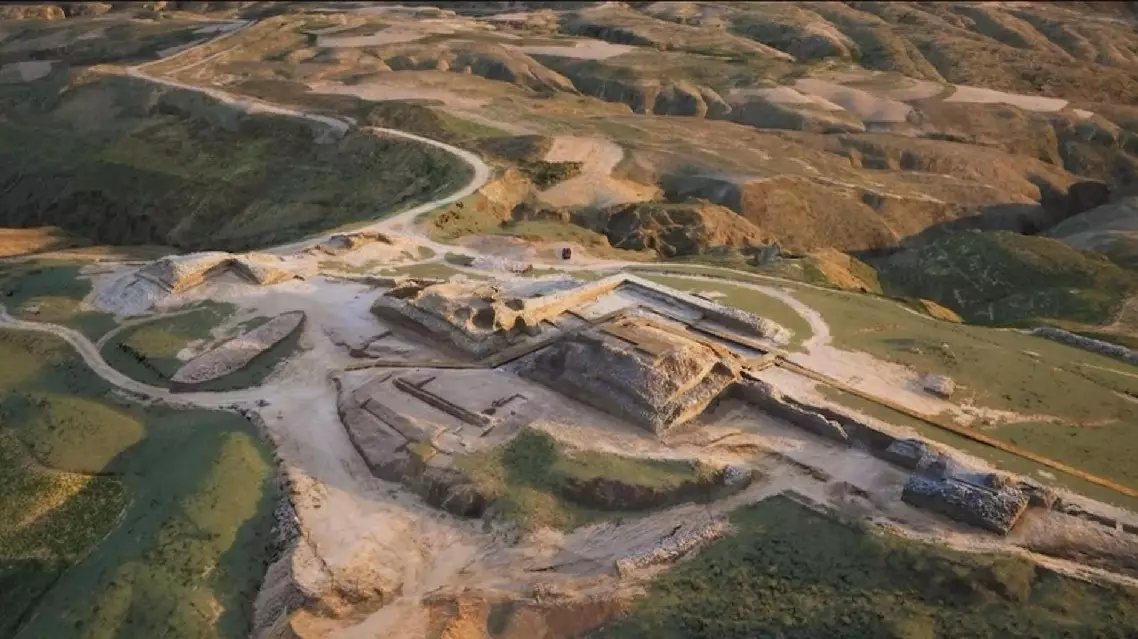
China's prehistoric Shimao ruins display advanced planning, construction techniques: archeologist