CHICAGO (AP) — Michigan coach Dusty May remembers watching Rumeal Robinson and the Wolverines win the national championship in 1989. He also recalls the cultural effect of the Fab Five on college basketball.
Now he is looking to make his own history at the school with a new generation of high-scoring Wolverines.
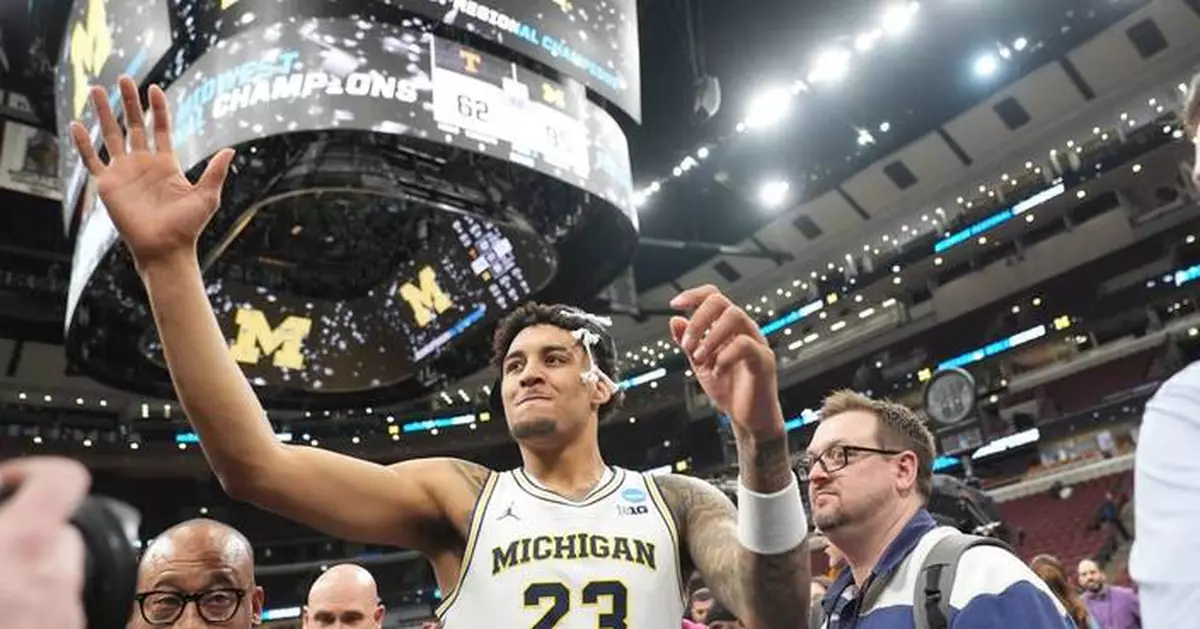
Michigan is going to the Final Four for the first time since 2018 after routing Tennessee 95-62 on Sunday. Led by versatile star Yaxel Lendeborg, the Wolverines became the first school to win at least four games in an NCAA tourney by double digits while scoring at least 90 points in each.
“Very, very grateful that all those people have poured in to allow us to represent Michigan, to have all the resources necessary to get here,” May said. “And I think we’re all carrying the flag for all those old guys.”
The 48-year-old May took Florida Atlantic to the Final Four in 2023. He was hired by Michigan in March 2024, taking over a program that was coming off an 8-24 season — the school’s worst record since 1960-61.
The turnaround was a quick one. The Wolverines went 27-10 in May's first season, and now they are going after the program's second national championship.
“We have a group that personally I could have lost with these guys,” May said. “I didn’t think we would because we’re so talented. But if we did, I wouldn’t feel much less about them. I would feel guilty we didn’t give them the experiences that they deserve.”
The transfer portal has been kind to May and Michigan (35-3), playing a major role in the team's success this year. Lendeborg (UAB), Elliot Cadeau (North Carolina), Morez Johnson Jr. (Illinois) and Aday Mara (UCLA) all began their college careers at different schools.
Lendeborg was the Big Ten player of the year and the Most Outstanding Player in the Midwest Region of the NCAA Tournament. The 7-foot-3 Mara has a school-record 100 blocks this season, and Johnson is averaging 13.2 points. Cadeau's steady play at point guard has become even more important since L.J. Cason was sidelined by a season-ending knee injury.
Cadeau had eight points, 10 assists and two steals against the Volunteers, giving him 1,005 points for his collegiate career.
“He just sets the pace and the tone of the game. ... He sees things that we don’t even see ourselves,” fellow guard Nimari Burnett said. “So, super unselfish guy. So the success that he has, he deserves it and more.”
Next up for Michigan is a national semifinal against Arizona on Saturday in Indianapolis, about 265 miles south of the Wolverines' Ann Arbor campus. Arizona advanced with a 79-64 win over Purdue on Saturday night.
The Wolverines and Wildcats are deep, athletic and unselfish, making for a potentially compelling showdown at the Final Four.
“I've seen a lot of Arizona, just watching big-time games in college basketball,” Burnett said. “We all are fans of good basketball. That's definitely what they do, and we look forward to the challenge.”
AP March Madness bracket: https://apnews.com/hub/ncaa-mens-bracket and coverage: https://apnews.com/hub/march-madness
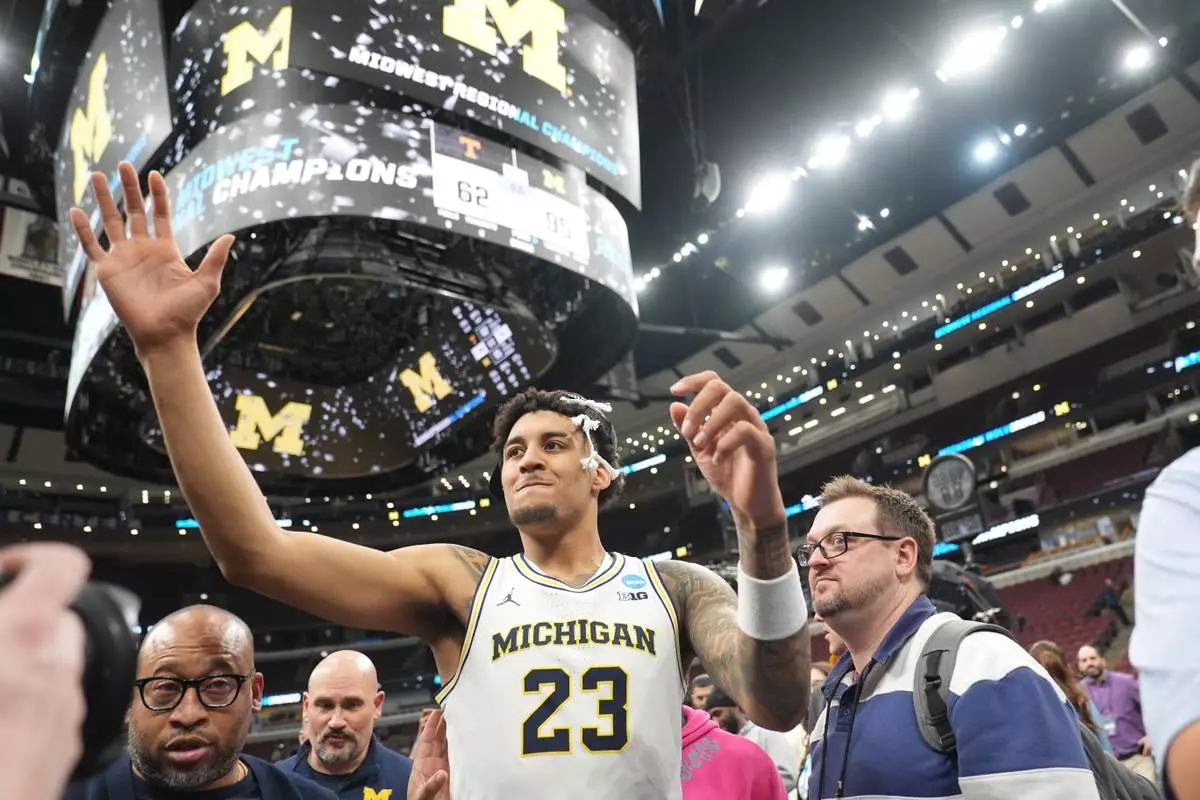
Michigan's Yaxel Lendeborg (23) celebrates after defeating Tennessee in the Elite Eight of the NCAA college basketball tournament, Sunday, March 29, 2026, in Chicago. (AP Photo/Erin Hooley)
HALABJA, Iraq (AP) — To speak with his mother inside Iran, Yaser Fattahi waits in self-exile in Iraq for brief calls arranged by a cousin back home who travels close to the border between the neighboring countries where he can pick up a signal to connect them.
Fattahi fled to neighboring Iraq in December, fearing arrest over his participation in anti-government protests in Iran. A trained nurse, he was caring for wounded protesters in their homes so they wouldn't have to seek care in state-run hospitals that were under surveillance.
Now, as the war intensifies, he worries constantly for his mother’s safety amid U.S. and Israeli bombardment.
The war has disrupted telecommunications and concentrated Iranian forces along the frontier, choking off communications and trade for many.
When Fattahi's cousin can make it to the border, he calls over WhatsApp using one phone with an Iraqi SIM card and then connects to Fattahi's mother using another phone with the Iranian cell network.
“The calls last a minute or two,” Fattahi said from Sulaymaniyah, in Iraq’s Kurdish region along the Iranian border. “She tells me to take care of myself, and that they are okay.”
Four days have passed since the last call. Fattahi keeps glancing at his phone. “I thought he would call today but he hasn’t,” he said.
The border between Iran and northern Iraq's Kurdish region has long been porous, alive with family ties, trade and smuggling. Now families are cut off from loved ones, and traders — even smugglers — hesitate to cross. Iranian forces have built up their presence to prevent incursions by Iranian Kurdish militant groups.
Those who travel close to the border to pick up Iraqi cell signals risk being shot, activists said. Others rely on smuggled Starlink connections and pay steep prices to stay in touch.
In the mountainous Iraqi district of Byara, relatives used to regularly cross the border to visit one another for family gatherings and religious celebrations.
The war has upended those longstanding traditions.
Nyan Fayaq, 25, a law student, stood over giant pots of food as she helped prepare a fast-breaking iftar meal in the final week of Ramadan while dozens of relatives gathered in shimmering Kurdish dress amid rolling green hills dotted with sheep.
Her thoughts were in the Iranian city of Saqqez, where she has family she has not been able to reach for more than a month.
Fayaq was born in Iran. Her parents divorced when she was 2, and she returned with her mother to Iraq, her mother’s homeland. She reached out to her uncles in the Iranian city of Saqqez 18 years later and remained in contact.
“They have electricity, gas and water, but everything has become very expensive because of America,” she said.
An Iranian Kurdish man who works in Iraq returned to his hometown of Merivan two weeks ago to fetch his wife to bring her into Iraq because he feared for her safety in Iran. He spoke on condition his name not be used, fearing it might compromise his ability to return.
Since then, he said he has been able to speak with his family only briefly. He said they have told him that Iranian police and security forces are operating outside their bases because many of them have been destroyed by airstrikes. AP cannot independently confirm these accounts.
They have been occupying schools and gyms against the wishes of local residents, they say.
The war has also brought the work of cross-border smugglers to a standstill.
Known as kolbars, these porters carry goods — such as cigarettes, electronics, and clothing — across Iran’s western provinces. They operate in a legal gray zone and risk death from border guards, harsh weather, and treacherous mountain terrain.
At times, people also rely on kolbars to smuggle themselves across the border. Many are Iranian Kurds without passports because they have not completed mandatory military service, while others are asylum-seekers hoping to make their way to Europe. Kurdish militant groups also use the same mountainous routes to move fighters and equipment into Iran for operations.
Being a kolbar is all 25-year-old Bilal Osman has ever known. It is a trade passed down from his father and grandfather.
Last year, he recalls, Iranian forces shot at a caravan of 12 mules while they were transporting goods in the mountains. “One bullet even hit a man’s leg,” he said.
“Sometimes a lot of soldiers are stationed along the border. If they see us, they shoot, beat us, or throw stones. Our life is hard, but this is how we make money to feed our families,” he said.
Near the foot of the mountains bordering Iran in Halabja, he tends to his mules and waits for word from Iranian kolbars on the other side. Since the war began, he says, there has been none.
“The kolbars simply can’t cross. We are always ready, but the borders are tightly controlled,” Osman said.
Iranian forces have “brought cameras for each spot, increased soldiers from five to at eac30 h location, and now even place soldiers between checkpoints,” he said. “We speak to people on the Iranian side every day, and they tell us they can’t come because the border is too heavily guarded.”
A kolbar on the Iranian side, who spoke on condition of anonymity out of security concerns, told The Associated Press that business has all but stopped since the war began because of the increased security presence.
Shiwa Hassanpour, an activist with the human rights monitor Hengaw Organization, based in Iraq’s Kurdish region, said people have been shot for approaching the border, because Iranian forces suspect them of being spies or informants.
Obtaining information from inside Iran has become increasingly difficult, she said. Locals rely on costly virtual private networks, or VPNs, to report events and send videos, meaning news often trickles out slowly. Hassanpour herself has not been able to contact her family for over 20 days.
She said that the Islamic Revolutionary Guard has deployed large numbers of troops across cities in Iran’s Kurdish region. These measures intensified after Iranian Kurdish opposition groups announced a coalition.
Since then, Hengaw has documented a sharp rise in mobile checkpoints, vehicle searches, and violence against civilians.
Using a VPN to bypass internet restrictions costs the equivalent of about $25. To communicate with relatives abroad, families pay up to the equivalent of $50, an amount most cannot afford, she said. People also pay hefty rates to use smuggled Starlink connections.
To prevent Iranians from using the Iraqi network to make calls, Iran targeted cell towers operated by Iraqi telecommunication companies Asiacell and Korek near the border and then ordered security forces to shoot anyone approaching the area, Hassanpour said.
Authorities have also arrested anyone caught with a VPN app on their phone, accusing them of spying for Israel or the U.S, she added.
Fattahi is still waiting to hear from his mother. Their calls are often muffled by static and wind because his cousin uses two phones to conduct them — one to call Fattahi and the other to reach his mother.
“It’s hard to hear her,” he said. “But it’s enough.”
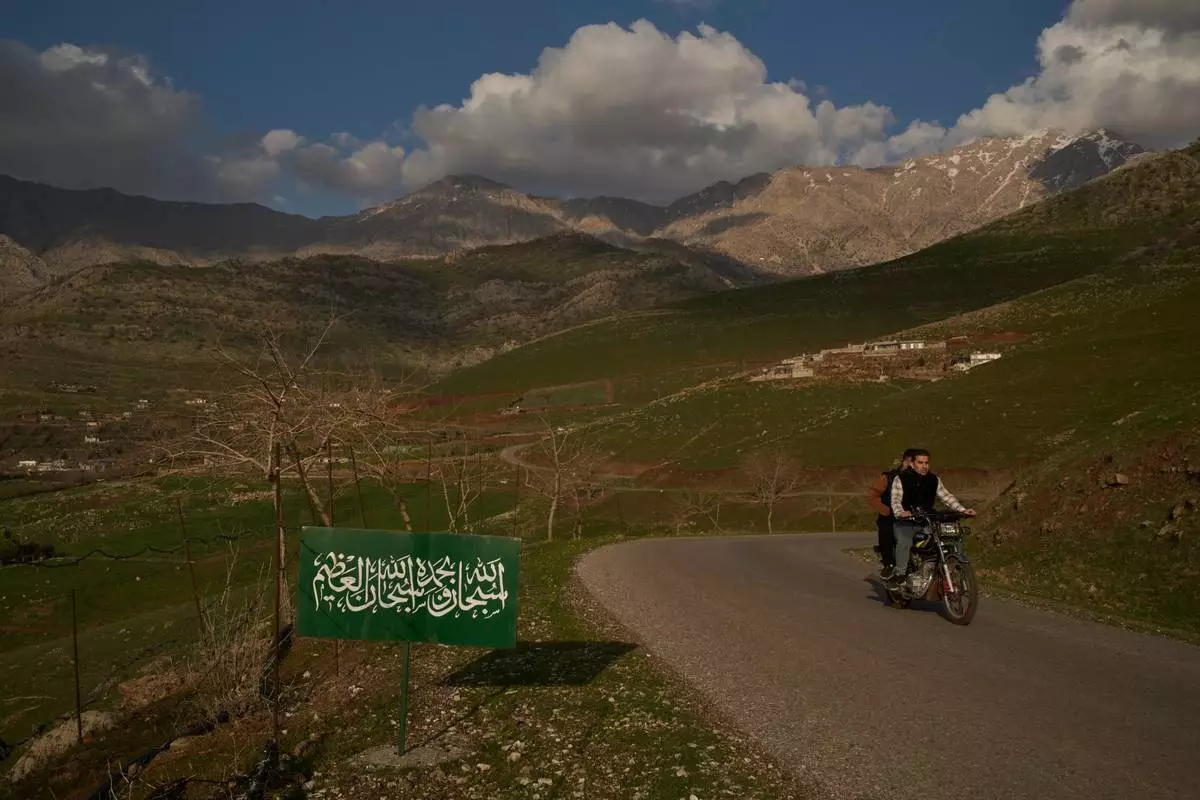
A man rides his motorcycle past a sign bearing a prayer in Arabic reading "Glory and praise be to Allah; glory be to Allah, the Great," along a road near the Iraq-Iran border in the mountainous Kurdish region near Halabja, Iraq, Tuesday, March 17, 2026. (AP Photo/Leo Correa)
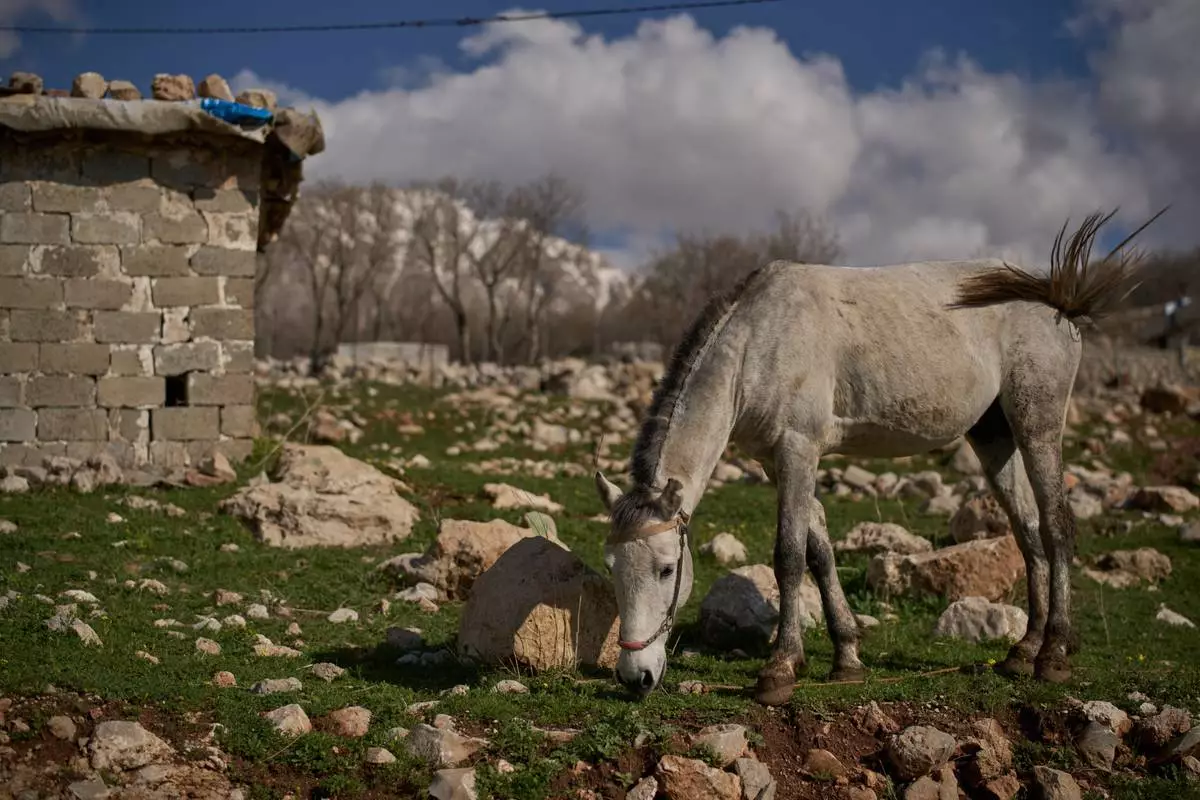
A horse used by Iraq-Iran cross-border smugglers stands at a compound in a village in the mountainous Kurdish region near Halabja, Iraq, Tuesday, March 17, 2026. (AP Photo/Leo Correa)
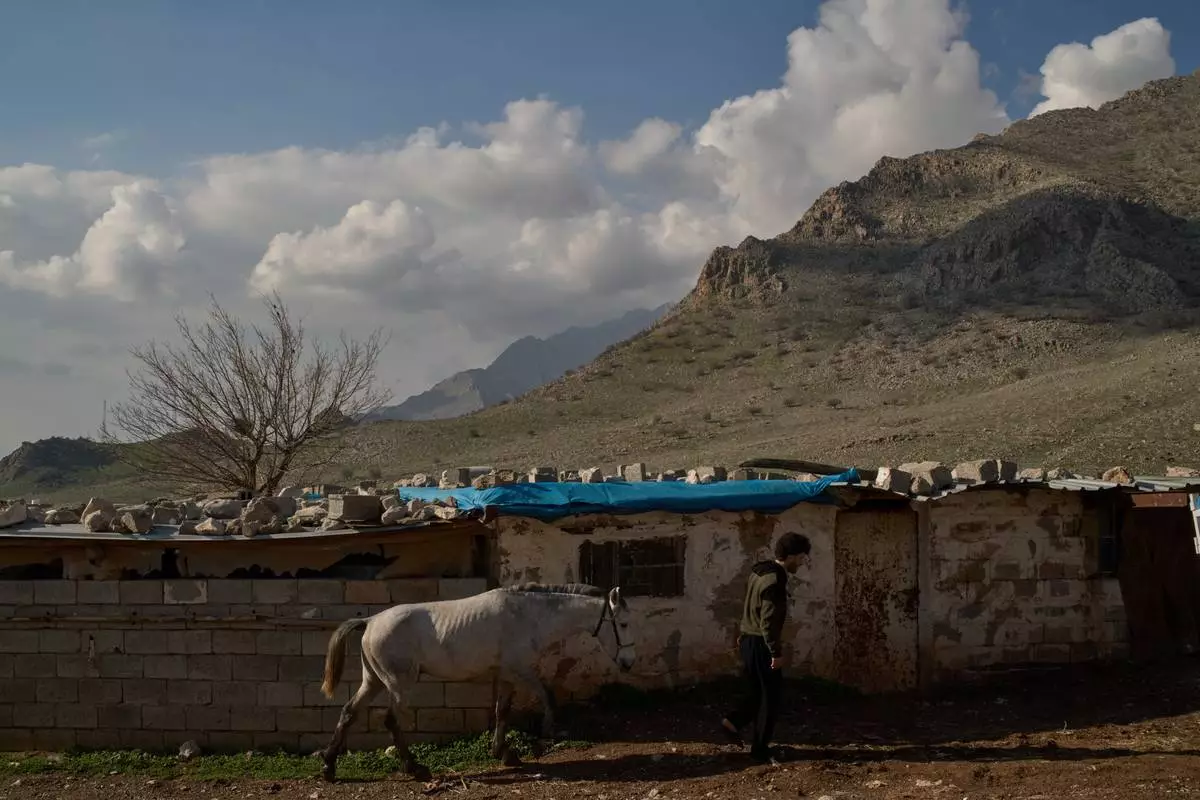
Ako Abdul Rahman, 22, right, an Iraq-Iran cross-border smuggler, leads a horse at a compound in a village in the mountainous Kurdish region near Halabja, Iraq, Tuesday, March 17, 2026. (AP Photo/Leo Correa)
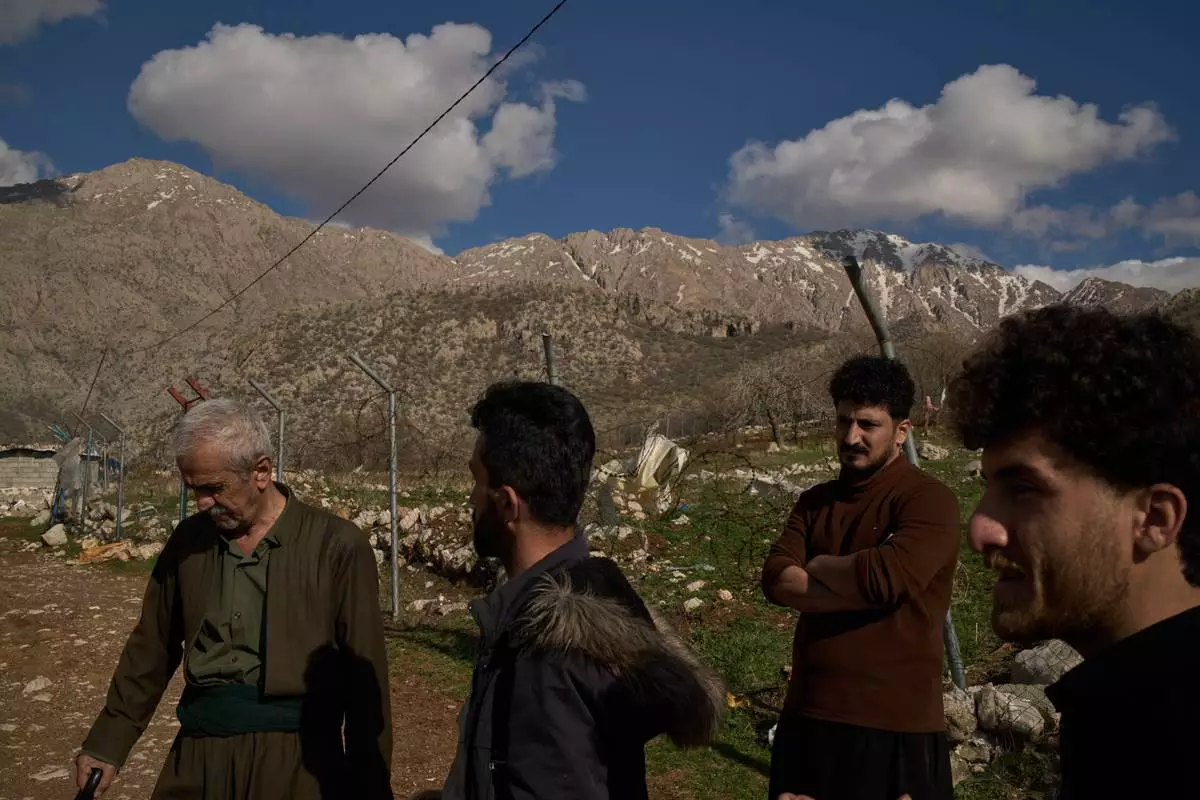
Ako Abdul Rahman, 22, right, an Iraq-Iran cross-border smuggler, chats with local colleagues at a compound in a village in the mountainous Kurdish region near Halabja, Iraq, Tuesday, March 17, 2026. (AP Photo/Leo Correa)
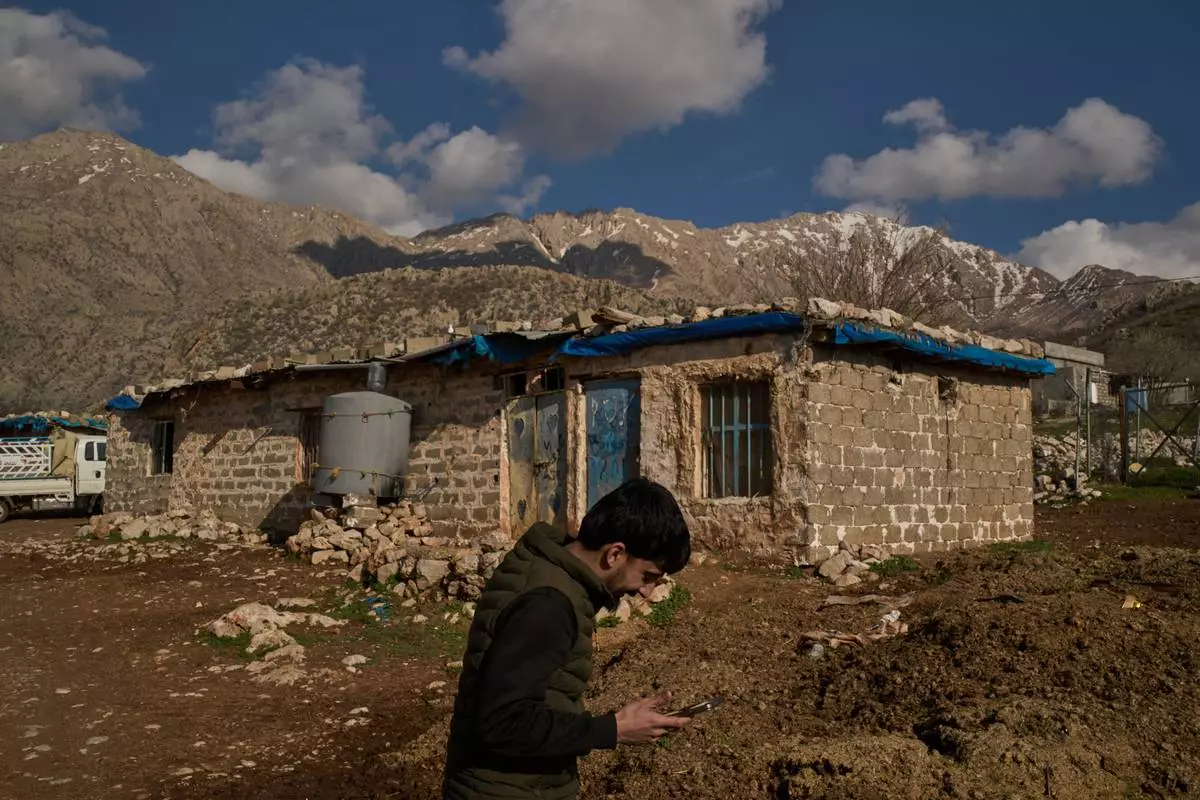
Bilal Osman, 25, an Iraq-Iran cross-border smuggler, speaks on the phone with a partner in Iran as he stands at a compound in a village in the mountainous Kurdish region near Halabja, Iraq, Tuesday, March 17, 2026. (AP Photo/Leo Correa)