Residents who participated in a tree-planting event with Chinese President Xi Jinping on Monday said they were inspired by the president, and vowed to contribute more to China's environmental efforts.
Xi, also general secretary of the Communist Party of China Central Committee and chairman of the Central Military Commission, was joined by residents and other Party and state leaders in Beijing's Changping District for the event, which is part of a tree-planting campaign that has been running in China for the past 45 years.
Xi waved to the crowd to extend his greetings before picking up a shovel to plant different types of saplings. While planting the trees, he asked the children at the site about their studies and daily lives, their participation in labor and sports, and their involvement in tree-planting activities. He stressed the importance of setting great goals at a young age, fostering a love of learning, work and nature, and striving to become pillars of society.
Talking to officials and residents, Xi said that China has seen sustained increases in both forest area and tree stocks, as well as continuous reduction in desert areas. This has made China the country with the largest and fastest increase in greening in the world.
Afforestation is an important task in building a Beautiful China, Xi said, urging sustained and solid efforts to advance the initiative.
Participants at the activity said they had been greatly inspired by Xi's words and deeds, vowing stronger devotion to building a beautiful China.
"I'm very excited to participate in this activity today. The general secretary was planting trees in a very serious manner. He took every shovel seriously, and then, he was meticulous and serious when patting the soil flat," said Li Ruixin, Party branch secretary of the local Baishan Village.
"Participating in this tree-planting activity makes me very happy. During the activity, I have experienced the joy of perseverance. It requires patience to do something well, just like filling the pits with soil little by little when planting trees." said Shi Manyu, a student at Changping School of Tsinghua University Primary School.
"Through this tree-planting activity, I have not only learned about more trees, but also experienced the joy of labor. While watering the trees, Grandpa Xi said to me, 'Be careful, don't have your hand pinched.' I think he is a very kind and good-natured grandpa," said Yu Wanruoshi, another student at the primary school.
"The general secretary is quite knowledgeable about tree planting. He said we should plant the types of trees that can adapt to local conditions to ensure their survival. Through this continuous work of voluntary tree planting, we can see the Party and the country's great confidence and determination in ecological conservation," said Yang Yang, Party branch secretary of the Xingshou Town Vegetable Planting Association.
"The fact that we have conducted this activity for so many years demonstrates to the world the perseverance of the Chinese people. Planting trees itself is an act that benefits both the present and future generations. I believe it's also the most responsible thing we can do for our future, for our children, and for our future home," said Wang Man, a researcher at the Beijing Aircraft Technology Research Institute of Commercial Aircraft Corporation of China.
"While planting trees, the children would say, 'We are contributing our share as the tree grows little by little.' As the saying goes, it takes ten years to grow a tree, but a hundred years to cultivate people. I think the process of planting trees is also a process of nurturing children to grow from generation to generation," said Sun Weiwei, a teacher of the primary school.
"As Grandpa Xi once said, planting trees is to plant the future. We should also grow strong and healthy like this little red pine, eventually becoming towering trees and builders of a beautiful China," said Lv Zekai, another student.
"Today, we are sowing seeds of green hope with every shovelful of soil. The essence of tree-planting and afforestation is to create a better ecological environment, enabling people to live a more wonderful life. This is a very important goal of building a beautiful China," said Wang Zhide, an engineer at the National Institute of Clean and Low-carbon Energy of China Energy Investment Corporation.
"I want to be an environmental researcher when I grow up, using my knowledge to protect our green home and to make the sky bluer, the water clearer, and our lives better," Shi said.
"This year marks the 45th anniversary of the nationwide voluntary tree-planting campaign. After returning from this activity, I will definitely lead more farmers to continuously add greenery based on my experience in ecological agriculture, so that our 'tree of agricultural development' will become more and more lush," Yang said.
"I think we should begin by doing small things in our daily lives and raise our awareness of environmental protection to contribute to the building of a beautiful China," said Liu Jianwei, Party branch secretary at the primary school.
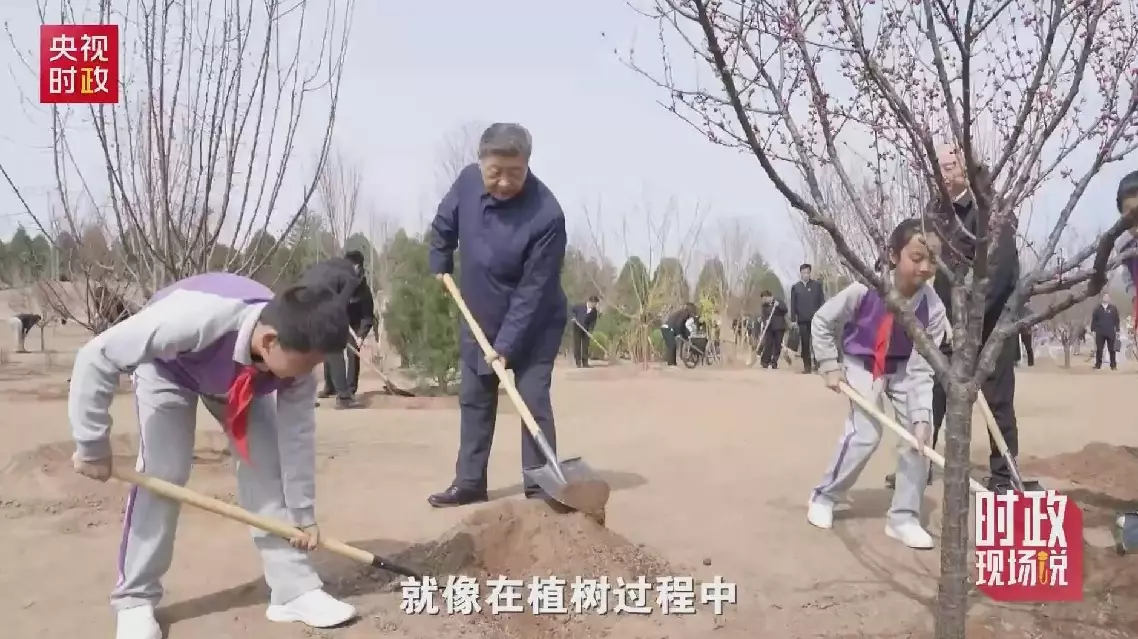
Residents inspired by Xi in tree-planting event