ULAANBAATAR, Mongolia (AP) — Mongolia has named its third prime minister in nine months as the ruling party tries to overcome internal power struggles at a time of mounting economic pressures and political infighting at home.
The hope is that Uchral Nyam-Osor can manage the divisions in the Mongolian People's Party that toppled his two predecessors and brought him to power. He called for unity after parliament confirmed his appointment Monday night.
“As others unite to confront crises, we cannot afford political infighting that weakens our economy,” he told lawmakers.
Uchral was elected as leader of the Mongolian People’s Party and speaker of the parliament last November. Before entering politics, he was a popular hip-hop artist known as “Timon.”
The 39-year-old lawmaker has positioned himself as a reform-minded leader focused on modernizing the country’s regulatory environment. He wants to end a Soviet-era system that gives officials the power to issue permits, creating fertile ground for corruption. Mongolia transitioned to democracy in 1990 after decades of Communist rule.
Ucrhal is a former minister of digital development and communications who promoted transparency reforms and digital governance initiatives. He has played a role in efforts to attract foreign investment to the resource-rich country, including a uranium-related agreement with France’s Orano Group in early 2025.
The Mongolian parliament has been paralyzed following a boycott earlier this month by the opposition Democratic Party and infighting in the ruling party. Together, that meant not enough members were showing up for the legislature to hold votes.
The previous prime minister, Zandanshatar Gombojav, who submitted his resignation Friday to resolve the crisis, had come under pressure because one of his senior ministers faced corruption allegations.
Uchral was seen as a compromise between factions in the Mongolian People's Party loyal to the president and the supporters of another former prime minister, Oyun-Erdene Luvsannamsrai.
A total of 107 of the parliament’s 126 lawmakers voted Monday night, with 88 supporting Uchral — or 82% — clearing the way for him to take office.
Zandanshatar, who is close to the president, had replaced Oyun-Erdene, last June. All three prime ministers are from the Mongolian People’s Party.
Uchral warned Monday that Mongolia is entering a period of three overlapping crises: rising global fuel prices, volatile commodity markets and deepening domestic political divisions.
He highlighted the country’s heavy reliance on coal and copper exports, warning that price swings could erode government revenue and strain public finances. The government is also demanding a greater share of the financial benefits in talks with mining giant Rio Tinto over the Oyu Tolgoi copper and gold mine.
Mongolia, a landlocked country that depends entirely on imported fuel, is vulnerable to supply disruptions and price hikes. The government has asked Russia to keep fuel prices stable, and Moscow has indicated it would respond favorably in the near term, Zandanshatar said at a ceremony to transfer power to Uchral.
Uchral's appointment comes amid renewed concern among foreign investors over Mongolia’s political instability, frequent policy changes and reputation for corruption and regulatory unpredictability.

FILE - Mongolian Prime Minister Gombojavyn Zandanshatar speaks to Russian President Vladimir Putin during their meeting on the sidelines of the Eastern Economic Forum in Vladivostok, Russia, Sept. 4, 2025. (Vladimir Smirnov, Sputnik, Kremlin Pool Photo via AP, File)
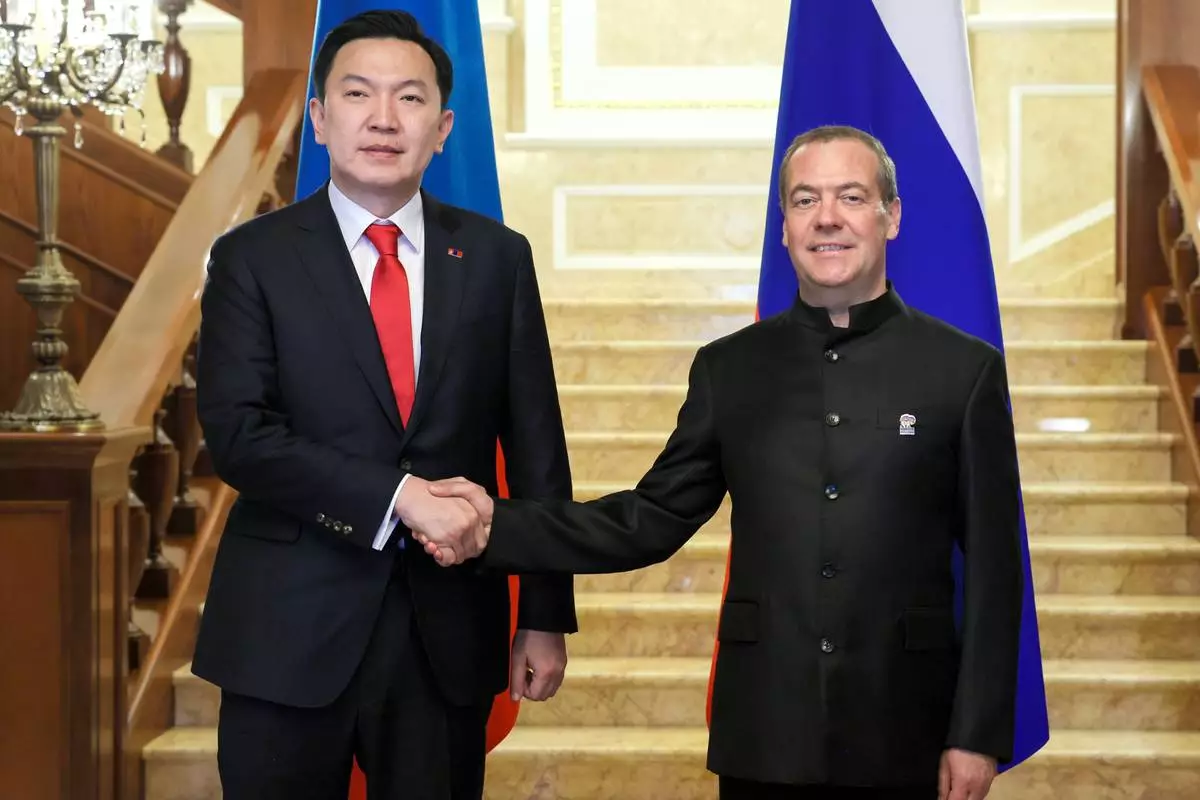
FILE - Russian Security Council Deputy Chairman and the head of the United Russia party Dmitry Medvedev, right, and Chairman of Mongolian People's Party and Chairman of the State Great Khural Nyam-Osoryn Uchral pose for a photo during their meeting at the Gorki state residence outside Moscow, on Feb. 10, 2026. (Ekaterina Shtukina, Sputnik Pool Photo via AP, File)
NEW YORK (AP) — U.S. gas prices jumped past an average of $4 a gallon for the first time since 2022 on Tuesday as the Iran war pushed fuel prices to soar worldwide.
According to motor club AAA, the national average for a gallon of regular gasoline is now $4.02 — over a dollar more than before the war began. The last time U.S. drivers were collectively paying this much at the pump was nearly four years ago, following Russia’s invasion of Ukraine.
The price is a national average, meaning drivers in some states have been paying well over $4 a gallon for a while now. Prices vary from state to state due to factors ranging from nearby supply to differing tax rates.
Since the U.S. and Israel launched a joint war against Iran on Feb. 28, the cost of crude oil — the main ingredient in gasoline — has spiked and swung rapidly. That’s because the conflict has caused deep supply chain disruptions and cuts from major oil producers across the Middle East.
Motorists around the world are also coping with higher gas prices due to the war. In Paris, for example, gas is at 2.34 euros per liter ($2.68), which is about $10.27 a gallon.
Higher gas prices are impacting consumers and businesses as many households continue to face wider cost of living strains. And as drivers pay more to cover necessities like gas, many may be forced to cut their budgets in other places.
More expensive fuel can also push up other spending, from utility bills to the price of many goods consumers buy each day.
In the immediate future, analysts point to groceries, which have to be restocked frequently and could also see price hikes as businesses’ transportation costs pile up.
But hauling other cargo and packages has also been impacted. The United Postal Service, for example, is seeking a temporary 8% added charge on some of its popular products including Priority Mail.
U.S. diesel prices — the fuel used for many freight and delivery trucks — is now going for an average of $5.45 a gallon, up from about $3.76 a gallon before the war began, per AAA.
If the war drags on, it’s possible that those prices could tick up even higher. Most tanker movement in the key Strait of Hormuz, where roughly one-fifth of the world’s oil typically sails through, remains at a halt. That’s led to cuts from major producers in the region who have no way of getting their crude to market. Meanwhile, Iran, Israel and the U.S. have all struck oil and gas facilities, worsening supply concerns.
In a search for some relief, the International Energy Agency pledged to release 400 million barrels of oil from emergency stockpiles of member nations. That includes the U.S., despite Trump initially downplaying the need for reserve oil.
The Trump administration has also eased sanctions to free up some oil from Venezuela, and temporarily Russia. The White House also says it’s waiving maritime shipping requirements under a more than century-old law, known as the Jones Act, for 60 days.
It's not yet clear if those efforts will bring relief for consumers. A lot of factors contribute to gas prices.
Refineries buy crude oil in advance, meaning some could be work with more expensive oil for a while, and it will take time for any new supply to trickle down to consumers.
And while steep crude prices are a leading driver behind today’s surge, U.S. gas prices typically tick up a bit at this time of year. More drivers are hitting the road and trying to fuel up while they can, so there’s higher demand. Warming weather also brings a shift to summer blend fuel, which is more expensive to produce than winter blend.
The U.S., which is a net oil exporter, hasn't seen as stark a shock as other parts of the world that rely more heavily on fuel imports from the Middle East, notably Asia. But that doesn’t mean America is immune to price spikes.
Oil is a globally-traded commodity. And most of what the U.S. produces is light, sweet crude — but refineries on the East and West coasts are primarily designed to process heavier, sour product. As a result, the country also needs imports.
Escalating geopolitical conflicts have disrupted oil flows and contributed to a surge in gas prices in the past. The U.S. average for regular gasoline climbed to its highest level of more than $5 a gallon in June 2022, nearly four months after the Ukraine war began and world leaders imposed sanctions against Russia, a leading oil producer.
Prices at the pump later fell from that record. Before Tuesday, per AAA data, the national average had stayed below the $4 mark since mid-August of 2022.
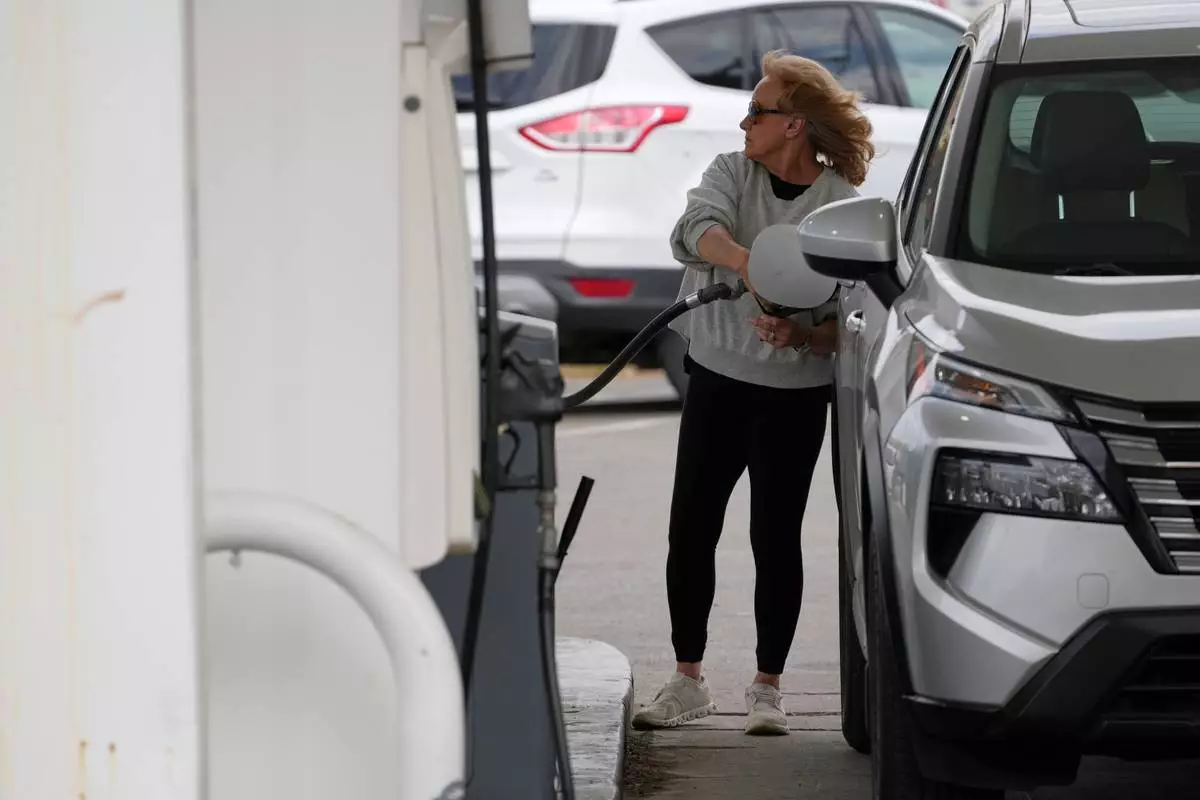
A woman fills her vehicle with fuel at a gas station, Monday, March 30, 2026, in Nashville, Tenn. (AP Photo/George Walker IV)
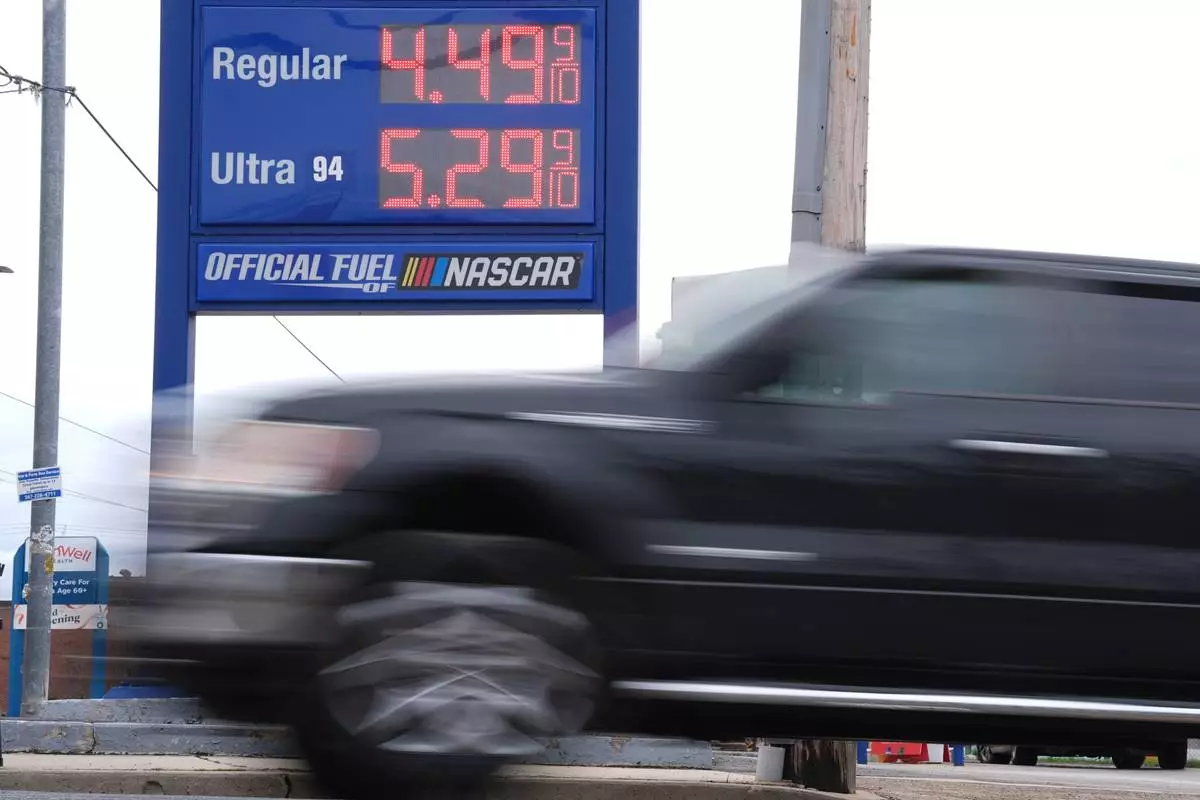
A vehicle passes a gasoline price board at a filling station in Philadelphia, Friday, March 27, 2026. (AP Photo/Matt Rourke)