MOUNTAIN VIEW, Calif.--(BUSINESS WIRE)--Mar 31, 2026--
Aeva (Nasdaq: AEVA), a leader in next-generation sensing and perception systems, today announced that the Georgia Department of Transportation (GDOT) has selected the Aeva CityOS™ intelligent transportation systems (ITS) platform for a deployment at 30 new intersections across multiple sites in the greater Atlanta area. The expansion represents a significant step toward scaling AI-powered intelligent infrastructure using Aeva’s 4D LiDAR technology in one of the largest cities in the United States.
This press release features multimedia. View the full release here: https://www.businesswire.com/news/home/20260331160154/en/
The expansion follows an initial rollout of CityOS across multiple intersections surrounding Centennial Olympic Park and the Georgia World Congress Center. The area is one of Atlanta’s busiest pedestrian corridors and a major destination for tourism, events, and convention activity. Its high concentration of foot traffic and multimodal activity made it an ideal environment to demonstrate how CityOS’s advanced sensing and AI-powered perception and analytics could improve roadway safety and traffic operations.
“Aeva CityOS brings real-time intelligence to road infrastructure,” said James Byun, Managing Director of Business Development at Aeva. “Deploying the platform in one of Atlanta’s busiest pedestrian corridors has shown how cities can use 4D LiDAR and AI to better understand traffic activity, improve safety for vulnerable road users, and manage mobility more effectively. The expansion of the deployment reflects the strong value transportation agencies see in this new generation of intelligent infrastructure.”
AI-Powered Traffic Intelligence with 4D LiDAR
CityOS combines Aeva’s automotive-grade 4D LiDAR with edge AI-powered perception and advanced analytics to provide continuous, real-time awareness of intersection activity. The platform detects and analyzes the movement of vehicles, pedestrians, cyclists, and other road users to support applications such as vulnerable road user safety monitoring, wrong-way driving detection, and real-time traffic flow analysis.
Each CityOS-enabled intersection is equipped with Aeva Atlas™ Orion sensors to deliver full-area coverage and comprehensive situational awareness. Powered by Aeva’s proprietary Frequency Modulated Continuous Wave (FMCW) LiDAR technology, the 4D LIDAR sensors measure 3D position and velocity simultaneously, enabling precise detection and tracking of moving objects.
Unlike traditional ITS technologies such as cameras, radar, or inductive loops, Aeva’s 4D LiDAR operates reliably in all lighting conditions, including direct sun glare and complete darkness, while providing higher spatial resolution and privacy-preserving sensing without reliance on identifiable imagery.
The Atlanta deployment will represent one of the first large-scale implementations of LiDAR-powered intelligent transportation infrastructure in the United States.
About Aeva Technologies, Inc. (Nasdaq: AEVA)
Aeva’s mission is to bring the next wave of perception to a broad range of applications from automated driving, manufacturing automation and smart infrastructure, to robotics and consumer devices. Aeva is accelerating autonomy with its groundbreaking perception platform that integrates lidar-on-chip technology, system-on-chip processing, and perception algorithms onto silicon leveraging silicon photonics. Aeva 4D LiDAR sensors uniquely detect velocity and position simultaneously, allowing automated devices like vehicles and robots to make more intelligent and safe decisions. For more information, visit www.aeva.com, or connect with us on X or LinkedIn.
Aeva, the Aeva logo, Aeva 4D LiDAR, Aeva Atlas, Aeries, Aeva Eve, Aeva Omni, Aeva CityOS, Aeva Ultra Resolution, Aeva CoreVision, and Aeva X1 are trademarks/registered trademarks of Aeva, Inc. All rights reserved. Third-party trademarks are the property of their respective owners.
Forward looking statements
This press release contains certain forward-looking statements within the meaning of the federal securities laws. Forward-looking statements generally are identified by the words “believe,” “project,” “expect,” “anticipate,” “estimate,” “intend,” “strategy,” “future,” “opportunity,” “plan,” “may,” “should,” “will,” “would,” “will be,” “will continue,” “will likely result,” and similar expressions. These forward-looking statements include, but are not limited to expectations about the expanded deployment of the Aeva CityOS ITS platform in the greater Atlanta area, our product features, performance, and potential applications. Forward-looking statements are predictions, projections and other statements about future events that are based on current expectations and assumptions and, as a result, are subject to risks and uncertainties. Many factors could cause actual future events to differ materially from the forward-looking statements in this press release, including, but not limited to: (i) the fact that Aeva is an early stage company with a history of operating losses and may never achieve profitability, (ii) Aeva’s limited operating history, (iii) the ability to implement business plans, forecasts, and other expectations and to identify and realize additional opportunities, (iv) the ability for Aeva to have its products selected for inclusion in infrastructure projects, (v) unforeseen manufacturing issues or defects, (vi) Aeva’s ability to scale production if any products achieve commercial success, (vii) market acceptance of LiDAR technology to infrastructure applications, (viii) general economic conditions and other material risks and other important factors that could affect our financial results. Please refer to our filings with the SEC, including our most recent Form 10-Q and Form 10-K. These filings identify and address other important risks and uncertainties that could cause actual events and results to differ materially from those contained in the forward-looking statements. Forward-looking statements speak only as of the date they are made. Readers are cautioned not to put undue reliance on forward-looking statements, and Aeva assumes no obligation and does not intend to update or revise these forward-looking statements, whether as a result of new information, future events, or otherwise. Aeva does not give any assurance that it will achieve its expectations.
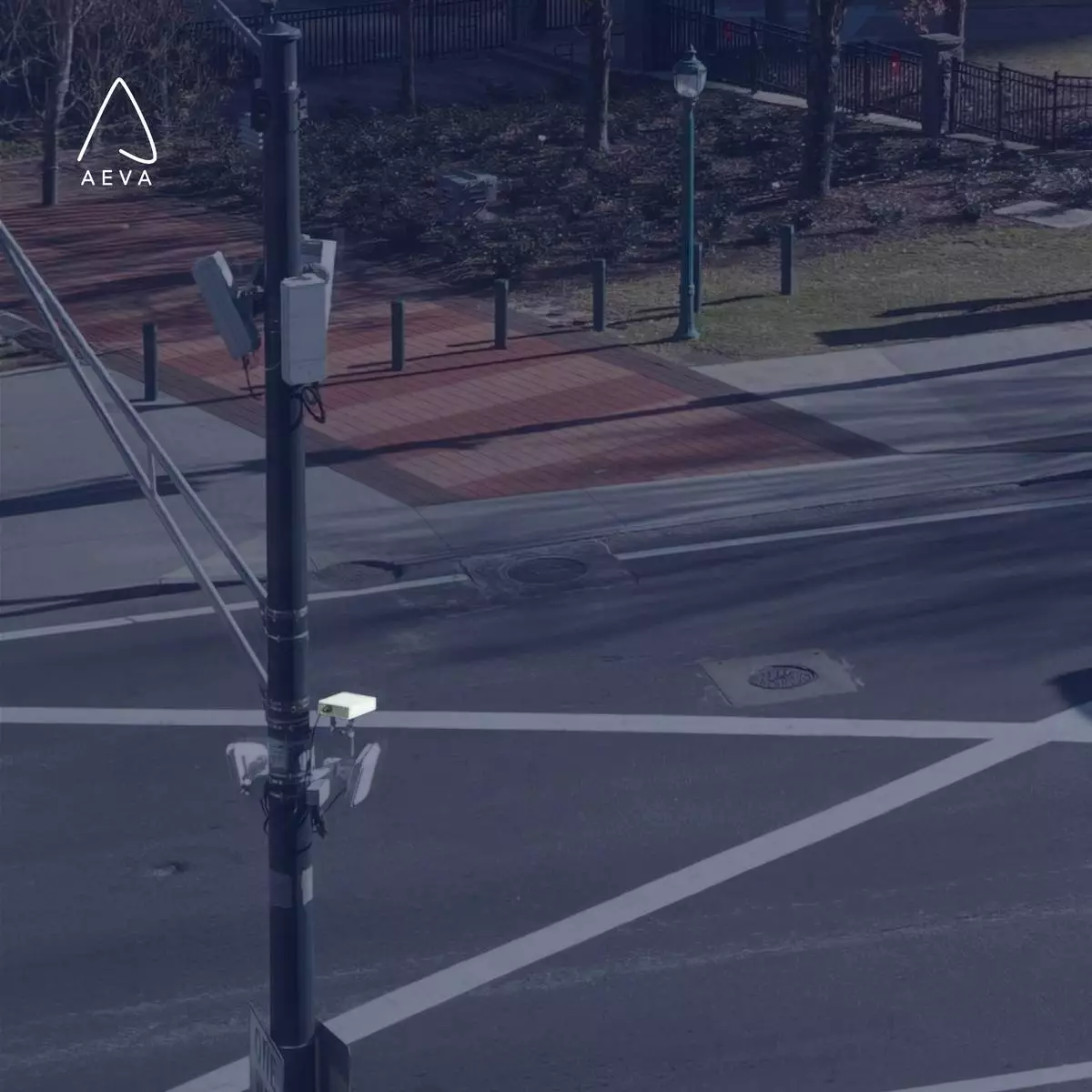
Aeva CityOS™ system in a major Georgia intersection