Skip to Content Facebook Feature Image

TomaGold Starts Drilling at Berrigan Mine

News

TomaGold Starts Drilling at Berrigan Mine
News

News

TomaGold Starts Drilling at Berrigan Mine

2026-03-31 19:30 Last Updated At:19:40

MONTRÉAL--(BUSINESS WIRE)--Mar 31, 2026--

TOMAGOLD CORPORATION (TSXV: LOT; OTCPK: TOGOF) (“ TomaGold ” or the “ Company ”) is pleased to announce that drilling has started at its Berrigan Mine project, located in the Chibougamau Mining Camp, Québec.

This press release features multimedia. View the full release here: https://www.businesswire.com/news/home/20260331476747/en/

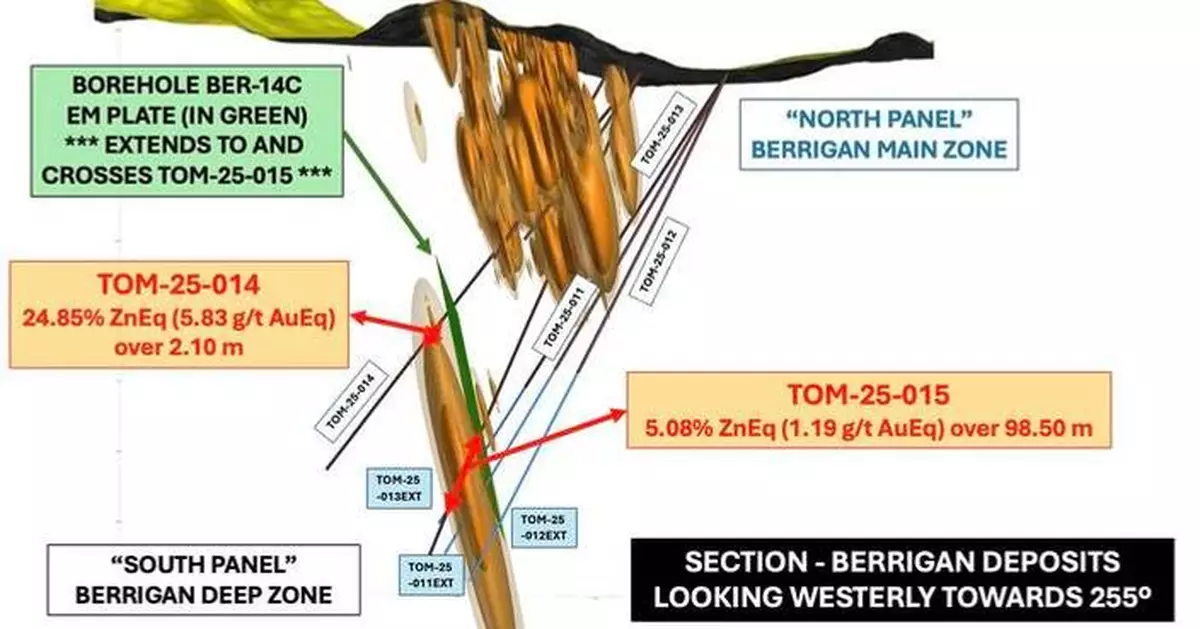
The Phase 2 drilling program will consist of approximately 1,500 metres of diamond drilling, with five extension holes targeting previously completed drill holes TOM-25-009 through TOM-25-013. The program aims to further evaluate the Berrigan Deep zone at depth (see Figures 1 and 2), while additional drilling will test new targets generated from ongoing geological and geophysical modeling.

David Grondin, President and CEO of TomaGold, stated: “This next phase will allow us to the test the potential of the Berrigan Deep zone, where our best intercept to date returned 5.08% ZnEq (1.19 g/t AuEq) over 98.50 m, including 23.20% ZnEq (5.44 g/t AuEq) over 4.90 m in drill hole TOM-25-015. Through these five extension holes, we aim to reach the core of the modeled conductive plates, which could significantly increase the volume of identified mineralization.”

Table 1: Summary of Phase 1 drilling results at the Berrigan Mine project

Notes:

About the Berrigan Mine Project
The Berrigan Mine property consists of 16 claims totalling 483 hectares located 4 km north-northwest of the town of Chibougamau. TomaGold has an option to acquire 100% of the property from Chibougamau Independent Mines Inc.

The property has been the subject of more than one historical estimate. Met-Chem Canada Inc. prepared the most recent of these in April 2001 in a report titled: “Pre-feasibility study: Etude Conceptuelle, Projects Berrigan and Tortigny” by Chuinard et al. In the report, a resource estimate completed using polygonal estimation techniques stated 1.39 Mt grading 3.17% Zn and 1.77 g/t Au on the main Berrigan Mine zone. No resource classifications were given for the resource (GM61359).

The mineral resource estimate presented above is historical in nature and was not prepared in accordance with National Instrument 43-101 standards. Accordingly, the reader is cautioned not to rely on this estimate, as the Company is not treating the estimate as a current mineral resource. The qualified person has not done sufficient work to make the resource current. Substantial data compilation, verification, and, potentially, additional drilling and resampling would be required by a qualified person before the historical estimate could be classified as a current mineral resource. There can be no assurance that any portion of the historical mineral resource will ultimately be confirmed or demonstrated to be economically viable. For further information regarding the Berrigan Mine Project, please consult the press release dated September 13, 2023.

Technical Disclosure
The drilling program was managed by Explo-Logik of Val-d’Or, Québec. Drill core was split in half, with one half submitted to AGAT Laboratories at Val-d’Or for analysis. Gold was analyzed by fire assay (50 g) with atomic absorption finish, while base metals were analyzed by four-acid digestion with ICP-OES finish. Samples with gold grades greater than 10 g/t are reprocessed using metallic screening with a 106 µm cutoff. The processed material is split and analyzed by fire assay with ICP-OES finish to extinction. A separate split is prepared to independently analyze mineralized intervals with a target grade greater than 1.00% Cu-Zn using a Na₂O₂ fusion with ICP-OES or ICP-MS finish. Sample preparation duplicates, certified reference standards, and blanks are inserted into the sample stream.

The technical content of this press release has been reviewed and approved by Jean Lafleur, P.Geo., Vice President of Exploration of the Company, and Suzie Tremblay, P.Geo., Vice President of Operations at Explo-Logik Inc. and a consultant to TomaGold, each acting as a Qualified Person under National Instrument 43-101.

About TomaGold
TomaGold Corp. (TSXV: LOT, OTCPK: TOGOF) is a Canadian junior mining company focused on the acquisition, exploration, and development of high-potential precious and base metal projects, with a primary focus on gold and copper in Québec and Ontario. The Company’s core assets are located in the Chibougamau Mining Camp in northern Québec, where it owns the Obalski gold-copper-silver project and holds options to acquire 12 additional properties, including the Berrigan Mine, Brosnan, Radar and Dufault projects. TomaGold also holds a 24.5% joint venture interest in the Baird gold property near the Red Lake Mining Camp in Ontario. In addition, the Company has lithium and rare earth element (REE) projects in the James Bay region, strategically positioned near significant recent discoveries.

Follow TomaGold:
WhatsApp: https://www.whatsapp.com/channel/0029Vb79qG6LdQeiiErI1e27
LinkedIn: https://www.linkedin.com/company/tomagold-corporation
Facebook: https://www.facebook.com/TomaGoldCorporation
Instagram: https://www.instagram.com/tomagoldcorp
X: https://x.com/tomagoldcorp

Cautionary Statement on Forward-Looking Information
This news release includes certain statements that may be deemed “forward-looking statements”. All statements in this news release, other than statements of historical facts, that address events or developments that the Company expects to occur, are forward-looking statements. Forward-looking statements are statements that are not historical facts and are generally, but not always, identified by the words “expects”, “plans”, “anticipates”, “believes”, “intends”, “estimates”, “projects”, “potential” and similar expressions, or that events or conditions “will”, “would”, “may”, “could” or “should” occur. Although the Company believes the expectations expressed in such forward-looking statements are based on reasonable assumptions, such statements are not guarantees of future performance and actual results may differ materially from those in the forward-looking statements. Factors that could cause the actual results to differ materially from those in forward-looking statements include the potential results of exploration and drilling activities, market prices, continued availability of capital and financing, and general economic, market or business conditions. Investors are cautioned that any such statements are not guarantees of future performance and actual results or developments may differ materially from those projected in the forward-looking statements. Forward-looking statements are based on the beliefs, estimates and opinions of the Company's management on the date the statements are made. Except as required by applicable securities laws, the Company undertakes no obligation to update these forward-looking statements in the event that management’s beliefs, estimates, opinions, or other factors should change.

Neither TSX Venture Exchange nor its Regulations Services Provider (as that term is defined in the policies of the TSX Venture Exchange) accepts responsibility for the adequacy or accuracy of this news release.
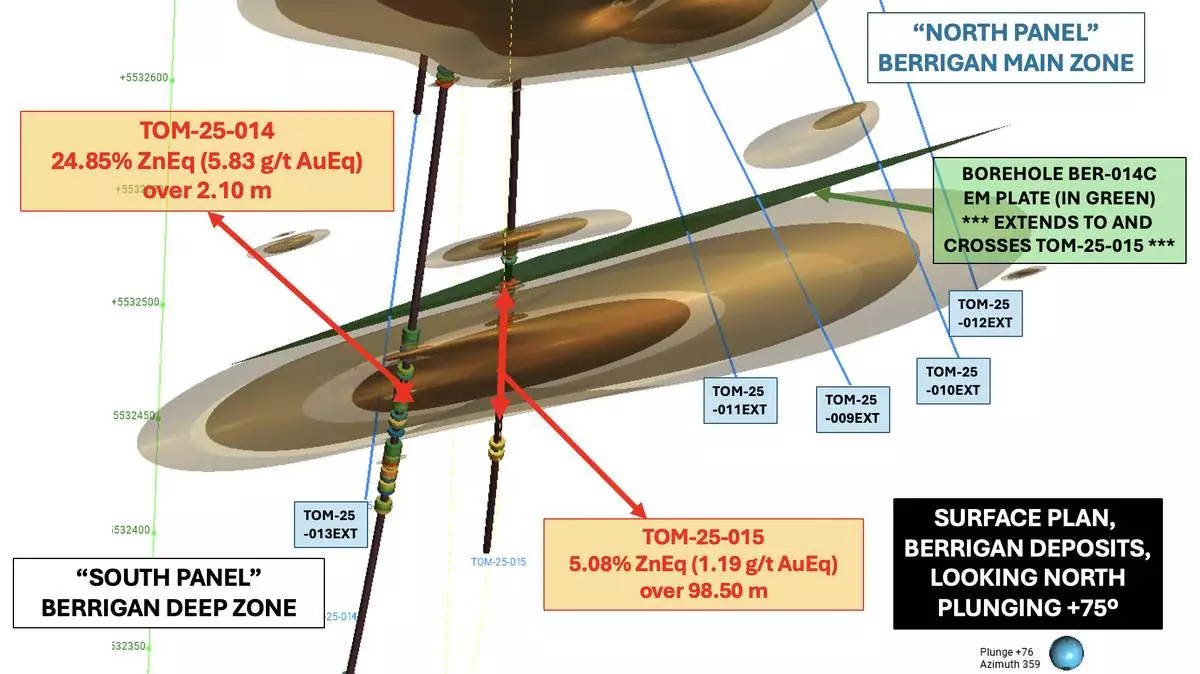
Figure 2 - Plan view of the Phase 2 extension drilling program at Berrigan Mine: 3D plan view showing drill holes TOM-25-009 to TOM-25-013 and their planned extensions (blue lines) targeting the modeled conductive plate at depth, along with significant intersections from holes TOM-25-014 and TOM-25-015 within the Berrigan Deep zone.
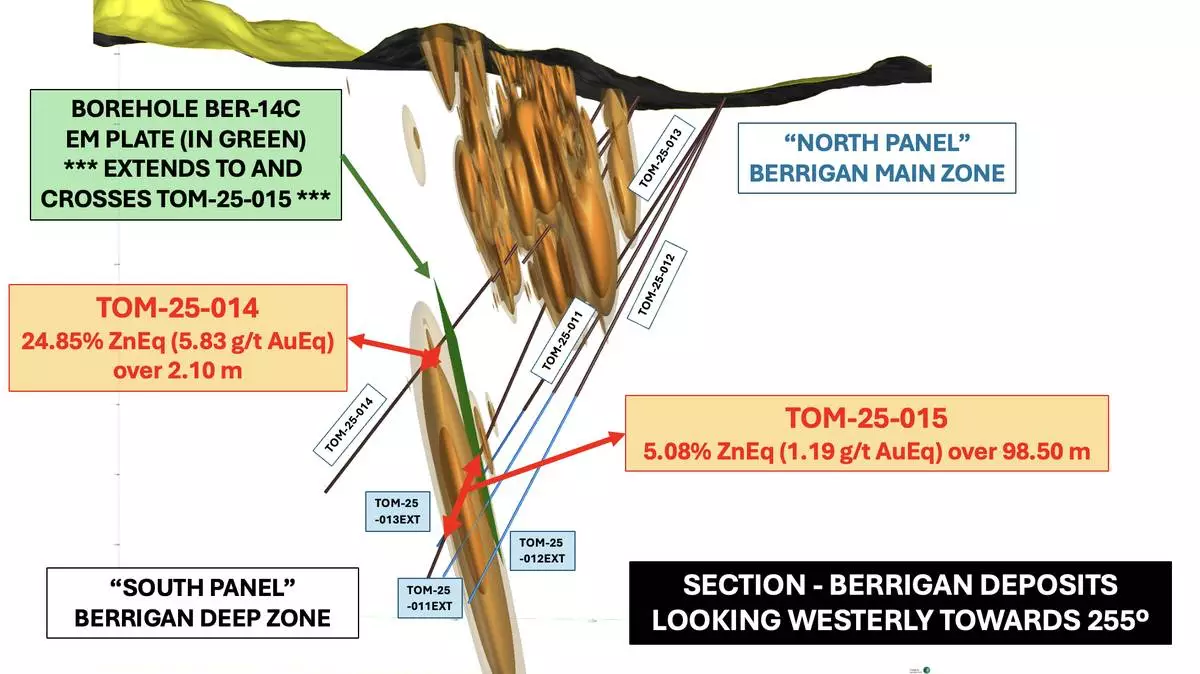
Figure 2 - Plan view of the Phase 2 extension drilling program at Berrigan Mine: 3D plan view showing drill holes TOM-25-009 to TOM-25-013 and their planned extensions (blue lines) targeting the modeled conductive plate at depth, along with significant intersections from holes TOM-25-014 and TOM-25-015 within the Berrigan Deep zone.

Figure 1 - Longitudinal view of the Phase 2 extension drilling program at Berrigan Mine: 3D longitudinal section showing drill holes TOM-25-009 to TOM-25-013 (with TOM-25-009 and TOM-25-010 located between TOM-25-011 and TOM-25-014) and their planned extensions (blue lines) targeting the modeled conductive plate at depth, along with significant intersections from holes TOM-25-014 and TOM-25-015 within the Berrigan Deep zone.

Figure 1 - Longitudinal view of the Phase 2 extension drilling program at Berrigan Mine: 3D longitudinal section showing drill holes TOM-25-009 to TOM-25-013 (with TOM-25-009 and TOM-25-010 located between TOM-25-011 and TOM-25-014) and their planned extensions (blue lines) targeting the modeled conductive plate at depth, along with significant intersections from holes TOM-25-014 and TOM-25-015 within the Berrigan Deep zone.

DUBAI, United Arab Emirates (AP) — A likely strike by the United States hit the central Iranian city of Isfahan early Tuesday, sending a massive fireball into the sky, and Tehran struck a fully loaded Kuwaiti oil tanker in the Persian Gulf.

The attacks were testament to the intensity of the monthlong war the U.S. and Israel launched against Iran, which has maintained its chokehold on the Strait of Hormuz, closing off the vital waterway for global energy shipments, sending oil prices skyrocketing and roiling world markets.

U.S. President Donald Trump, who has been insisting there is progress in diplomatic talks toward a ceasefire, shared video of the attack on Isfahan, with fiery explosions lighting up the night sky. Isfahan is home to one of three sites earlier attacked by the U.S. military in June and some of Iran’s highly enriched uranium is likely stored or buried or there.

Meanwhile, Israel said another four soldiers had been killed in its invasion of Lebanon, as were two more United Nations peacekeepers, prompting the U.N. Security Council to schedule an emergency session for later Tuesday.

Spot prices of Brent crude, the international standard, hovered around $107 a barrel in early trading, up more than 45% since the war started Feb. 28 when the U.S. and Israel attacked Iran.

Iran’s stranglehold on the Strait of Hormuz, the waterway leading our of Persian Gulf through which a fifth of the world’s oil is transported during peacetime, has driven up global oil prices, as have its attacks on Gulf regional energy infrastructure.

In response to growing Gulf Arab anger, Iranian Foreign Minister Abbas Araghchi insisted Tuesday that Tehran is only targeting U.S. forces. Several states have been encouraging Washington to continue the war until Iran's military capabilities are destroyed.

“Our operations are aimed at enemy aggressors who have no respect for Arabs or Iranians, nor can provide any security," Araghchi wrote on X. "High time to eject U.S. forces.”

Despite these words, attacks on civilian targets continued as an Iranian drone hit a Kuwaiti oil tanker in Dubai waters, sparking a blaze that was later put out, the Dubai Media Office said.

Four people in Dubai were also wounded when debris from an intercepted drone fell into a residential area.

Air raid sirens sounded in Bahrain, while Saudi Arabia's Defense Ministry said it had intercepted three ballistic missiles launched toward Riyadh, and falling debris from a drone intercepted southeast of the capital caused minor damage to six homes.

Sirens were also heard in Jerusalem and loud explosions were heard not long after Israel's military warned of an incoming missile barrage from Iran.

Israel and the U.S. launched a new wave of strikes on Iran, hitting Tehran in the early morning hours.

The video shared by Trump appeared to show a massive attack on Isfahan, where NASA fire-tracking satellites suggest the explosions happened near Mount Soffeh, an area believed to have military positions. Iran has not yet confirmed the attack.

A satellite image taken just before the 12-day war in June between Iran and Israel suggests Tehran transferred a truckload of highly enriched uranium to its nuclear facility at Isfahan.

The image from an Airbus Defense and Space Pléiades Neo satellite shows a truck loaded with 18 blue containers going into a tunnel at the Isfahan Nuclear Technology Center about two weeks before the U.S. bombed the site.

Analysts determined that the truck likely carried most or all of Iran's stockpile of uranium enriched up to 60% purity. That’s a short, technical step to weapons-grade levels of 90%.

Trump has said this week that “great progress is being made” in talks with Iran to end military operations. But he said if a deal is not reached “shortly,” and if the Strait of Hormuz is not immediately reopened, the U.S. would broaden its offensive by “completely obliterating” power plants, oil wells, Kharg Island and possibly even desalination plants.

The U.S. has also sent a contingent of 2,500 Marines to the region, and another is on its way, while ordering 1,000 paratroopers to the theatre as well.

Trump has openly talked about the possibility of trying to seize Kharg Island, Iran's main oil export hub, and Iran has accused the U.S. of using diplomacy to stall until more troops can be brought in.

The U.S. already has targeted military positions on Kharg. Iran has threatened to launch its own ground invasion of Gulf Arab countries and to mine the Persian Gulf if U.S. troops set foot on its territory.

Twice during Trump’s second term, the U.S. has attacked Iran during high-level diplomatic talks, including with the Feb. 28 strikes that started the current war.

The U.N. Security Council planned to convene an emergency session Tuesday after officials said three peacekeepers in southern Lebanon had been killed in less than 24 hours.

The U.N. peacekeeping mission in the region where Israel is battling the Iran-backed Hezbollah did not say who was responsible for the deaths.

In Iran, authorities say more than 1,900 people have been killed, while 19 have been reported dead in Israel.

Two dozen people have been killed in Gulf states and the occupied West Bank. In Lebanon, officials said more than 1,200 people have been killed, and more than 1 million have been displaced.

Ten Israeli soldiers have died in Lebanon, including the four announced Tuesday, while 13 U.S. service members have been killed in the war.

Rising reported from Bangkok. Sally Abou AlJoud in Beirut contributed to this report.

Residents and Israeli security forces inspect a site struck by an Iranian missile in Petah Tikva, Israel, Tuesday, March 31, 2026. (AP Photo/Ohad Zwigenberg)

Residents and Israeli security forces inspect a site struck by an Iranian missile in Petah Tikva, Israel, Tuesday, March 31, 2026. (AP Photo/Ohad Zwigenberg)

People cross an intersection in downtown Tehran, Iran, Monday, March 30, 2026. (AP Photo/Vahid Salemi)

People cross an intersection in downtown Tehran, Iran, Monday, March 30, 2026. (AP Photo/Vahid Salemi)

A woman holds a banner showing portraits of the late Iranian Supreme Leader Ayatollah Ali Khamenei, left, and his son Ayatollah Mojtaba Khamenei, the successor to him, during a campaign in support of the government at the Enqelab-e-Eslami, or Islamic Revolution, square in downtown Tehran, Iran, Monday, March 30, 2026. (AP Photo/Vahid Salemi)

A woman holds a banner showing portraits of the late Iranian Supreme Leader Ayatollah Ali Khamenei, left, and his son Ayatollah Mojtaba Khamenei, the successor to him, during a campaign in support of the government at the Enqelab-e-Eslami, or Islamic Revolution, square in downtown Tehran, Iran, Monday, March 30, 2026. (AP Photo/Vahid Salemi)

A firefighter battles flames at a damaged workshop after an alert of incoming missiles in Petah Tikva, Israel, Tuesday, March 31, 2026. (AP Photo/Oded Balilty)

A firefighter battles flames at a damaged workshop after an alert of incoming missiles in Petah Tikva, Israel, Tuesday, March 31, 2026. (AP Photo/Oded Balilty)

Members of the Basij paramilitary force stand at a checkpoint in Tehran, Iran, Sunday, March 29, 2026. (AP Photo/Vahid Salemi)

Members of the Basij paramilitary force stand at a checkpoint in Tehran, Iran, Sunday, March 29, 2026. (AP Photo/Vahid Salemi)

Monsignor Simon Khoury inspects a damaged house following an Iranian missile strike in Shefaram, Israel, Monday, March 30, 2026. (AP Photo/Ariel Schalit)

Monsignor Simon Khoury inspects a damaged house following an Iranian missile strike in Shefaram, Israel, Monday, March 30, 2026. (AP Photo/Ariel Schalit)

Israeli authorities inspect a damaged house following an Iranian missile strike in Haifa, Israel, Monday, March 30, 2026. (AP Photo/Ariel Schalit)

Israeli authorities inspect a damaged house following an Iranian missile strike in Haifa, Israel, Monday, March 30, 2026. (AP Photo/Ariel Schalit)

A portrait of Iran's late Supreme Leader Ayatollah Ali Khamenei, left, is seen, as smoke rises following an Israeli airstrike in Dahiyeh, Beirut's southern suburbs, Lebanon, Monday, March 30, 2026. (AP Photo/Hassan Ammar)

A portrait of Iran's late Supreme Leader Ayatollah Ali Khamenei, left, is seen, as smoke rises following an Israeli airstrike in Dahiyeh, Beirut's southern suburbs, Lebanon, Monday, March 30, 2026. (AP Photo/Hassan Ammar)

Portraits of Hezbollah's late leaders Hassan Nasrallah, right, and his cousin, Hashem Safieddine, are seen, as smoke rises following an Israeli airstrike in Dahiyeh, Beirut's southern suburbs, Lebanon, Monday, March 30, 2026. (AP Photo/Hassan Ammar)

Portraits of Hezbollah's late leaders Hassan Nasrallah, right, and his cousin, Hashem Safieddine, are seen, as smoke rises following an Israeli airstrike in Dahiyeh, Beirut's southern suburbs, Lebanon, Monday, March 30, 2026. (AP Photo/Hassan Ammar)

Recommended Articles