A prototype for China's next-generation, lower-cost cargo spacecraft is ready to conduct verification of key technologies in orbit, after being launched into space atop a Lijian-2 Y1 carrier rocket on Monday.
The successful launch of the Qingzhou Cargo Spacecraft Test Vehicle is a prelude to the launch of a full model, and marks a major step forward in China's efforts to develop lightweight, agile and cost-effective freighters to resupply its orbiting Tiangong Space Station.
The prototype spacecraft, weighing just 4.2 tons, carried 27 projects with a total payload of 1.02 tons, and will conduct in-orbit tests at altitudes ranging from 200 to 600 kilometers.
The name Qingzhou translates to "light ship". The spacecraft is developed by the Innovation Academy for Microsatellites of the Chinese Academy of Sciences.
Its structure features a main pressurized module for crew supplies and science experiments, and an unpressurized aft section capable of carrying external payloads and space exposure experiments.
The vehicle's available volume for cargo is 27 cubic meters. For the storage of special supplies, the spacecraft is equipped with five modular "space refrigerators" -- temperature-controlled containers each with a volume of 60 liters.
Qingzhou is seen as a lower-cost complement to China's existing Tianzhou cargo spacecraft, which has been carrying out delivery missions to the Tiangong Space Station.
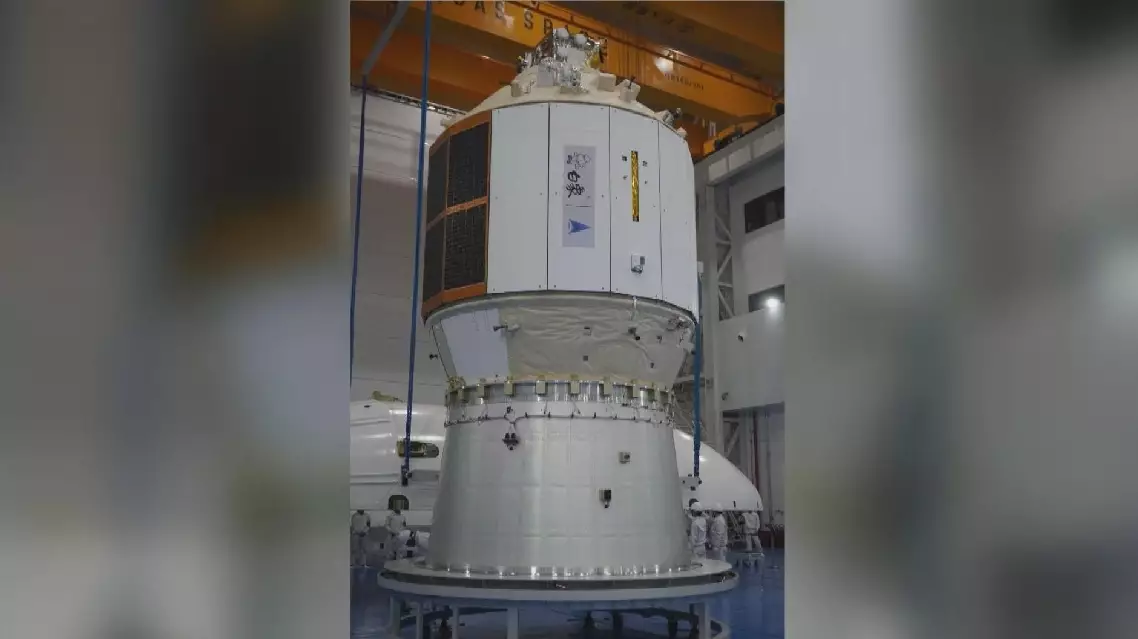
China's lower-cost cargo spacecraft prototype set to start in-orbit technological verification