The traffic administration authorities in Shanghai have applied an AI-powered traffic management system to improve traffic flow and reduce congestion in the mega city, achieving promising results in optimizing traffic signal timing and scenario solution.
A successful example of the application of this system in operation is the implementation of a reversible-lane plan in the busy Changhai Road of Yangpu District, where there are two third-grade hospitals, which rank at the top of China's three-tier hospital grading system, with heavy traffic during morning peak.
By adjusting the four lanes in both the east and west directions to three west-east lanes and one east-west reversible lane, the AI-driven system helps increase the average vehicle speed from 17.5 kilometers per hour to 26.4 kilometers per hour on this road section.
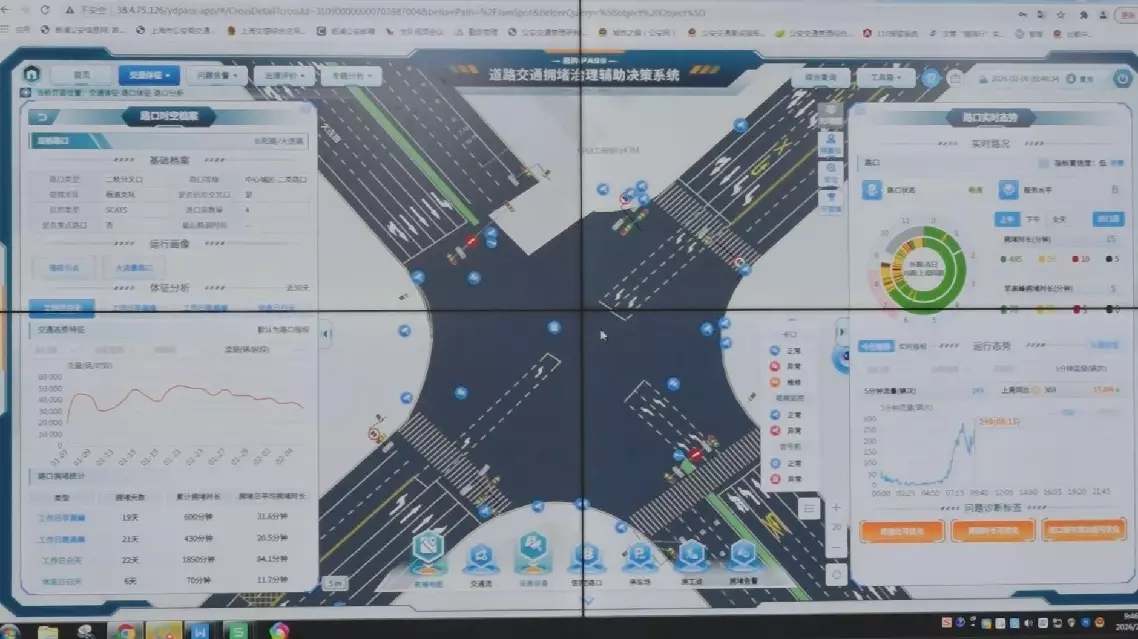
"The large model for traffic congestion relief helps us to monitor the traffic situation at intersections in real time, and then provide some suggestions on the changes in traffic flow at intersections through AI analysis," said Liu Chengjie, a local traffic police officer.
The AI-powered system also helps to optimize traffic signals.
"What's the most convenient is that it can automatically adjust the ratio of green traffic lights. We don't need to intervene it manually as the model can refresh its operation plans," Liu said.
Trained on police strategies and road network rules, the model can intelligently analyze and continuously optimize traffic solutions.
"In the intersection overflow scenario, we've made upgrade 48 times, and the accuracy rate of traffic lights has increased from 72 percent to 86 percent. At present, it usually takes us two months to train for new scenarios. We have been constantly expanding our knowledge base and increasing the upgrade of scenarios to enable the model to learn as much as possible at each intersection or analyze more scenarios," said Lu Zhuoliang, a police officer at the AI traffic congestion relief task force under the traffic management division of Shanghai Municipal Public Security Bureau.
At present, the large model for traffic congestion relief has been applied to over 360 key intersections in Shanghai, with an average increase of 12.9 percent in traffic efficiency.
It is expected that by October this year, it will cover over 1,800 intersections in Shanghai.
Shanghai uses AI to tackle traffic congestion