Skip to Content Facebook Feature Image

US-Israeli war on Iran disrupts travel businesses from Tanzania

HotTV

HotTV

HotTV

US-Israeli war on Iran disrupts travel businesses from Tanzania

2026-04-01 16:09 Last Updated At:04-02 12:09

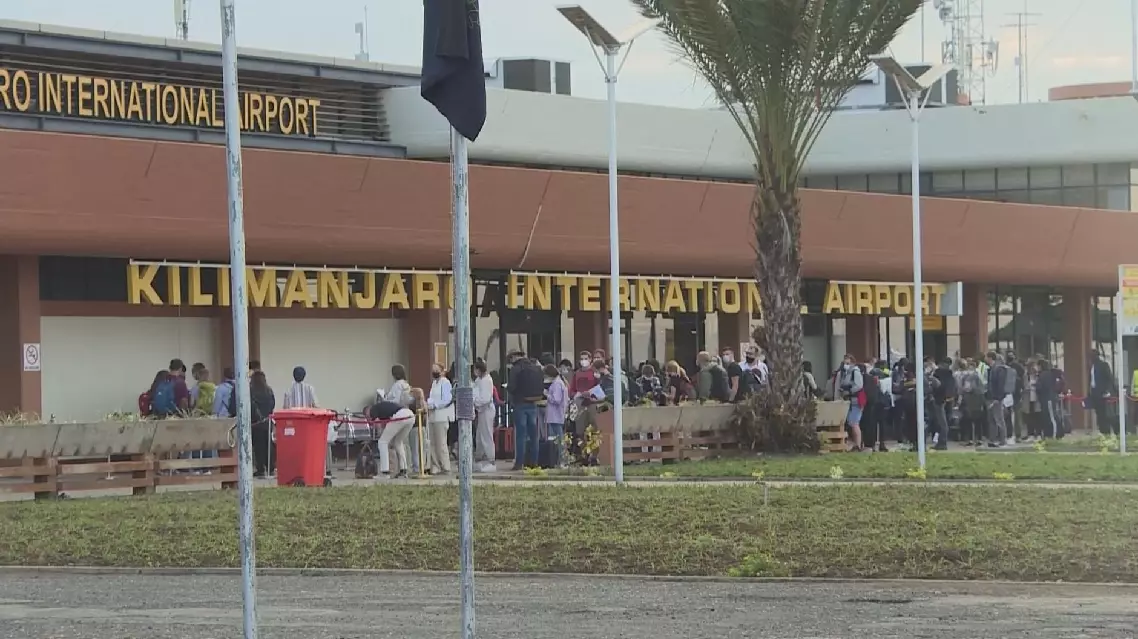
Tanzanians doing business in the Middle East have been forced to scale down or cease operations altogether, as the U.S.-Israeli war on Iran disrupts global travel.

In early March, Tanzanian authorities sent a special flight to bring home more than 200 citizens from Dubai.

Mustapha Khatow, who runs the travel agency Sky Link Travel and Tours, said he has spent nearly four decades in the tourism industry, moving between Dubai and Tanzania, serving both corporate and leisure travelers. But the recent tensions involving Iran and the disruption to flights and business have hit hard, forcing him to relocate his family back to Tanzania.

"Tanzanian travel agents in the whole, they have been hit, because we've had huge cancellations for Eid, people going to Dubai, for Easter holidays, going to Dubai. So, we have lost a big chunk of people who do not wish to go to Dubai at this time," he said.

The impact is being felt beyond tourism. Supply challenges linked to the conflict have pushed up global oil prices, raising concerns for import-dependent economies like Tanzania. Authorities say they are taking measures to cushion businesses and maintain steady fuel supplies.

Aviation and tourism in the Middle East have also taken a hit. In Dubai, more than 80,000 travel bookings were canceled in the first week of the conflict as airports faced intermittent closures and uncertainty, leading to millions of dollars in losses.

Reports indicate that visitor arrivals in the Middle East could decline by between 11 percent and 27 percent in 2026. Travel industry professionals like Khatow view the downturn as collateral damage from the conflict and hope for a swift resolution to help revive tourism.

"Those big traders who bring containers to Tanzania, they have a challenge because of the shipping lines getting delayed, freight charges going up. And again, another issue is Air Tanzania has not been flying to Dubai since then, apart from one repatriation flight," he said.

Khatow said diplomacy will be key to restoring stability, while accurate reporting can help limit further damage to businesses.
US-Israeli war on Iran disrupts travel businesses from Tanzania

US-Israeli war on Iran disrupts travel businesses from Tanzania

Japanese shares closed sharply lower Monday, with the Nikkei 225 plunging 3.9 percent to around 64,000 points as investors sold off heavyweight technology stocks, said Timothy Pope, a market analyst for China Global Television Network (CGTN).

Analysts said the drop, which briefly exceeded 4 percent intraday, reflected profit-taking after recent gains and mounting concerns over U.S. rate hikes and the Middle East conflict.

The 225-issue Nikkei Stock Average ended down 2,563.52 points, or 3.85 percent, from Friday at 64,024.60.

The broader Topix index finished 96.71 points, or 2.45 percent, lower at 3,852.38.

Artificial intelligence- and semiconductor-related shares led the decline, tracking Wall Street losses late last week amid growing expectations of a U.S. Federal Reserve rate hike later this year. Lingering uncertainty over the Middle East conflict also weighed on market sentiment.

Despite the Nikkei posting its fourth-largest intraday point drop on record, analysts said the move was more likely a temporary pullback following the recent rally, as growth hopes for the technology sector remain intact.

Pope noted that the tech slide coincided with fresh missile strikes by Israel and Iran, raising worries over higher fuel costs for energy‑import dependent Japan.

"Over in Tokyo the Nikkei 225 shed 3.9 percent to close back around 64,000 points. For the Nikkei the tech slump coincided with more missile strikes by Israel and Iran in the Middle East. For energy import dependent Japan, we are seeing the prospect of still higher fuel costs and that sent government bonds lower. The Japanese Yen also remains around 160 per dollar, which makes currency intervention a real worry for the markets as well. And despite the healthy real wage growth data out of Japan last week, the first quarter GDP was revised down today thanks to weak capital expenditure from businesses," said Pope.

Japanese shares drop sharply as  Middle East conflict weighs on sentiment: analyst

Japanese shares drop sharply as Middle East conflict weighs on sentiment: analyst

Recommended Articles