China's commitment to a development model that ultimately benefits all its people is vividly reflected in "veggie expresses" shuttling daily between urban and rural areas in Guiyang City of southwest China's mountainous Guizhou Province.
In the outskirts of Guiyang, around 5:30 each morning when the sky is still dark, villagers taking heavy loads of farm goods will gather at their local bus stops. They carry baskets filled with vegetables freshly picked at dawn, waiting for buses.
These are no ordinary buses. Instead of briefcases or laptops, there are more vegetables than passengers -- garlic sprouts, pea shoots, and celtuce, among others -- filling the carriage with the fresh scent of agricultural products.
With most of the passengers being elderly, the drivers and other staff members are willing to lend a hand, helping them load their heavy baskets of farm goods onto the bus.
"Most of them are elderly, around 60 to 80 years old. They can't lift the heavy loads, so of course we will help them," said Zhang Jinping, a driver.
Compared with regular bus routes, this "veggie express" makes only four stops, offering much higher efficiency -- cutting travel time by more than 20 minutes.
To make the trips safer, the bus companies have made multiple tailored modifications, including installing custom-made shelves inside the vehicles. The villagers are also provided with "care cards," one function of which is to allow the driver or medical staff to quickly contact the cardholder's family should an emergency occur.
"Sometimes we worry about their health. If something unexpected happens, we can call their Villagers' Committee or their family members right away to notify them. We can also get the passenger in question to the hospital as soon as possible," said Luo Qiong, captain of the Third Bus Fleet of the Central Division at Guiyang Public Transport Co., Ltd.
In addition to the convenience in travel, these veggie expresses charge extremely low fares -- basically under 10 yuan (about 1.46 U.S. dollars) -- helping farmers save on transportation costs.
"Previously, there was the absence of such farmer-friendly buses, so we had to take private cars. That meant taking risks, but we had no choice. It [private car ride] was expensive, and after paying for the ride, we only could only make a few dozen yuan (a few U.S. dollars)," said Sun Derong, a villager.
Since 2024, Guiyang has expanded this model to 41 dedicated shuttle bus routes, which have handled over 600,000 passenger trips.
"We saw what they really need and launched these dedicated routes for farm produce transport. It solves villagers' need to get their goods to the city markets and also meets city residents' strong demand for the supply of fresh vegetables. So, in a way, it connects the farmlands directly to the urban residents' dining table," said Zhou Kaimin, deputy general manager at Guiyang Public Transport Co., Ltd.
The "veggie express" is a tailored solution to a specific, real-life problem. By making it easier to connect the mountainous countryside with the city proper, Guiyang is ensuring that the benefits of modernization reach everyone.
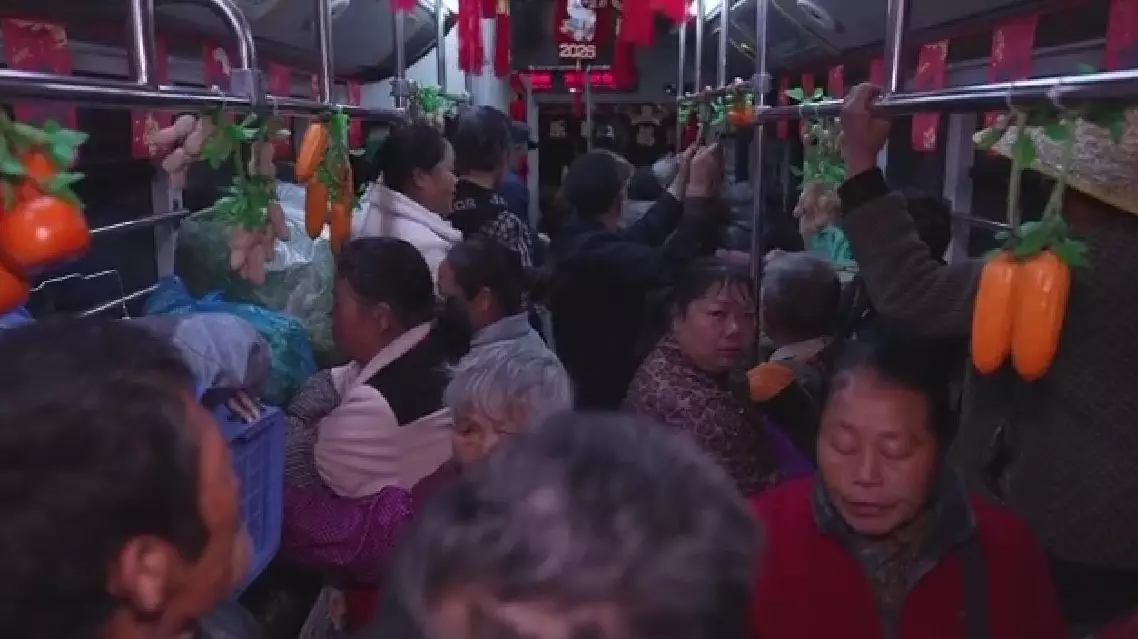
Special bus lines help villagers sell agricultural products in southwest China city