China is stepping up efforts to control desertification in its fourth-largest desert by building straw checkerboards along the desert edge.
In Zhongwei City of northwest China's Ningxia Hui Autonomous Region, about 2,000 residents gathered to install rows of straw checkerboards, a traditional sand-fixing method, locking shifting dunes in the Zhongwei part of the Tengger Desert and protecting the Yellow River, China's "mother river."
During the event, participants were divided into groups to plant drought-resistant shrubs, sow hardy grass seeds, and build straw checkerboards on the desert surface to stabilize sand and prevent wind erosion. Drones were also deployed to transport straw.
Located on the southeast edge of the Tengger Desert and adjacent to the Yellow River, Zhongwei has been at the forefront of desertification control efforts.
Over the years, the city has built a 153-kilometer sand-blocking green barrier belt along the southeastern edge of the Tengger Desert by strengthening cross-regional joint prevention and control, applying advanced science and technology, and improving sand-control efficiency.
Through these efforts, a total of 146,000 hectares of desertified land have been successfully treated.
"Through comprehensive measures such as engineering sand fixation, restoration of degraded forests and grasslands, and enclosure protection, we aim to treat over 30,000 hectares of desert this year, further expanding the green belt for desert edge management," said Li Chuang, deputy director of the Zhongwei Bureau of Natural Resources.
China has taken an active role in global desertification control. Since signing the United Nations Convention to Combat Desertification in 1994, the country has been a leader in halting land degradation and reversing desertification, and has continuously shared sand control experience, technologies and talent abroad.
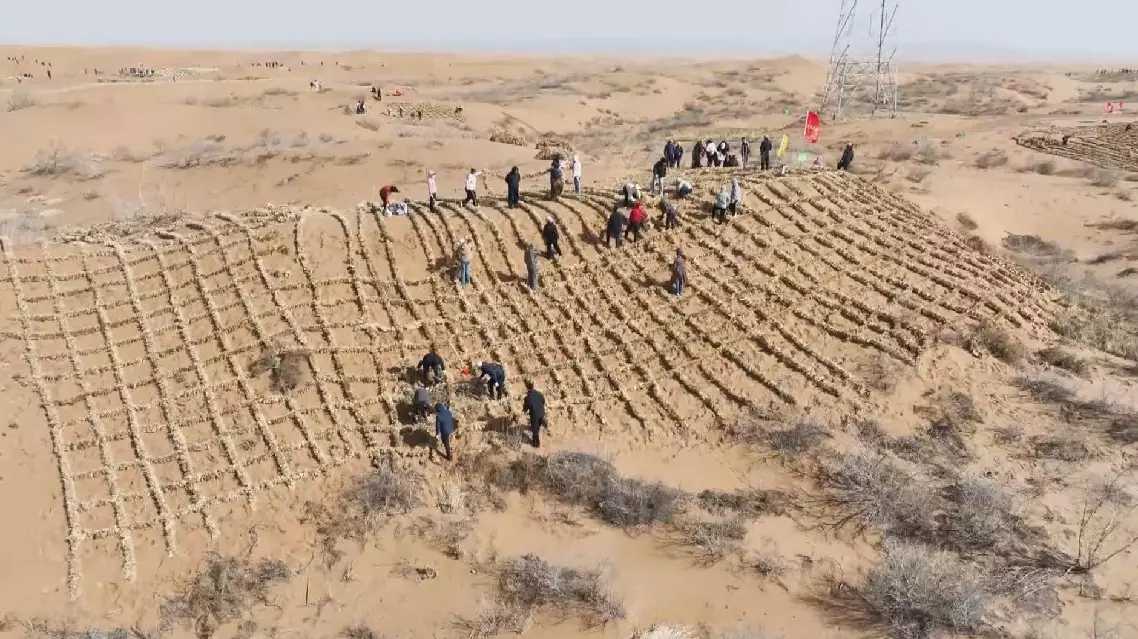
China steps up desertification control in its fourth-largest desert