It was supposed to be a time to celebrate as the top finishers in the NCAA Division III 5,000-meter title race lined up on the eight-tiered podium to receive their trophies.
Instead, when winner Seth Clevenger’s name was announced, the other seven runners stepped off their perches and walked away.
With the NCAA holding its biggest party of the year at this week’s Final Four, the protest over Clevenger’s alleged use of performance enhancers at one of its smaller championships is a telling illustration of what critics see as a glaring weak spot in college sports.
They point to an NCAA anti-doping policy rife with imperfections, all of which undercut the association′s ability to provide a level playing field -- a responsibility that means more than ever with growing name, image and likeness opportunities that raise the stakes for players.
“In the NIL era, failing to have a robust anti-doping program doesn’t just invite doping into college athletics — it undermines fairness, the very heart of the game,” said Travis Tygart, the CEO of the U.S. Anti-Doping Agency.
USADA has no authority over the NCAA, though college athletes who also compete on national and Olympic teams are subject to the world anti-doping protocols.
Video of Clevenger being ghosted on the podium has garnered more than 10 million views on social media, part of a mushrooming protest against the former Iowa State distance runner who moved down to Division III Rowan University earlier this year. More than 750 D-III runners have since signed a letter to school and conference officials demanding a “full and public investigation” into Clevenger.
Last month, Clevenger won NCAA indoor titles at 3,000 and 5,000 meters, setting meet records in both. His wins allowed his new school to eke out the team title by one point.
Clevenger did not respond to multiple requests for comment from The Associated Press. In response to a series of questions about its anti-doping measures, the NCAA said it has a “rigorous drug-testing policy.” Shawn Tucker, the athletic director at Rowan, declined to comment on Clevenger specifically.
″In line with Rowan athletics and NCAA policies, we assure you that all rostered student-athletes competing for Rowan have been both academically and athletically eligible to compete this academic year,” Tucker said.
Clevenger is not known to have tested positive for either of the banned drugs he is alleged to have used: a hard-to-detect and widely available peptide called BP-157 that some believe is key to injury recovery; and erythropoietin (EPO), a well-known red blood cell booster detectable through blood tests, the likes of which the NCAA is not known to administer.
Because Clevenger let his membership to Olympic-affiliated USA Track and Field lapse after 2023, he only needs to follow NCAA rules, which are far less demanding than the system that governs international sports and is helmed by USADA in the United States.
With that agency on the sideline, the NCAA’s handling of cases like Clevenger's has largely stayed under the radar, below ever-rotating headlines about the transfer portal, eligibility lawsuits and, more recently, the new college landscape's impact on a March Madness tournament that was built on underdog stories but has tilted recently more toward deeper-pocketed programs.
Those who track doping issues have taken notice. They see the Clevenger case as something with implications far beyond a single D-III school.
“In this case, there was enough conversation, and you had people walking off the podium,” said researcher Oliver Catlin, president of the Anti-Doping Sciences Institute. “If you ignore something like that, that’s going to send a horrendous message through the rest of the ranks. And people pay attention and it’s going to get repeated.”
The seeds of this saga were planted at Iowa State, where Clevenger spent most of his three years low on the depth chart for the highly rated Cyclones.
Given a chance to race at the Nuttycombe Invitational in Wisconsin last October while Iowa State rested its top runners, Clevenger ran the 8-kilometer championship in 23 minutes, 37.9 seconds. That was 4.5 seconds better than a personal best he had topped by 28 seconds only three weeks earlier.
Eight days after that, Iowa State suspended multiple athletes, including Clevenger, “for breaking team rules.” The school did not specify which rules had been broken but Clevenger did not race for Iowa State again and wound up at Rowan, less than 20 miles from his childhood home of Haddonfield, New Jersey. Cyclones coach Jeremy Sudbery did not respond to requests from AP for an interview.
Since then, Clevenger has admitted to using BP-157, a person close to the case told AP, speaking only on condition of anonymity because that detail has not been made public by the runner or his attorney. The track website letsrun.com published a story last month about the allegations; an Instagram page soon after carried a post that purportedly shows a receipt for an order of EPO placed through Clevenger’s email account.
The AP could not confirm the authenticity of the email, nor of a letter to Iowa State administrators that has also shown up on social media and appears to be from Clevenger’s mother, who insists her son never took EPO.
The email and letter are among evidence that Catlin and other anti-doping experts said could be used to investigate a case under world anti-doping rules. The ability to investigate potential evidence other than blood and urine samples led to the ban of cyclist Lance Armstrong and dozens of other athletes even though they did not test positive for drugs.
The NCAA’s lack of tools to open those sort of investigations is viewed as a big hole in its drug-fighting program.
“An effective anti-doping program can’t just test -- it must also investigate,” Tygart said. “Without both, cheaters game the system and clean athletes may be falsely harmed on just suspicion, not evidence.”
Five years ago, the NCAA got great reviews for putting on a successful post-COVID version of March Madness in Indianapolis – the site of this year’s Final Four – filled with constant testing and a solid list of protocols to handle players who fell ill.
It received virtually no blowback when AP reported that not a single test for performance enhancers had been conducted the entire tournament.
Six years before that, the NCAA’s own medical chief at the time, Brian Hainline, said the association’s drug-fighting program “could be improved considerably." That was in response to AP reporting that revealed the Final Four teams were subject to different drug-testing policies based on their on-campus policies.
College sports still operates under essentially the same system, leaving schools in charge of the bulk of their anti-doping efforts and how to sanction those who get caught.
The NCAA said its program “undergoes regular review by the membership, including two reviews in the past five years.”
“Each academic year, 10,000 NCAA student-athletes are tested without notice in year-round testing or at one of the 92 NCAA championships in 24 sports," the association said. Privacy laws typically prevent schools from making public statements about doping cases and the NCAA doesn't disclose test results.
Year-round, out-of-competition testing is considered the gold standard, and while the NCAA does have a program for that in Divisions I and II,, officials in Division III studied a year-round program but never adopted it. The NCAA drug testing handbook says D-I and D-II athletic departments are, under most circumstances, notified at least two days in advance of a visit from testers.
“Giving notice of testing, even a couple of hours before the collection, is mostly theater — just to say you test," Tygart said.
The lack of a true investigatory arm also denies Clevenger the chance to clear his name if, as his school claims, he has done nothing wrong.
“There’s got to be due process,” Catlin said. “You’ve got to protect the athletes to one degree. And, from the NCAA's perspective, you have to protect your sports environment. And based on this case, it certainly doesn’t sound like that’s happening.”
AP college sports: https://apnews.com/hub/college-sports
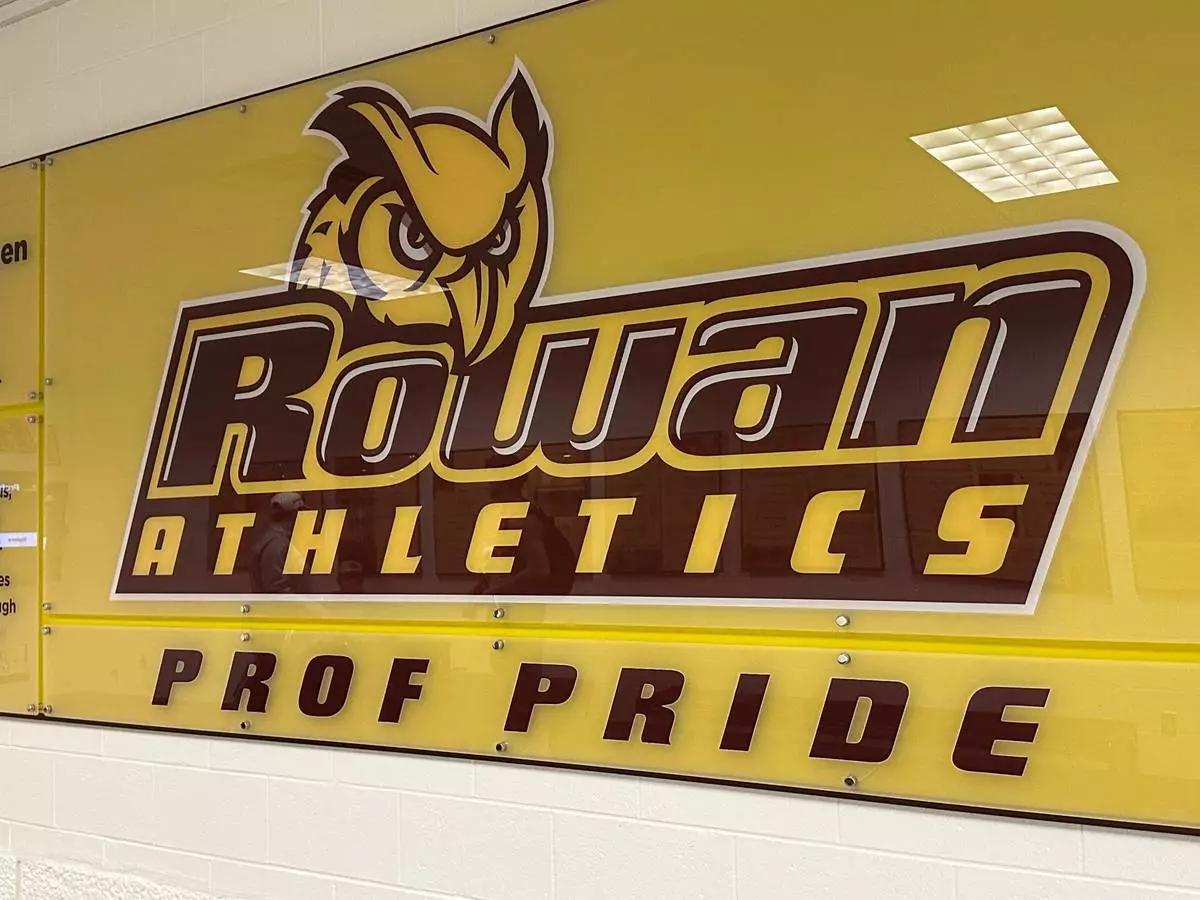
A Rowan Athletics sign is displayed, Tuesday, March 31, 2026, on Rowan University campus in Glassboro, N.J. (AP Photo/Dan Gelston)
BEIRUT (AP) — When the Israel- Hezbollah war broke out in early March, Hussein Shuman fled the heavy bombardment of the southern suburbs of Beirut, but he didn’t bother trying to rent an apartment elsewhere.
In areas deemed “safe” because the Lebanese militant group has no presence, he feels that Shiite Muslims like him are not welcome. Residents regard them with suspicion as potential Hezbollah members, and landlords charge exorbitant prices to rent to displaced families.
Instead, the 35-year-old, who works at a perfume company, headed to central Beirut where he set up a small tent where he has been staying, along with his wife, 7-year-old son and 5-year-old daughter.
Shuman even rejected an offer from a friend who invited him to bring his family to the Christian mountain town of Zgharta. He preferred to remain in his tent, even though it has flooded twice in the past two weeks.
“By staying here I have my dignity and respect,” Shuman said, sitting on a chair near his tent as a barber gave him an open-air hair cut. “We will not stay in a place where we are going to be humiliated.”
In a country full of suspicion, the more than 1 million people — most of them Shiite — displaced as a result of Israel’s evacuation orders and airstrikes have limited options.
Some landlords in Christian areas refuse to rent to Shiites. Others demand inflated rents and deposits that few can afford. Fatima Zahra, 42, from Beirut’s southern suburbs, said she and her sister sold their finest jewelry to pay the $5,000 the landlord charged up front for two months’ rent.
In some Beirut neighborhoods, displaced people who can afford to pay high rents are only allowed to take the apartment after landlords inform the security agencies to check on whether the family has any links to Hezbollah.
Sectarian tensions are a sensitive issue in Lebanon because the country fought a 15-year civil war ending in 1990 that largely broke down along sectarian lines.
Social frictions have worsened since Israel’s targeted airstrikes killed Hezbollah officials or members of Iran’s paramilitary Revolutionary Guard in predominantly Christian, Sunni and Druze areas, raising fears among the hosts that Hezbollah members are mingling within the civilian population.
The Lebanese are deeply divided over Hezbollah’s wars with Israel, with many in the small nation blaming the Iran-backed group for dragging the country into a deadly conflict that has so far left more than 1,300 people dead and over 4,000 wounded. Hezbollah fired missiles into Israel two days after the U.S. and Israel attacked Iran on Feb. 28, triggering the ongoing Middle East war.
The renewed war has caused widespread destruction and paralyzed the economy at a time when Lebanon is still in the throes of a historic economic crisis that broke out in late 2019. The country has not yet recovered from the last Israel-Hezbollah war in 2024.
In mid-March, an Israeli airstrike on an apartment in the town of Aramoun killed three people, prompting some local residents to call for the displaced to leave the area.
Days later, an airstrike on the nearby town of Bchamoun also killed three people, including a four-year-old girl, who were displaced from Beirut’s southern suburbs, where Hezbollah has a strong presence.
In neither case did Israel announce the intended target of the strikes, but neighbors assumed that someone in the targeted apartments was a Hezbollah member.
“Had we known that they were linked to Hezbollah, we would have kicked them out,” an angry man who owns an apartment in the building in Bchamoun said at the scene.
In late March, a missile exploded over the predominantly Christian Keserwan region north of Beirut, with debris falling on different areas. Although the Lebanese army later said that it was an Iranian missile passing over Lebanon that fell, many initially assumed that it was an Israeli airstrike targeting displaced people.
No one was was hurt by the missile debris, but a group of young men attacked displaced Shiites in the district of Haret Sakher near the coastal city of Jounieh, calling for their eviction, before local officials intervened.
“We don’t want them here,” shouted a Haret Sakher resident shortly after the strike. He said that some of the displaced refer to their hosts as “Zionists,” accusing them of being aligned with Israel because they criticize Hezbollah for dragging the country into the conflict. He added: “We don’t want national coexistence.”
George Saadeh, a member of Jounieh’s municipal council, told The Associated Press that he had called on Haret Sakher residents to avoid any reaction “so that we can preserve civil peace.”
In a predominantly Christian area just north of Beirut, plans to house displaced people in an abandoned warehouse near the port were suspended last week after drawing backlash from lawmakers and residents.
“The Israeli targeting campaign has created a lot of paranoia,” said Maha Yahya, director of the Beirut-based Carnegie Middle East Center. “If you see a displaced person, maybe you wonder, ‘What if this person is a target?’”
Fearing the tension could slip out of control, the army has beefed up its presence on the streets.
Last week, army commander Gen. Rudolphe Haikal toured Beirut and the southern city of Sidon and told troops that they should be “firm in the face of any attempt to undermine internal stability,” the army said in a statement.
Police forces, including a SWAT unit, were deployed at major intersections in the capital to preserve peace and prevent any friction between the displaced and locals. Police patrols pass through the tent city by Beirut’s coast where Shuman and his family are staying.
An official at the municipality of the predominantly Sunni town of Naameh, just south of Beirut, said that they have received thousands of people displaced from southern Lebanon.
The official said that in order to avoid tensions, they opened a school in one district for displaced Shiites and another in a different neighborhood for people displaced from Sunni border villages.
“There are concerns among people,” that conflict could break out said the official who spoke on condition of anonymity because he was not authorized to speak to the media.
With the Israeli airstrikes and ground invasion mainly targeting Shiite areas, U.S. ambassador to Lebanon Michel Issa, a Lebanese-American, was criticized for stoking sectarianism. He told reporters in late March that the U.S. had asked Israel for a commitment that Christian villages in southern Lebanon will not be attacked.
“We have asked the Israelis to leave Christian villages in the south alone and they told us that they will not touch Christian villages,” Issa said. However, he added, “They (Israelis) said that they cannot guarantee” that the villages would be left alone “if there is infiltration into these villages” by Hezbollah members.
Several Christian villages in southern Lebanon have asked displaced Shiites who were sheltering there to leave, fearing that their presence might trigger Israeli attacks.
Legislator Taymour Joumblatt who is the leader of the Progressive Socialist Party, the largest Druze-led political group in the country, said that the biggest concern in the country now is “strife.”
“The most important thing is to reduce sectarian pressures on the ground,” Joumblatt said. “Our Shiites brothers are part of this country and our humanitarian duty is to help them.”
———
Associated Press writer Isabel DeBre contributed to this report from Beirut.
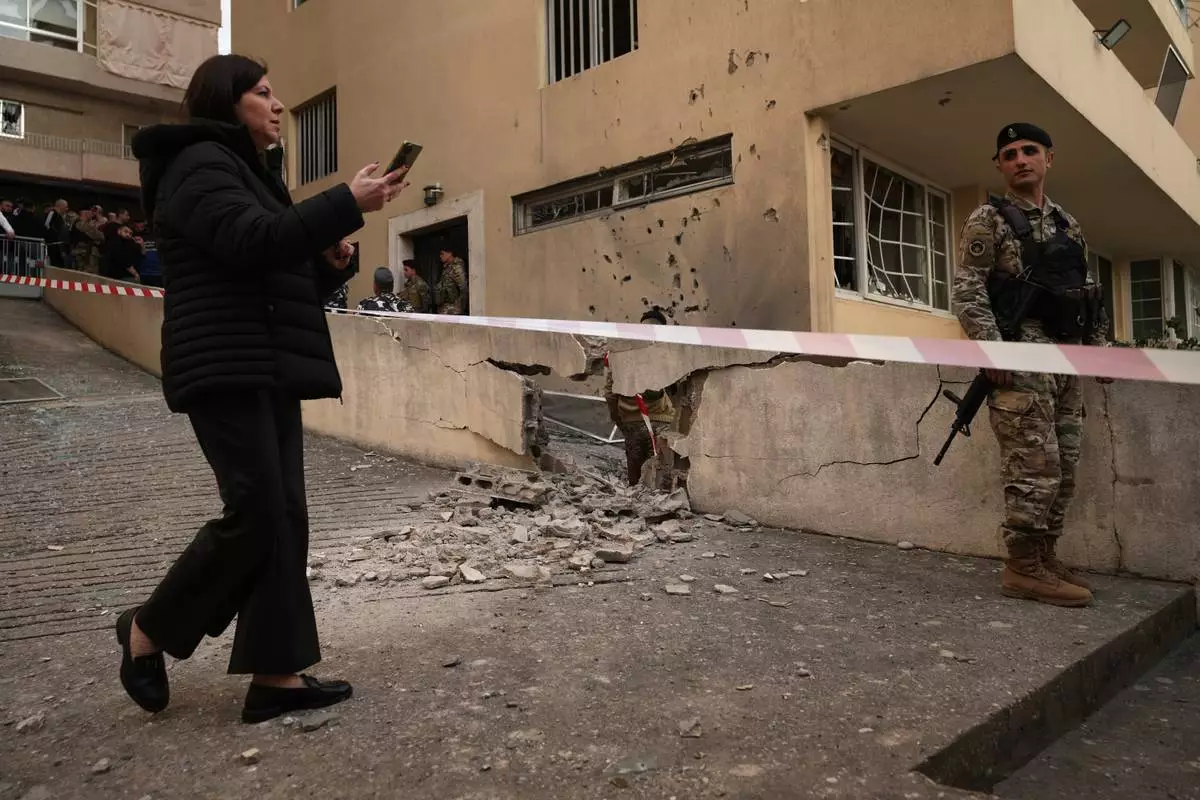
A woman passes an army soldier at the site where an intercepted missile fell in Sahel Alma, north of Beirut, Lebanon, Tuesday, March 24, 2026. (AP Photo/Hassan Ammar)
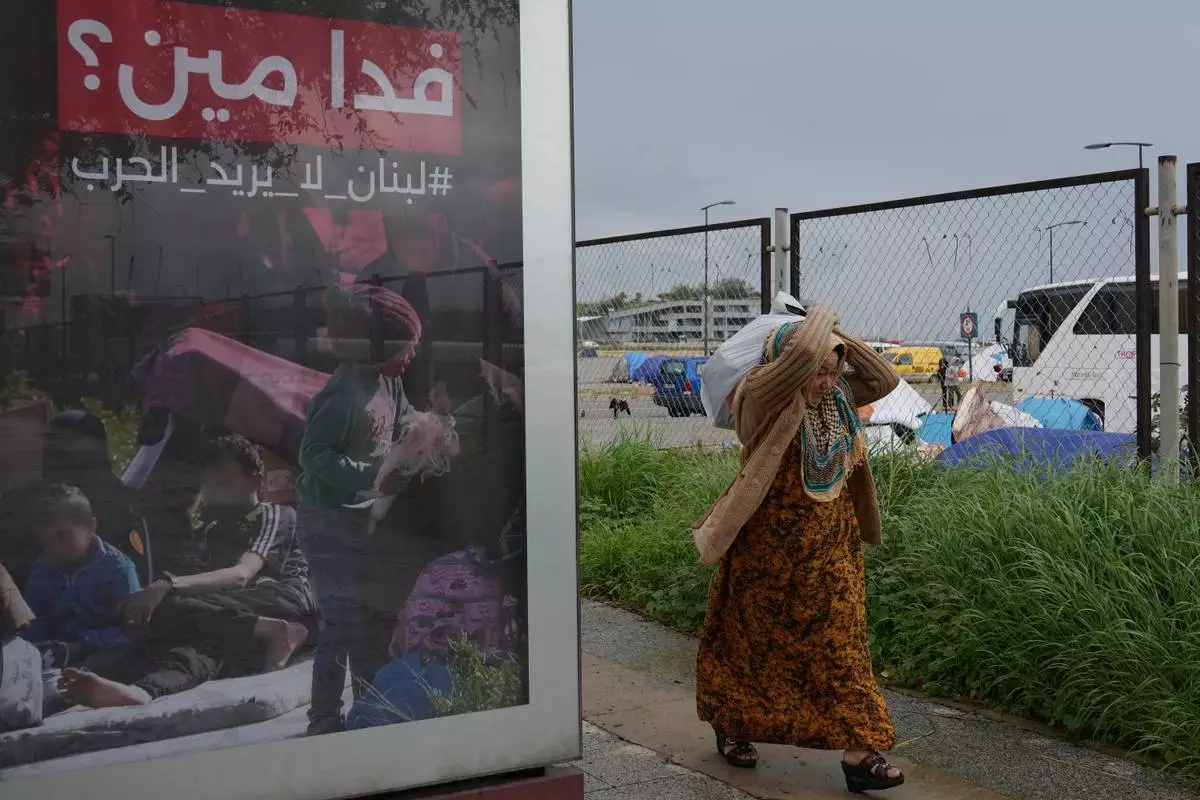
FILE — A displaced woman who fled Israeli airstrikes in southern Lebanon, carries her belonging as she moves to a better spot to shelter from the rain, past an Arabic anti-war poster that reads, "Sacrificing for whom? Lebanon does not need war," in Beirut, Saturday, March 21, 2026. (AP Photo/Hussein Malla, File)
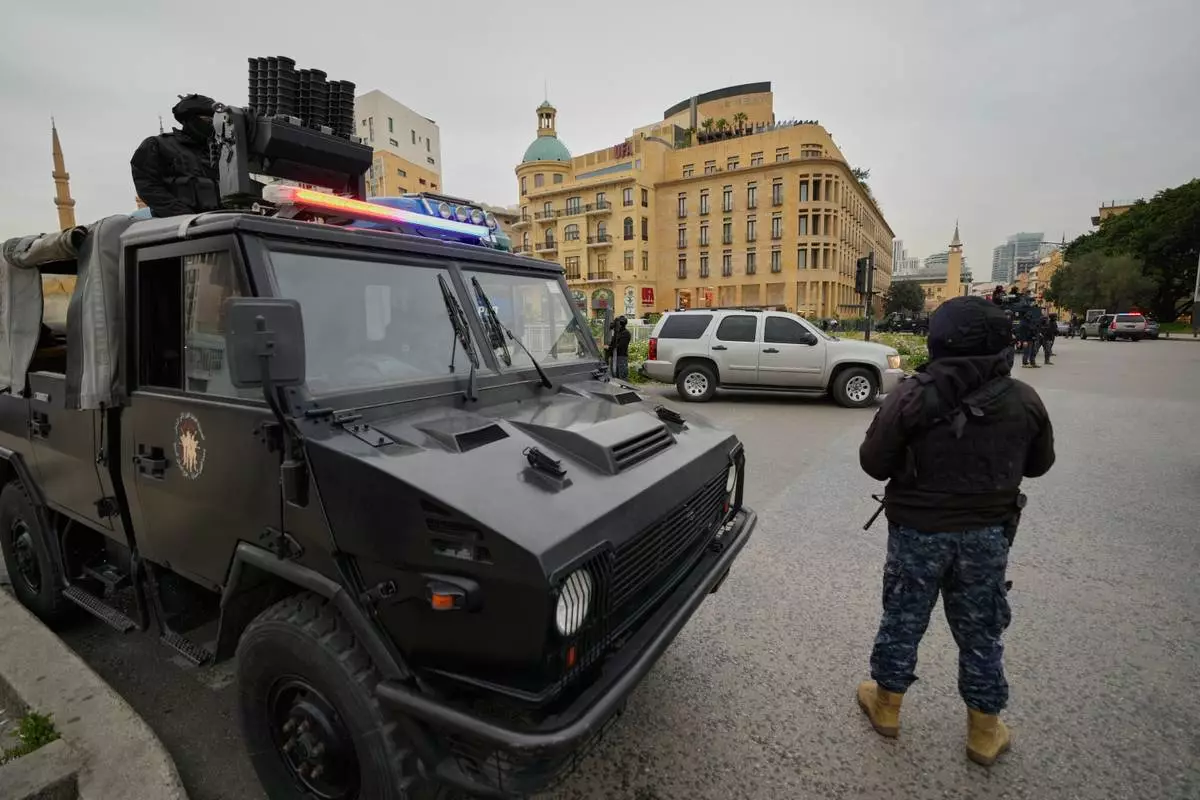
Special forces police officers deployed amid tensions between people displaced by Israeli strikes and local residents in Beirut neighborhoods, Lebanon, Wednesday, April 1, 2026. (AP Photo/Hussein Malla)
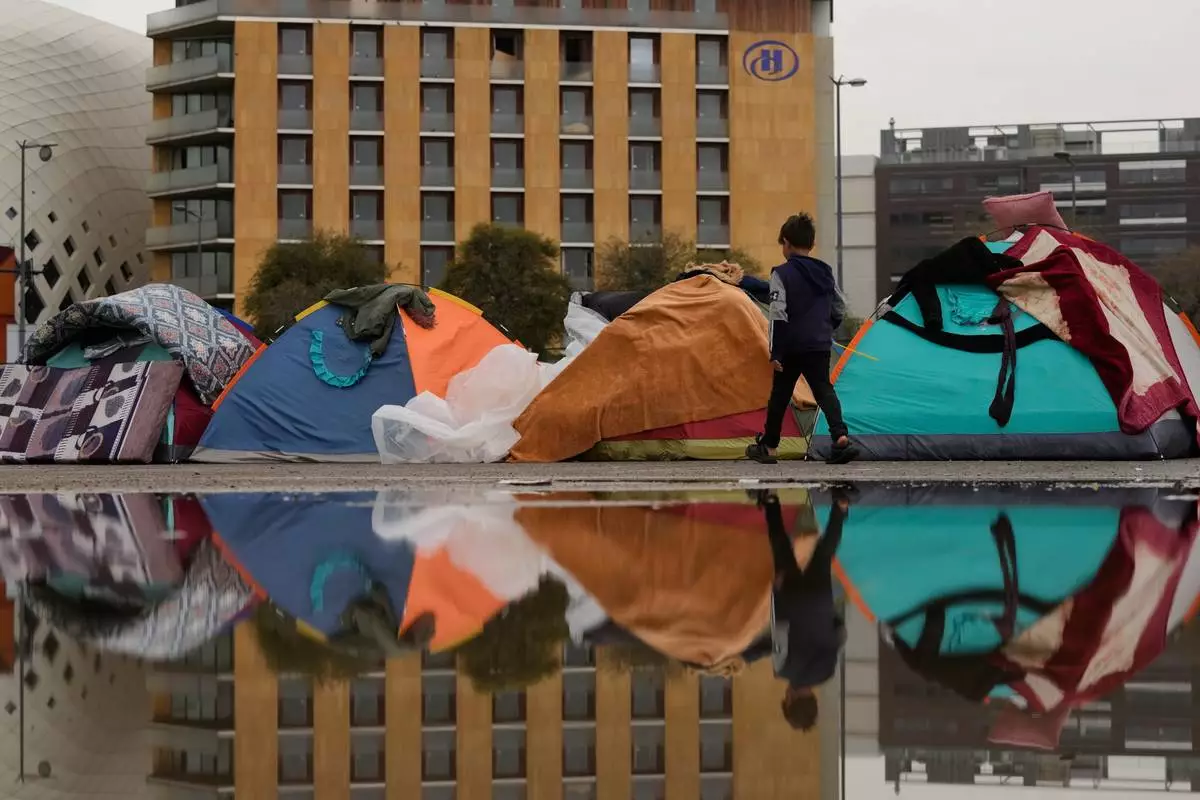
FILE — A child walks past tents sheltering people displaced by Israeli airstrikes in southern Lebanon and Dahiyeh, Beirut's southern suburbs, along the Beirut waterfront in Beirut, Lebanon, Saturday, March 14, 2026. (AP Photo/Hassan Ammar, File)
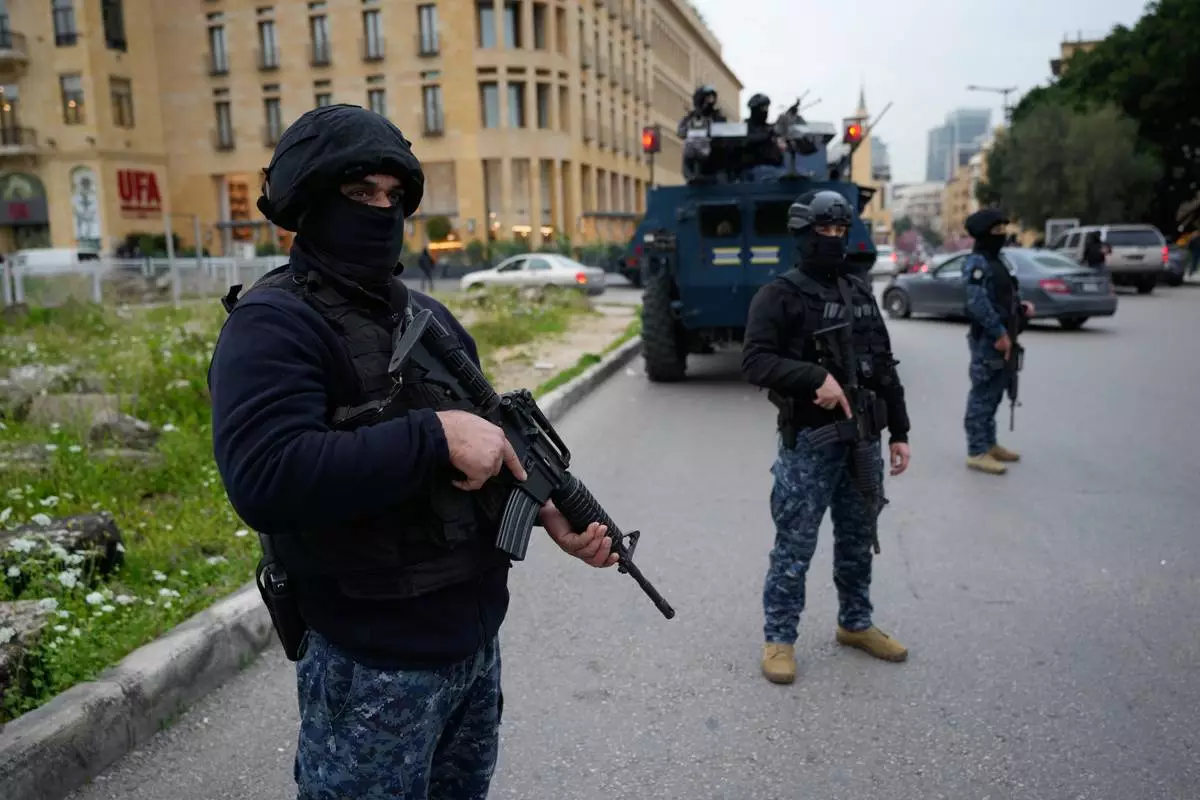
Special forces police officers deployed amid tensions between people displaced by Israeli strikes and local residents in Beirut neighborhoods, Lebanon, Wednesday, April 1, 2026. (AP Photo/Hussein Malla)
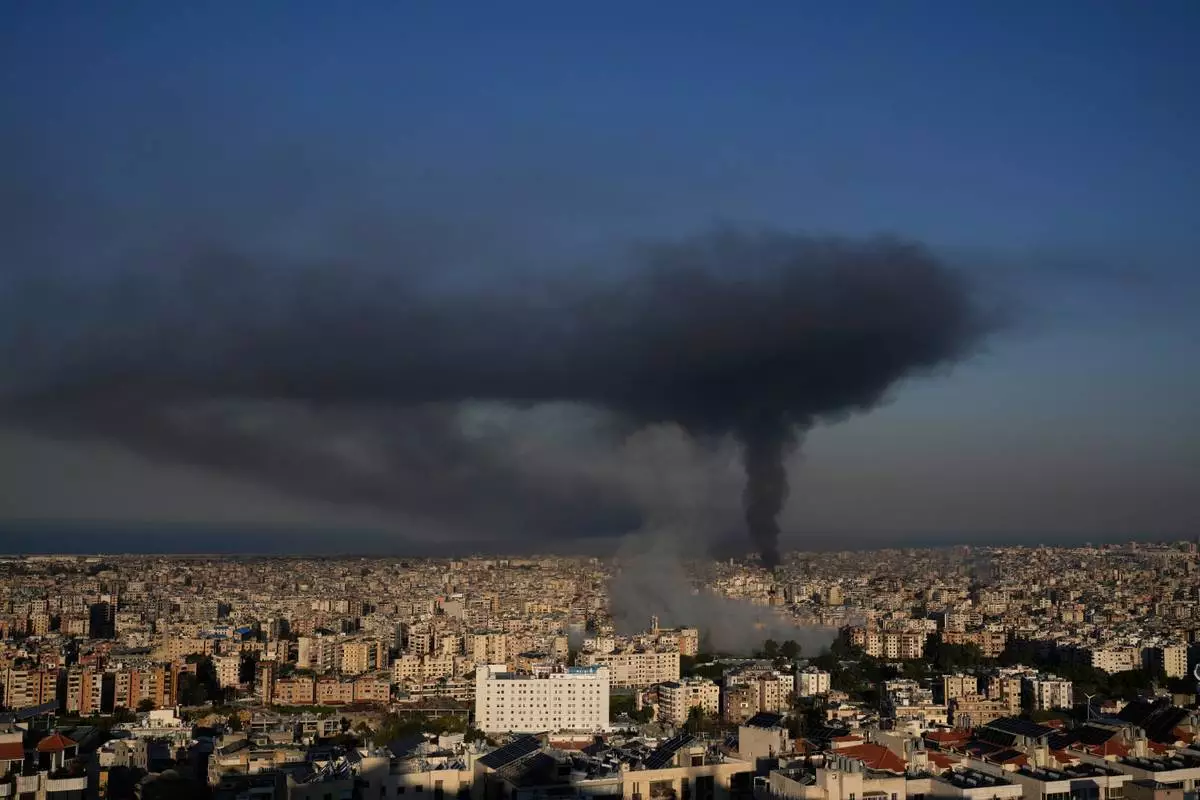
File — Smoke rises from Israeli airstrikes in Dahiyeh, a southern suburb of Beirut, Lebanon, Tuesday, March 3, 2026. (AP Photo/Hussein Malla, File)