Germany startup holoride, a pioneering leader in automotive infotainment, is seeking to deepen its presence in China to develop innovative in-vehicle entertainment solutions, the company's chief technology officer Jakob Schweißhelm said.
The Munich-based company creates an entirely new media category for passengers by connecting Extended Reality (XR) content with data points from the vehicle in real time. These data points include physical feedback, like acceleration and steering, traffic data, as well as travel route and time. The firm's technology provides a new type of immersion into any kind of virtual reality (VR) content, creating a breathtaking, immersive experience, and significantly reducing motion sickness.
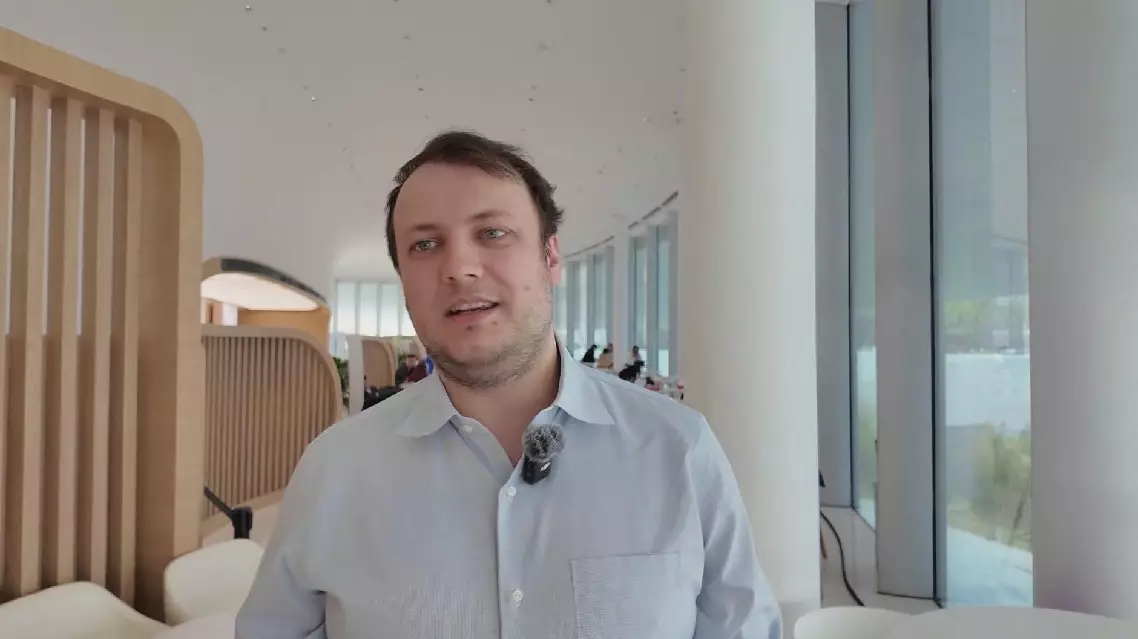
Speaking to China Media Group (CMG) at the 2026 Zhongguancun Forum (ZGC Forum) Annual Conference, which ran from March 25 to 29 in Beijing, Schweißhelm said holoride's vehicle-integrated XR technology uses a spatial perception engine to create immersive, motion-sickness-reducing experiences. He also explained how the technology transforms real-time vehicle data into immersive entertainment content.
According to Schweißhelm, cars are evolving from mere means of transport into a "third living space", with the open-mindedness of Chinese users toward new technologies accelerating this transformation.
"When you are sitting in the vehicle and looking at the rigid screen, the eye no longer sees that movement. But the body continues to feel every movement the car makes. This dissonance is what makes people feel car sick. What we are doing now is that we use all the sensors in the vehicle, turn them into a sensory system, and provide visual feedback to the customer, so that he sees what the body feels, no matter what he is currently looking at on the screen. This reduces that missing motion perception," Schweißhelm said.
He then highlighted the practical benefits for customers and compared his solution with conventional infotainment systems. "This creates benefits for the customer: he can use entertainment equipment longer, watching videos, or playing games. Yes, there is a special software platform or software technology called 'Spatial Perception Engine'. This makes a certain upgrade over current infotainment systems possible", added Schweißhelm. Schweißhelm also discussed holoride's strategic expansion into China, expressing his team's enthusiasm for the opportunities in the Chinese market.
"We have now opened our Beijing office here in China, in Shijingshan, and that is where we are working. We are collaborating with local partners specifically for the Chinese market to create and produce our own content. The difference is that in China, people are far more open to new technologies compared to European markets. As a result, our offerings have been met with much more enthusiasm and sincerity, which has greatly helped us advance our developments," he concluded.
German automotive infotainment pioneer eyes deeper innovation partnership with China