NASHVILLE, Tenn.--(BUSINESS WIRE)--Apr 6, 2026--
Sometime around 4:20 a.m. on a cold, foggy Sunday morning in mid-November of 2022, four University of Idaho students were brutally murdered at a house they shared in Moscow, Idaho.
This press release features multimedia. View the full release here: https://www.businesswire.com/news/home/20260406581643/en/
The case instantly captured national attention, including round-the-clock coverage by international media who descended on the small college town to report on its first murder in years. After an intensive investigation involving local, state and federal agencies, Bryan Kohberger was charged and eventually pled guilty to the crimes, avoiding a trial, and denying the community answers to important questions:
What were his motives? Where are the weapons? How did a lone assailant with no known connection to the victims enter the house in the middle of the night, viciously murder four people in less than ten minutes and escape, barely leaving a trace? Why were two residents spared? Why did a witness who saw the masked assailant wait eight hours before calling 911?
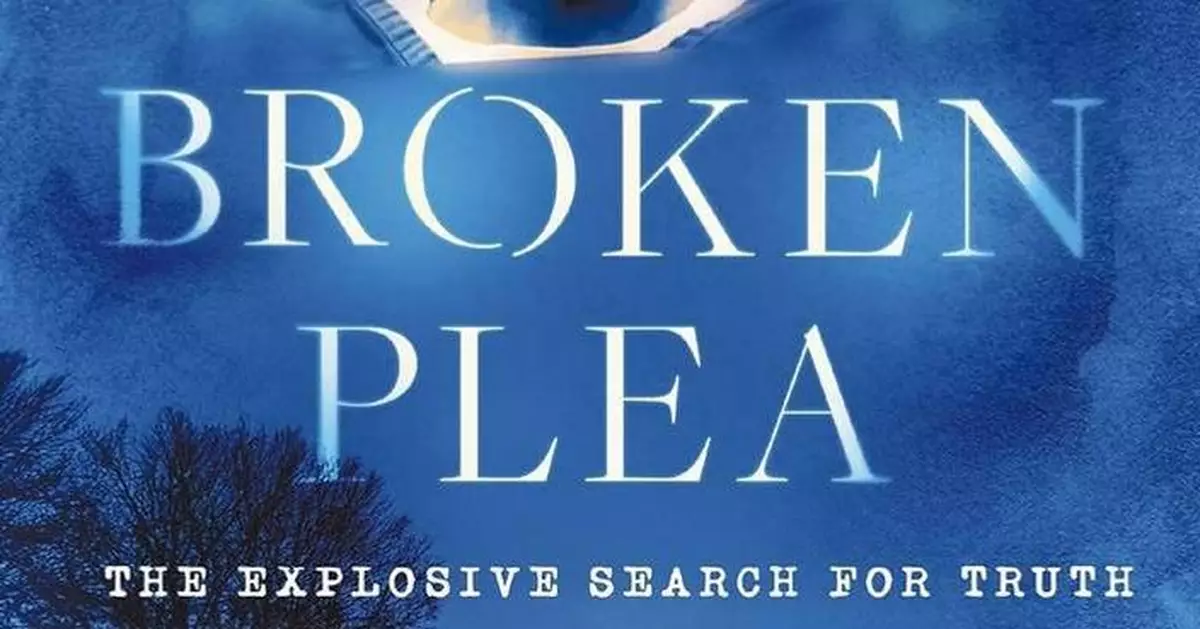
In this can’t-put-it-down page-turner, former FBI agent, journalist and bestselling author Christopher Whitcomb re-opens the case. Based on information provided by defense and prosecution sources, he scrutinizes tens of thousands of previously undisclosed files, including police reports, photographs, body-camera video, laboratory reports, autopsy findings, forensic and DNA analyses, unpublished interviews, surveillance logs and expert findings. In lieu of theories and conjecture, Whitcomb discovers shocking evidence-based revelations.
Though Whitcomb does not challenge the veracity of Kohberger’s plea, he does present troubling flaws in the case, including questions about how one man could possibly have committed these crimes alone. Looking at the three pillars of the prosecution’s case, he discovers significant flaws in DNA analysis, including court documents that indicate police never actually matched Kohberger to the KA-BAR knife sheath found at the scene.
Whitcomb also documents vexing contradictions in how police identified a white sedan, how investigators tied Kohberger’s phone to the scene. He relies on the prosecution’s own expert to show that large areas of the house were cleaned up and altered after the fact.
With an engaging writing style that grabs readers by their lapels, Whitcomb raises important questions about how police handled crime scene analysis, evidence retention, alternate suspects, and contradictory witness statements. In the end, he clearly demonstrates that this case is not what we have been led to believe.
“I wrote this book because I believe the American system of justice is the best in the world, but that doesn’t mean it is perfect,” Whitcomb said. “Cops err, technologies fail, and witnesses falter. And yes, guilt may be the domain of lawyers and courts, but if we as a society truly believe in its foundations, we should be willing to ask hard questions; look deeper. None of us knows what happened in Moscow that horrific night in November, but it is my hope that this book will be a first step toward understanding.”
Broken Plea will be released on April 28, 2026, and will be available in hardcover, ebook, and audiobook formats. You can pre-order today at: https://www.harpercollinsfocus.com/harper-select/books/broken-plea/.
ABOUT CHRISTOPHER WHITCOMB
Christopher Whitcomb is a writer, entrepreneur, and former FBI agent with operational experience in more than 30 countries. He is the author of the bestselling Cold Zero: Inside the FBI Hostage Rescue Team, the novels Black and White, and the memoir Anonymous Male: A Life Among Spies. He has worked as an on-air analyst for NBC and co-hosted Checkpoint CNBC where he was nominated for a Peabody Award, reporting on terrorism from Guantanamo Bay. He has written for numerous outlets, including The New York Times, GQ, Netflix, CBS Films, and HBO.
ABOUT HARPER SELECT:
Harper Select, based in Nashville, TN, publishes an exclusive number of hand-selected memoirs and narrative nonfiction each year. Recent NYT Bestsellers include books from Joanna Gaines, Mark Harmon, Leon Carroll, Jr., Kelsey Grammer, Allison Holker and Loyola Chicago’s Sister Jean.

Courtesy of Harper Select, an imprint of HarperCollins Focus.
Iran’s state-run IRNA news agency said Tehran rejected the latest ceasefire proposal and wants a permanent end to the war. The agency said it has conveyed its response to the U.S. through Pakistan, a key mediator.
“We only accept an end of the war with guarantees that we won’t be attacked again,” Mojtaba Ferdousi Pour, head of the Iranian diplomatic mission in Cairo, told The Associated Press on Monday.
Also Monday, Israeli Defense Minister Israel Katz said Israel attacked the South Pars petrochemical plant at Asaluyeh in Iran. He made the announcement after Iran said the facility had been attacked. An Israeli attack in March on South Pars facilities sparked major Iranian attacks targeting oil and gas infrastructure across the Gulf Arab states.
Meanwhile, Israel and the United States carried out a wave of attacks on Iran, killing more than 25 people. Iran responded with missile fire on Israel and its Gulf Arab neighbors.
And U.S. President Donald Trump’s deadline for Tehran to reopen the Strait of Hormuz loomed. Trump gave Tehran a deadline that expires Monday night Washington time, saying if no deal was reached to reopen the strait, the U.S. would hit Iran’s power plants and other infrastructure targets and set the country “back to the stone ages.” Following Trump’s expletive-laced threat on Easter Sunday, Iran’s parliamentary Speaker Mohammad Bagher Qalibaf called the threats of targeting Iran’s infrastructure “reckless.”
Here is the latest:
He said Monday’s strike on an Iranian petrochemical facility is part of a systematic campaign aimed at destroying the Guard’s “money machine.”
“We are destroying factories, we are eliminating activists and we continue to eliminate senior figures,” he said in a videotaped statement.
Netanyahu said he also spoke to President Trump about the U.S. rescue of two downed crew members in Iran. He said the president thanked Israel for assisting in the mission.
A resident of Tehran in his early twenties says U.S.-Israeli strikes on civilian infrastructure and Trump’s intensifying threats have “terrified” people.
“Everyone is very anxious and scared that the water, power and gas will be cut,” he said, speaking anonymously for his security.
The student first spoke with The Associated Press on the eve of the war, when he participated in anti-government protests at his Tehran university’s campus. At the time, he described heated disagreements with friends who said they hoped a threatened Israeli-U.S. attack would overthrow the Islamic Republic.
“Those who were supporting the war are no longer supporting it,” he said Monday.
Sunday, he heard the sound of “a lot of explosions” around the city from his home in the Sattar Khan area. He said he’d turned to taking sleeping pills to get through nightly bombardments.
— Amir-Hussein Radjy
Beth Hammack, president of the Federal Reserve Bank of Cleveland, said Monday in an interview with The Associated Press that if inflation remains persistently above the Fed’s 2% target, the central bank should consider lifting its benchmark interest rate.
While Hammack also said the Fed might have to cut its rate if higher gas prices caused the economy to slow and unemployment to rise, a potential rate hike is a noticeable shift for the Fed from before the Iran war, when officials forecast two rate cuts this year. A hike could lift longer-term interest rates for things like mortgages and auto loans.
“My baseline is that we’re on hold for quite some time,” Hammack said, “but I can foresee scenarios where we would need to reduce rates ... if the labor market deteriorates significantly. Or I could see where we might need to raise rates if inflation stays persistently above our target.”
The Iran-backed Houthis said they launched a barrage of cruise missiles and drones at several military sites in southern Israel, “successfully achieving its objectives,” according to the group’s military spokesperson.
Brig. Gen. Yahya Saree, the military spokesperson for the Houthis, said in a statement Monday that the missiles were launched as part of a joint operation with the Iran’s Revolutionary Guard and the Islamic Resistance in Lebanon.
Iranian President Masoud Pezeshkian praised Maj. Gen. Majid Khademi, intelligence chief of Iran’s Revolutionary Guard, according to Iran’s state media.
Iran’s media reported Pezeshkian lauded Khademi’s intelligence role and security efforts “against all kinds of conspiracies of enemies.”
“His martyrdom speaks to the fact that the security and independence of Islamic Iran is indebted to the sacrifice and selflessness of the brave sons who, in the most difficult circumstances, work tirelessly for the honor and peace of this land,” he said.
The agency said it had has conveyed its response to the U.S. through Pakistan, a key mediator.
“We won’t merely accept a ceasefire,” Mojtaba Ferdousi Pour, head of the Iranian diplomatic mission in Cairo, told The Associated Press on Monday. “We only accept an end of the war with guarantees that we won’t be attacked again.”
The response came ahead of a deadline by President Trump to begin bombing Iranian energy and infrastructure.
Israel’s ministry of defense said Monday that the country’s defense industries would “significantly increase” production and stockpiling of missile interceptors as the war with Iran stretches on.
In a statement, the ministry said production of missile interceptors for the Arrow system, which defends against long-range ballistic missiles, would be sped up. Arrow has been critical in Israeli air defense during the current war, throughout which Israeli authorities have maintained there’s no shortage of interceptor missiles.
Samir Geagea, who leads the Lebanese Forces political party, made the remarks in statement after an Israeli strike hit an apartment building in the town of Ain Saadeh late Sunday, killing a party official, his wife and a woman visiting them.
The strike heightened existing tensions between host communities and more than a million displaced Lebanese, largely Shia from southern Lebanon, deeply divided over Hezbollah and their position on the war.
“Taking responsibility from the outset would have been better for everyone,” he said, talking about the Lebanese security agencies’ sluggish disarmament process of Hezbollah.
The military says the strikes hit dozens of helicopters and aircraft it said belonged to the Iranian Air Force. It said the strikes targeted Bahram airport, Mehrabad airport and Azmayesh airport.
A resident of central Tehran has described living with “anxiety and fear” as U.S.-Israeli strikes pummel the capital.
“Constantly, there is the sound of bombs, air defenses, drones,” she said, speaking on condition of anonymity for her safety.
At least one strike hit near her home, waking her on Wednesday, she said. Rushing into the neighboring street, she saw it “filled with people in pajamas, some of them wrapped in blankets, some of them crying with fear.”
She also described her anger at the popular satellite channel, Iran International, which is based abroad. She said its coverage had amplified exiled Iranian voices supporting strikes on the Islamic Republic. “Some people thought war might bring good things, but war doesn’t bring anything but destruction and bloodshed.”
Iranian authorities have moved to ban any contact with several Persian-language satellite channels based abroad. Many viewers inside Iran say the frequencies are often disrupted.
— Amir-Hussein Radjy
The U.S. stock market is making only hesitant moves, while oil prices are unsettled as mediators try to forge a ceasefire agreement ahead of a deadline President Trump has set to bomb Iranian power plants.
The S&P 500 rose 0.1% in early trading Monday. The index is coming off its first winning week in the last six. The Dow Jones Industrial Average slipped 107 points, and the Nasdaq composite rose 0.4%.
Oil prices flipped between gains and losses as uncertainty continued about what will happen in the war with Iran and how long it will slow the flow of oil and natural gas.
▶ Read more
In a statement released Monday, Mirjana Spoljaric, the president of the International Committee of the Red Cross, raised alarm about destruction of civilian infrastructure and nuclear facilities in the Iran war.
“Across the Middle East, our teams are seeing the destruction of infrastructure essential for civilian life,” including hospitals, schools, power plants, water systems and more, Spoljaric wrote.
“Most alarming are potential threats to nuclear facilities. Any miscalculation can cause irreversible consequences for generations to come.”
Turkish Foreign Minister Hakan Fidan and his Iranian counterpart, Abbas Araghchi, held a telephone conversation Monday, during which they discussed “the state of the war” and other developments, a Turkish official said. The official provided the information on condition of anonymity in line with government rules and did not elaborate.
The call came as two Middle East officials said mediators from Egypt, Pakistan and Turkey sent Washington and Tehran a proposal calling for a 45‑day ceasefire and for the reopening of the Strait of Hormuz.
— Suzan Fraser
Iran’s foreign ministry spokesperson, Esmail Baghaei, has told journalists in Tehran that messages are being exchanged, but “negotiations are entirely incompatible with ultimatums, crimes and threats of war crimes.”
It comes after Israel’s military said Iran had launched missiles toward the country.
U.S. Ambassador to Israel Mike Huckabee wrote in a social media post on Monday that Israel’s military and Mossad secret service had assisted in the U.S. effort to rescue an airman whose plane was downed by Iran.
Huckabee thanked Israel for helping the U.S. military and intelligence agencies in the post to X.
Israeli officials have said Israel provided support, including intelligence, in the rescue, but troops weren’t actively involved on the ground.
A former Iranian foreign minister and adviser to the supreme leader called for Arab countries to discourage U.S. President Donald Trump from striking Iran’s power plants.
Ali Akbar Velayati warned the entire region would go “dark” if Trump fulfilled his threat and bombed Iran’s power plants.
“The rulers of #Arab_countries should, in order to prevent the region from going dark, make Trump understand that the #Persian_Gulf is not a place for gambling,” he wrote on social media.
The United Nations nuclear watchdog on Monday confirmed recent strikes struck close to Iran’s Bushehr nuclear power plant, with one hitting just 75 meters (82 yards) from the facility’s perimeter.
The International Atomic Energy Agency said in a social media post that its own analysis showed the plant was not damaged as of Sunday.
IAEA Director General Rafael Grossi called for ceasing such attacks, which cause “a very real danger to nuclear safety.”
Iran’s Atomic Energy Organization has reported four attacks close to the facility since the war started Feb. 28. The last strike Saturday killed a security guard and damaged a support building, the organization said.
The Bushehr nuclear power plant uses low-enriched uranium from Russia, along with Russian technicians, to supply about 1,000 megawatts of power for Iran.
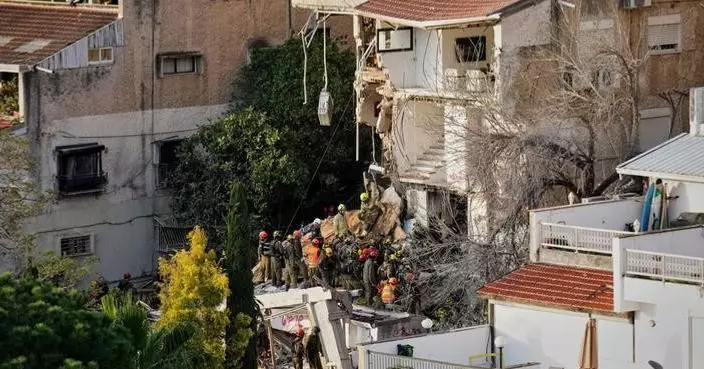
Israel’s military confirmed four people found dead at the site of a missile strike in Haifa were members of the same family.
Search and rescue teams found two bodies underneath the rubble Sunday. After 18 hours digging they found two more “deep under the debris” Monday,” Lt. Col. Nadav Shoshani said.
He said the warhead that hit the building had not exploded on impact, complicating rescue efforts and posing a continued threat.
They were found after hours of overnight rescue efforts, the military said.
Israel’s military said Monday it killed the leader of the paramilitary Revolutionary Guard’s undercover unit in its expeditionary Quds Force.
Lt. Col. Nadav Shoshani, a military spokesman, confirmed the killing of Asghar Bakeri in a briefing to reporters.
He said Bakeri had planned attacks on Israeli and American targets as well as operations in Israel, Syria and Lebanon.
The hilly Christian town of Ain Saadeh, east of Beirut, was in shock Monday after an Israeli missile crashed into an apartment building, killing an anti-Hezbollah politician, his wife and another woman.
Israel said it targeted a Hezbollah militant, but the third-story apartment was empty.
The strike blew out the walls and windows of the floor below, killing Pierre Mouawad, an official in the Lebanese Forces, a Christian political party opposed to the Iran-backed Hezbollah group, and his wife, Flavia Mouawad.
“This is the first time something like this has happened here,” family friend Nadine Naameh said. “We had always felt safe here.”
Neighbors wept outside the collapsed apartments as crews swept away the rubble.
“The people who live here are against violence. They don’t want this war,” according to municipal official Pierre Said.
Israel said it was investigating “reports that several uninvolved individuals were harmed.”
Israel’s defense minister said Monday that Israel attacked the South Pars petrochemical plant at Asaluyeh.
Israel Katz made the announcement in a statement after Iran said the facility had been attacked.
Katz said Israel had “just carried out a powerful strike on the largest petrochemical facility in Iran, located in Asaluyeh, a central target responsible for about 50% of the country’s petrochemical production.”
An Israeli attack in March on South Pars facilities sparked major Iranian attacks targeting oil and gas infrastructure across the Gulf Arab states.
When asked about the South Pars strike, Lt. Col. Nadav Shoshani, Israel’s military spokesperson, said only that there would be “no immunity” for Iran as talks progress.
The White House did not immediately respond when asked about the South Pars strike Monday morning.
Attacks targeted facilities Monday at Iran’s South Pars natural gas field, Iranian media outlets reported.
The semiofficial Fars news agency and the judicary’s Mizan news agency both reported the attack, blaming the U.S. and Israel.
Neither country immediately claimed any attack at Asaluyeh in Iran’s southern Bushehr province.
Iran condemned the first Israeli strike on South Pars in March, with Iranian President Masoud Pezeshkian warning of “uncontrollable consequences” that “could engulf the entire world.” The attack on South Pars saw Iran increasingly target Gulf Arab oil and natural gas sites.
U.S. President Donald Trump has warned of possible attacks on power plants and bridges this week if the Strait of Hormuz is not opened.
After Israel’s earlier attack, Trump said Israel would not attack South Pars again, but warned on social media that if Iran continued striking Qatar’s energy infrastructure, the United States would retaliate and “massively blow up the entirety” of the field.
Iran shares the South Pars field with Qatar, which refers to its part of the massive offshore field as the North Field.
The field is the world’s largest gas field and sits under the waters of the Persian Gulf.
Pakistan Foreign Minister Ishaq Dar spoke with his Japanese counterpart Toshimitsu Motegi by phone and called for “urgent de-escalation.”
A Pakistan Foreign Ministry statement said Dar “reaffirmed Pakistan’s commitment to supporting all initiatives aimed at de-escalation and the achievement of lasting peace and stability.”
Motegi appreciated and supported Pakistan’s “constructive role” in facilitating dialogue and diplomacy for regional peace and stability, the ministry said, adding that the leaders agreed to maintain contact.
Israel’s military warned the public Monday morning of another missile barrage coming from Iran, the fifth such alert of the day.
Israel’s military said four people were found dead at the site of a missile strike in Haifa.
They had been trapped under rubble and were found after hours of overnight rescue efforts, the military said.
European Council President António Costa said Monday that an “escalation will not achieve a ceasefire and peace,” which was likely a warning aimed at U.S. President Donald Trump.
“Only negotiations will, namely the ongoing efforts led by regional partners,” he added in the statement posted on X.
Costa’s call comes as Trump has threatened to begin bombing power plants and bridges this week if Iran does not open the Strait of Hormuz.
He wrote that “any targeting of civilian infrastructure, namely energy facilities, is illegal and unacceptable.”
“The Iranian civilian population is the main victim of the Iranian regime,” Costa wrote. “It would also be the main victim of a widening of the military campaign.”
The death toll in an airstrike on an Iranian residential building has risen to at least 15 people, authorities said Monday
The strike hit near Eslamshar, a city southwest of Iran’s capital Tehran.
An airstrike hit an information and communication technology building at Tehran’s Sharif University of Technology on Monday morning, according to Mohammed Vesal, an economics professor at the university.
Vesal, who spoke to a team from The Associated Press that had traveled to Iran from abroad to report there, said the attack disrupted online learning for the university.
All students have left the campus because of the war.
“All web services of the university are down now because of this violent attack on our infrastructure,” Vesal said. “This is a purely academic institution.”
Sharif University of Technology is considered Iran’s top engineering school.
Multiple countries over the years have sanctioned the university for its work with the military, particularly on Iran’s ballistic missile program, which is controlled by the country’s paramilitary Revolutionary Guard.
Responding to the attack, Iranian Foreign Minister Abbas Araghchi called the university “the MIT of Iran.”
“Aggressors will see our might,” Araghchi wrote on X.
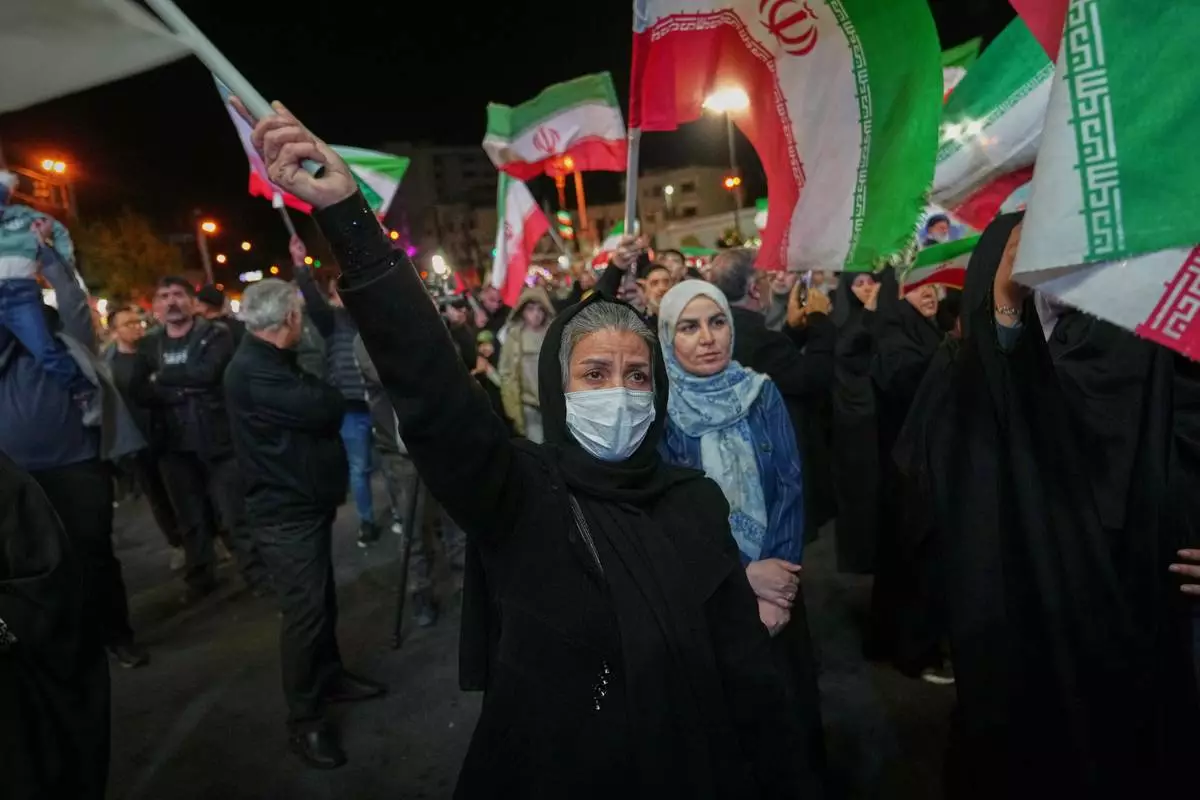
Women hold Iranian flags during a pro-government gathering in a square in Tehran, Iran, Sunday, April 5, 2026. (AP Photo/Francisco Seco)
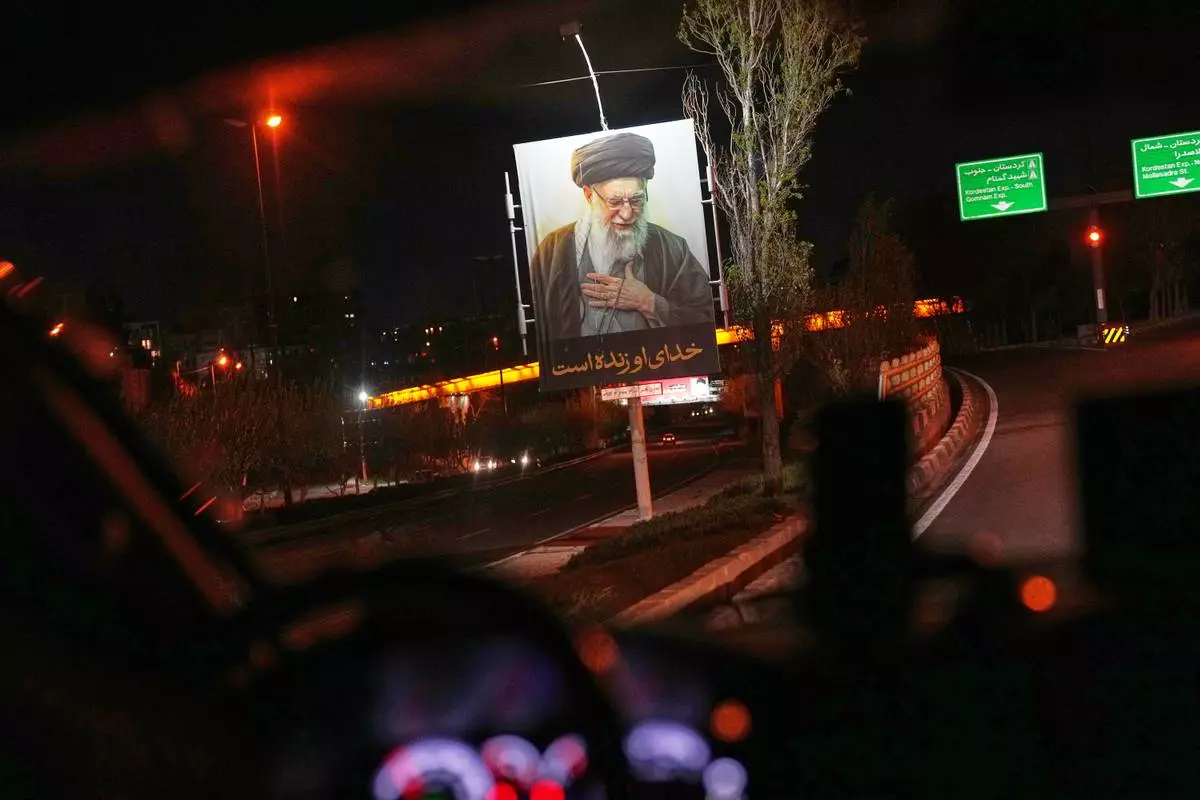
A picture of the late Iranian Supreme Leader Ayatollah Ali Khamenei hangs on the side of the road in the outskirts of Tehran, Iran, early Sunday, April 5, 2026. (AP Photo/Francisco Seco)
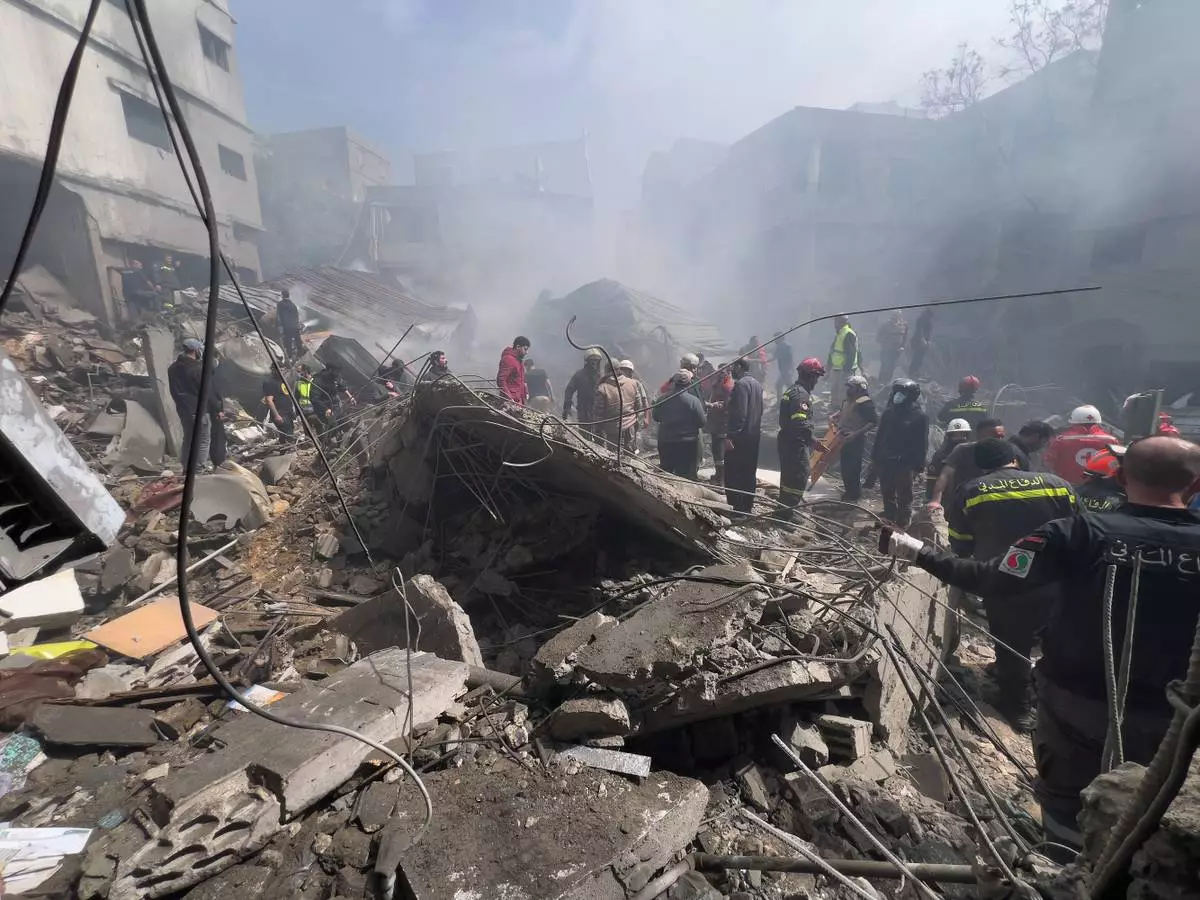
Rescue workers search for victims at the site of an Israeli airstrike that hit a crowded neighbourhood south of Beirut, Lebanon, Sunday, April 5, 2026. (AP Photo/Hussein Malla)
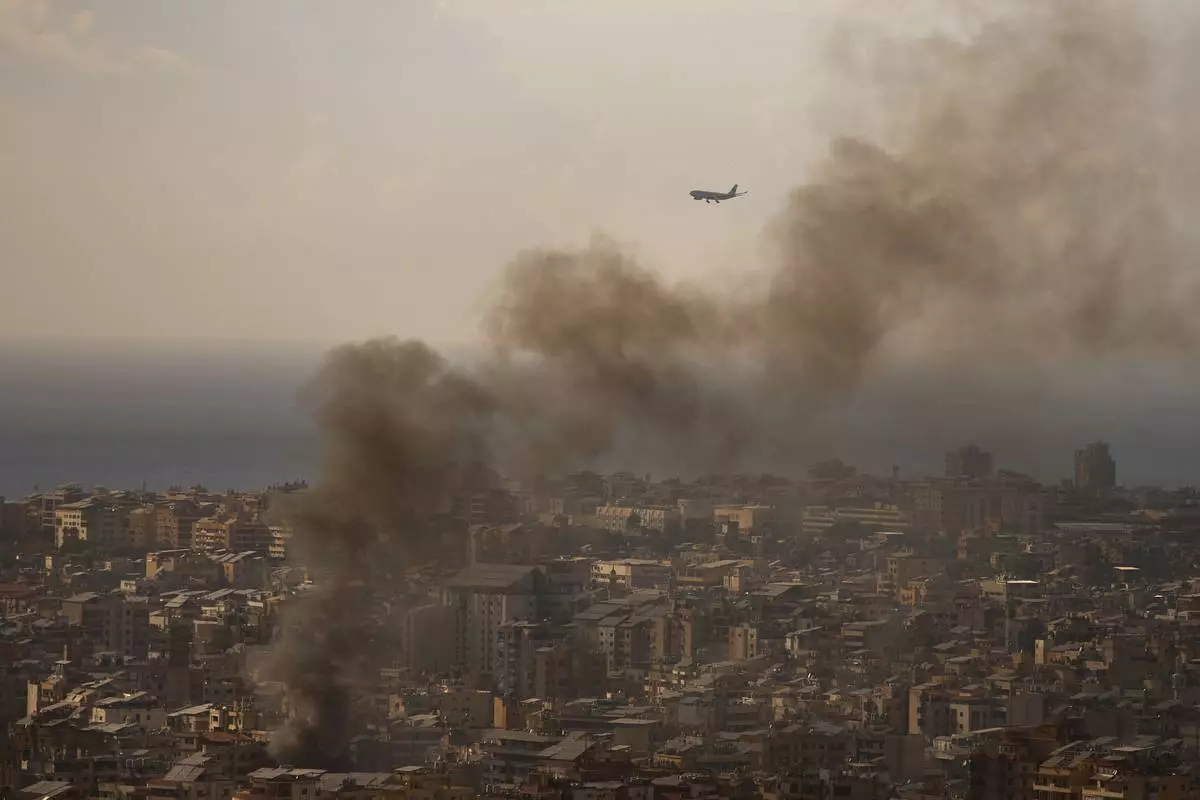
A commercial plane is preparing to land at Beirut Airport as smoke rises from Israeli airstrikes in Dahiyeh, a southern suburb of Beirut, Lebanon, Sunday, April 5, 2026. (AP Photo/Emilio Morenatti)
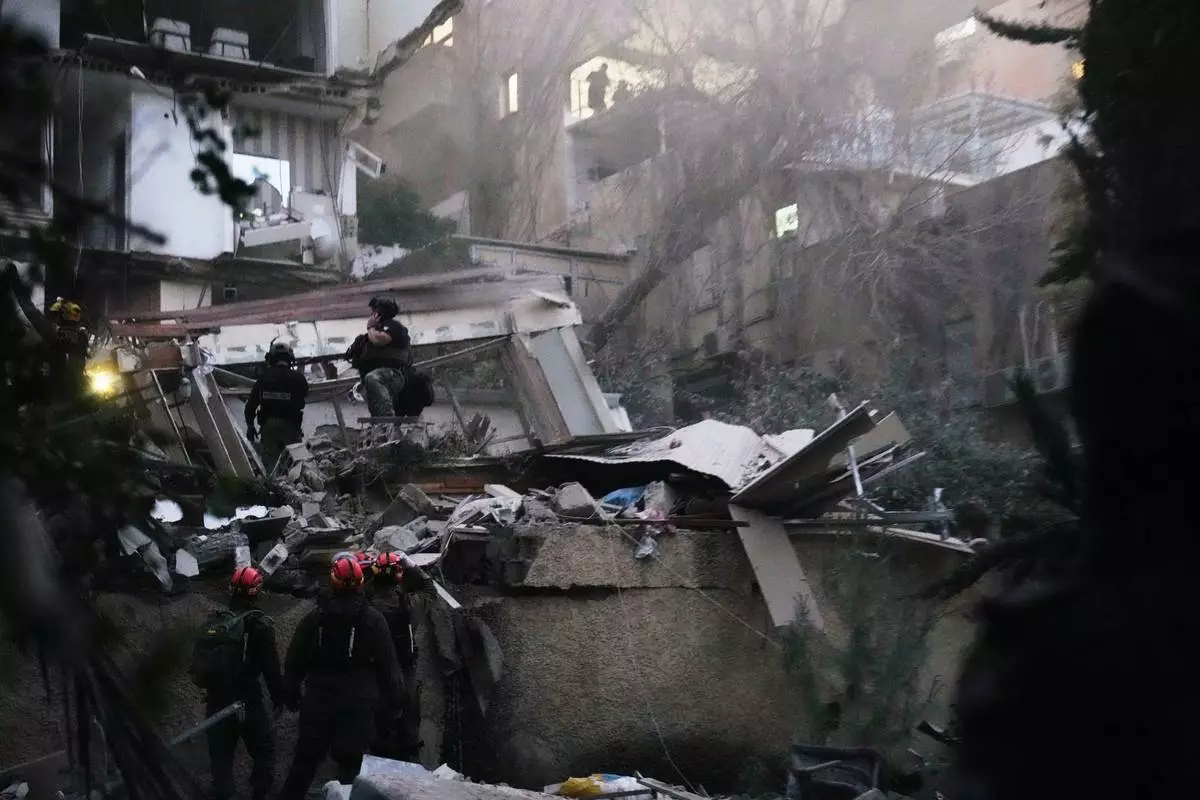
Israeli security forces and rescue teams work amid the rubble of a residential building struck by an Iranian missile in Haifa, Israel, Sunday, April 5, 2026. (AP Photo/Ariel Schalit)